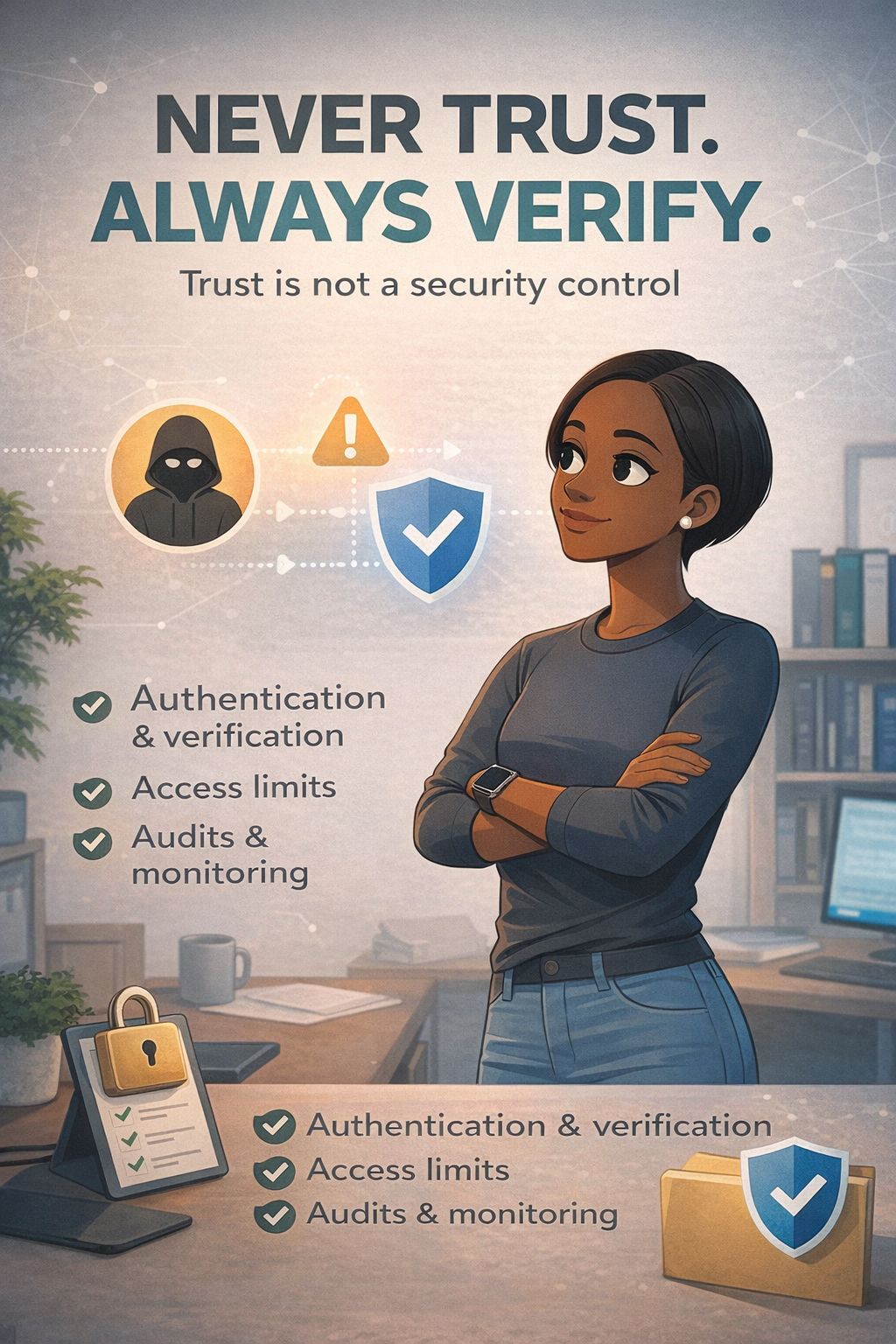
Trust is human.Security is intentional. In everyday life, trust helps relationships work. We trust colleagues, friends, family, service providers, and systems to do the right thing. Without trust, society would struggle. But in cybersecurity, trust alone is not enough. This is where one of the most important principles comes in: Never trust. Always verify. This doesn’t mean people are bad. It means systems must be designed to remain secure even when trust fails. Why Trust Fails in Security Security planning starts with one simple truth:humans make mistakes. People forget.People get tired.People feel pressure.People respond to urgency. Trust does not protect systems in these moments. A trusted employee can click a phishing link.A trusted vendor can be compromised.A trusted account can be misused. None of this happens because people are careless it happens because people are human. What “Never Trust, Always Verify” Really Mean “Never trust, always verify” is not about suspicion.It is about designing systems that do not rely on assumptions. Verification means: Verification protects both the user and the system. Security Controls Exist for a Reason Security controls reduce risk where trust alone cannot. Examples include: These controls do not replace trust they support it by creating accountability and resilience. Attackers Exploit Trust Social engineering works because attackers understand one thing:trust bypasses verification. They pose as: Once trust replaces verification, controls are quietly ignored and that is where breaches happen. Why This Matters in GRC In governance, risk, and compliance, trust is never the answer to “what went wrong.” The real question is:“What controls failed or were missing?” GRC is built on evidence, accountability, and repeatability.Verification makes that possible. Final Thought Trust makes things move faster.Verification makes things safer. Good security does not assume bad people it assumes imperfect moments. That is why the rule remains simple and powerful: Never trust. Always verify. Want more like this?I share practical, human-centred cybersecurity lessons and career insights by email.
Why Convenience Is The Enemy Of Security
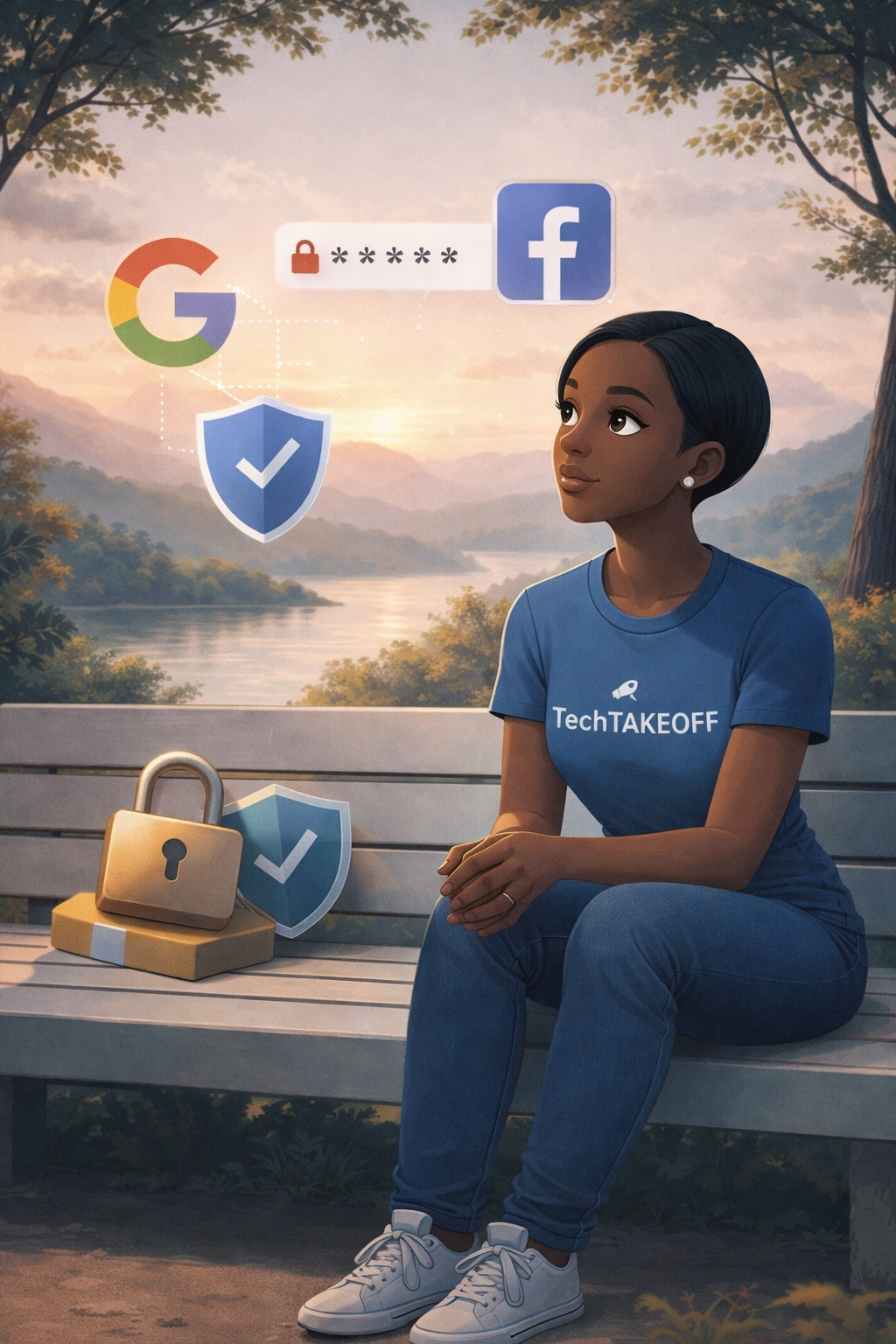
In the beginning, convenience felt harmless. When I first started using social media, I didn’t think much about passwords. I wasn’t careless I was being practical. Using the same password for all my accounts made life easier. One password to remember. No stress. No confusion. It felt efficient. And honestly, I thought, “At least I won’t forget it.” What I didn’t understand then was that convenience quietly trades comfort for risk. When Convenience Feels Smart….Until It Isn’t Using one password everywhere worked… until it didn’t. When my Google account was taken over, the process of getting it back was long and exhausting. Emails. Verifications. Waiting. Proving ownership again and again. It took time, patience, and persistence before I finally recovered it. That experience alone was sobering. But when my Facebook page was taken over, I made a different decision. I didn’t fight for it the same way. I simply started again and built a new one from scratch. Not because it didn’t matter but because the cost of recovery felt heavier than starting over. Both experiences taught me something I had ignored before. Convenience Creates Single Points of Failure The problem with convenience is not that it is wrong it is that it concentrates risk. One password across multiple platforms means one mistake opens many doors. Once that password is exposed, everything connected to it becomes vulnerable. I didn’t fully understand this until I lived through the recovery process. It was during that time resetting access, securing accounts, rebuilding that the importance of passwords finally became clear to me. Security Is Designed to Be Inconvenient for a Reason Security slows you down on purpose. Multiple passwords.Verification steps.Authentication codes. All of these things feel inconvenient because they interrupt ease. But that interruption is intentional. It exists to protect you during moments when convenience would otherwise cost you everything. Attackers depend on ease.Security depends on friction. And most people are not patient, we are always in a hurry. What Changed for Me After those experiences, I stopped prioritising convenience over protection. I began to see passwords not as obstacles, but as boundaries. I understood that the slight discomfort of managing them properly was nothing compared to the stress of losing access and control over my digital life. Convenience had taught me comfort.Security taught me responsibility. Final Thought Convenience feels good in the moment.Security protects you in the long run. Most security failures don’t happen because people are reckless they happen because people choose what feels easiest. And sometimes, the easiest choice is the most expensive one. Want more like this?I write about human-centred cybersecurity, risk, and career transitions.

Personal Digital Hygiene Tips for the Holiday Season
The holiday season is a time for joy, travel, reconnection, and celebration. It’s also a season when many of let our guard down online and offline. Unfortunately, attackers know this too. When we are distracted, excited, or eager to share good moments, our digital hygiene often slips. That is why being intentional during this season matters more than ever. Think of digital hygiene the same way you think of personal hygiene:small, consistent habits that quietly protect you. 1. Be Mindful of What You Share Especially During Travel To my fellow African brothers and sisters travelling home to celebrate:resist the urge to show off. The “I have arrived” mentality of posting locations, arrivals, gifts, or lifestyle updates in real time can expose you and your loved ones to unnecessary risk. Protect yourself and your family by: Privacy is protection. Not everything needs an audience. 2. Keep Certain Things Private for Your Own Safety Not everyone watching your posts has good intentions.Some people are observing quietly, connecting dots, and gathering context. What feels like harmless celebration can become useful information to someone with the wrong motives. Digital hygiene means knowing that: 3. Be Extra Careful with Holiday Messages and “Opportunities” During the festive season, messages increase giveaways, offers, collaborations, job promises, and quick favors. Slow down before responding. You don’t owe strangers access to your time or your trust. 4. Young Ladies: Be Intentional About Online Relationships This part matters. Please don’t fall for “he said he lives abroad” as proof of legitimacy.Photos can be edited. Stories can be curated. Lifestyles can be staged. It is incredibly easy to make life look a certain way online. And the truth is simple:you don’t need someone abroad to validate your worth or your future. If you’re earning a decent salary, building your life, and growing you can travel abroad by yourself. You don’t need illusions sold through messages and filtered photos. Digital hygiene also means emotional hygiene. 5. Use Strong Passwords and Enable 2FA Avoid passwords linked to anything visible on your social media names, dates, locations, hobbies. Make sure Two-Factor Authentication (2FA) is turned on for: That extra step protects you when emotions or distractions creep in. 6. Be Careful with Direct Messages Scammers love the holidays because people are more open and less guarded. If a message feels: Pause and Verify. 7. Awareness Is the Real Gift Digital hygiene is not about fear.It is about intentional living online and offline. Understanding that: …is one of the strongest forms of protection you can give yourself and your family. Final Thought Enjoy the holidays.Celebrate fully.Reconnect with loved ones. Just remember:what you keep private today can protect you tomorrow. Security starts with awareness and awareness is always in season. Merry Christmas!

Why 2FA and Multi-Factor Authentication Matter More Than You Think
For a long time, I believed a strong password was enough. If it was long, unique, and “hard to guess,” I felt protected. What I didn’t understand back then is this: Passwords don’t fail people do.And attackers know that. After experiencing social engineering firsthand, I learned a painful but important lesson: once an attacker convinces you to hand over access, your password becomes irrelevant. That’s where Two-Factor Authentication (2FA) and Multi-Factor Authentication (MFA) step in not as an inconvenience, but as protection for very human moments. What 2FA and MFA Really Are….. Two-Factor Authentication (2FA) means proving your identity in two different ways.Multi-Factor Authentication (MFA) simply adds even more layers. These layers usually fall into three categories: When more than one of these is required, stealing just one is no longer enough. Why Passwords Alone Are Not Enough Social engineering doesn’t crack passwords it bypasses them. Attackers rely on: Once they convince you to share a code or approve access, the system believes the request is legitimate. I have lived this. That is why 2FA and MFA exist, not because users are careless, but because humans are human. We get distracted. We get hopeful. We trust. We move fast. Security has to account for that reality. 2FA as a Human Safety Net One of the most important apps on my phone today is my authenticator app.Without it, even I cannot log into some of my own accounts. And that’s a good thing. Till today, I still receive authentication prompts, emails or messages asking me to verify my identity because someone, somewhere, is trying to log in. Those alerts are reminders that threats don’t stop just because time has passed. 2FA acts like a second voice asking:“Are you sure this is really you?” Even if an attacker gets your password: That pause, that interruption is often enough to stop an attack in its tracks. Security Is Everyone’s Responsibility Security isn’t just for tech professionals or cybersecurity teams.It is a shared responsibility. Being secure doesn’t mean being paranoid but it does mean being intentional.It means slowing down.Verifying before trusting.And understanding that convenience should never come at the cost of control. Don’t be too trusting.Trust, but always verify. In my next post, I’ll go deeper into social engineering, using my personal experiences to show how attackers think and how easily trust can be manipulated when we’re not paying attention. Because understanding the human side of security is where real protection begins.