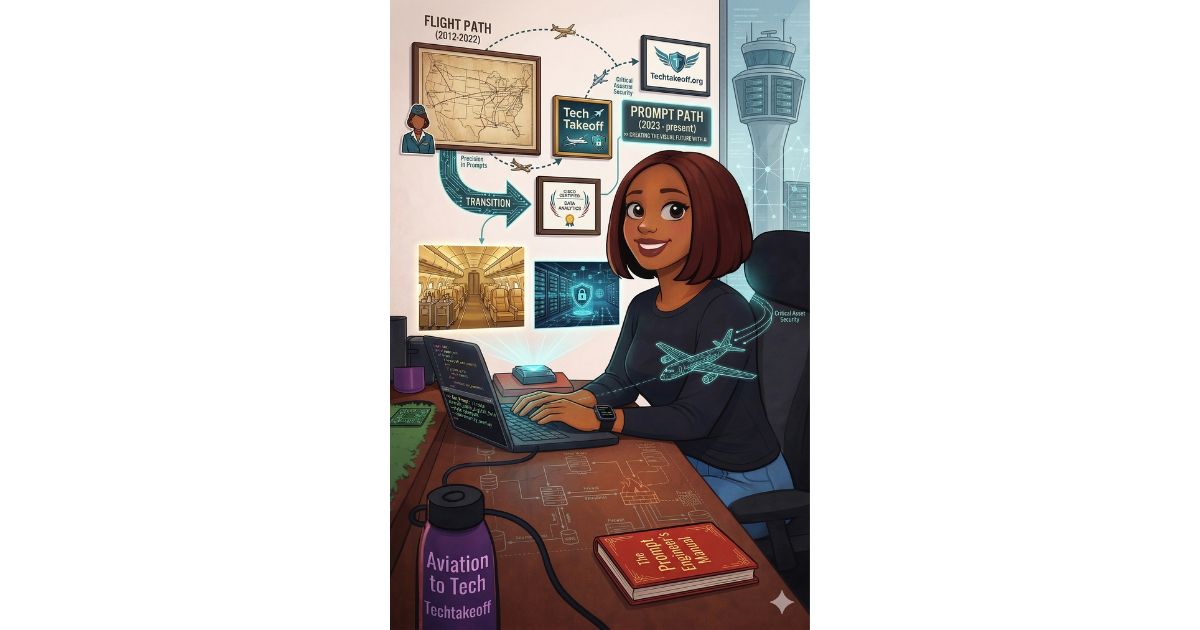

When people hear I am transitioning from aviation to cybersecurity, they often look surprised. But the deeper I go into this field, the more I see the connections.
Aviation didn’t just prepare me for cybersecurity…
it trained me for it.
For over a decade, I lived in a world built on safety, psychology, procedures, and risk awareness. As a Purser, my role went far beyond what most people imagine. Many reduce the flight attendant job to smiling and serving food, but that’s the smallest piece of the picture.
I always understood why I was truly on board:
Safety. Security. Compliance. Protection.
And that mindset mirrors cybersecurity more than people realize.
1. Safety Culture → Security Mindset
Aviation teaches one foundational truth:
Safety must be intentional.
Every checklist, every briefing, every drill exists because one small mistake can lead into something big. That awareness constantly assessing risk, thinking ahead, anticipating problems is exactly what cybersecurity demands.
Security frameworks are just digital versions of the safety culture I have lived in for years.
2. Reading People → Understanding Social Engineering
Aviation sharpened my instincts like nothing else.
I learned the art of body language how a passenger’s posture, tone, or choice of words reveals what they’re not saying. I can spot nervousness, dishonesty, or hidden intentions in seconds.
As passengers boarded, I was already profiling them quietly and professionally, not to judge them but to ensure safety.
I also learned how to use words strategically how to get people to comply with instructions without being rude or confrontational.
That is pure social engineering:
- persuasion
- emotional intelligence
- trust-building
- behavioural cues
Cybersecurity deals with attackers who exploit human weakness, not just system weakness.
Aviation trained me to see those weaknesses before they are exploited.
3. Procedures and Drills → Structured Incident Response
Aviation does not believe in “winging it.”
You train for emergencies you pray will never happen.
You follow procedures that keep chaos from becoming catastrophe.
Cybersecurity incident response uses the same structure:
Identify → Contain → Act → Review.
My muscle memory for structured action already existed long before I opened my first cybersecurity textbook.
4. Crisis Management → Remaining Calm During Security Incident
Turbulence. Medical emergencies. Unruly passengers.
I’ve seen them all.
That ability to stay centred in chaos transfers perfectly into cybersecurity, where breaches, alerts, and system failures require calm, not panic.
Aviation taught me that.
5. Compliance in Aviation → GRC in Cybersecurity
Here’s the part most people never see:
Flight attendants must memorize and obey strict aviation compliance laws.
If I violate them, I risk losing my cabin crew licence full stop.
My job depended on understanding and applying policies flawlessly.
This is exactly what GRC (Governance, Risk & Compliance) in cybersecurity is built on.
- Knowing the rules
- Following the rules
- Documenting behaviour
- Reporting incidents
- Reducing risk
- Protecting people and systems
Aviation trained me to treat compliance as non-negotiable.
Cybersecurity simply gives that mindset new tools and a new environment.
6. Global Exposure → Understanding Global Threats
Flying to different countries teaches you to think globally.
Threats, behaviours, and risks differ across cultures.
Cyber threats behave exactly the same way shaped by region, motive, and environment.
My global lens gives me a head start here too.
I am Not Starting From Zero,I am Bringing Everything With Me
For a while, I thought starting cybersecurity meant wiping my past clean.
But now I see the truth:
Aviation laid the foundation. Cybersecurity is the evolution.
Safety → Security
Passenger behaviour → Social engineering awareness
Crisis management → Incident response
Compliance laws → GRC
Leadership → Collaboration in tech
Body language → Human-based threat detection
I am not abandoning one career for another.
I am carrying the best of aviation into a field where it fits surprisingly well.
And honestly?
I think I am exactly where I’m meant to be.
Want more like this?
I write about human-centred cybersecurity, risk, and career transitions.