
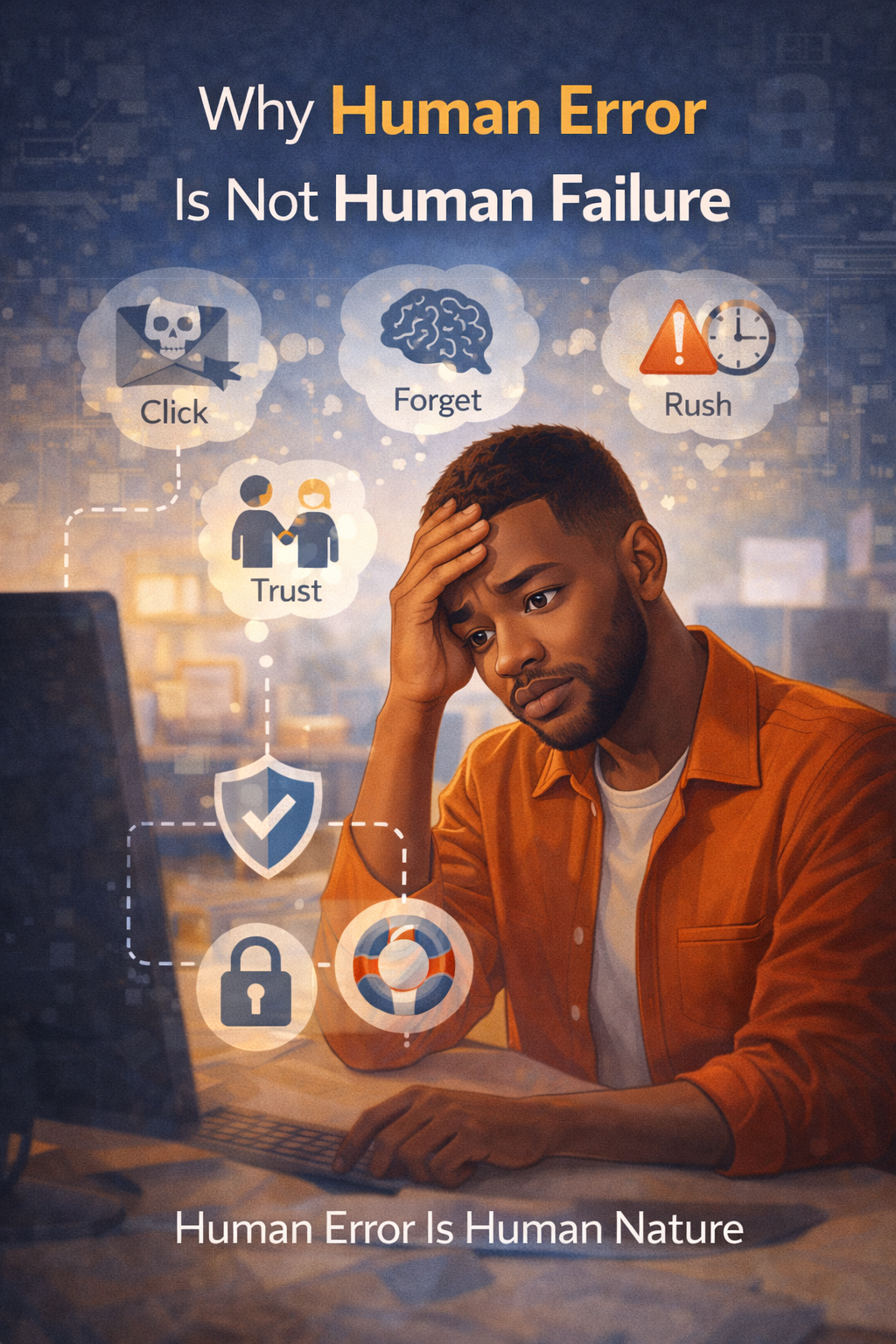
Why Human Error Is Not Human Failure
In cybersecurityand especially in GRC human error is often treated like a flaw. A weakness. Something to blame when things go wrong.
But the truth is simpler and more honest:
Human error is not human failure. It is human nature.
People forget.
People get tired.
People rush.
People trust.
People multitask.
That doesn’t make them careless. It makes them human.
If systems were only attacked by breaking code, security would be much easier. But attackers understand something important: humans are part of every system. That’s why most incidents don’t start with sophisticated hacking tools they start with a click, a response, a moment of urgency, or misplaced trust.
When an employee clicks a phishing link, it’s not because they are foolish. It’s often because the message was designed to exploit emotions like fear, authority, or opportunity. When someone reuses a password, it’s usually because convenience feels necessary in a fast-moving world. These are not failures of character; they are predictable human behaviors.
This is exactly why GRC exists.
Policies, controls, training, and procedures are not there to punish people they are there to support people. GRC assumes humans will make mistakes and designs guardrails around that reality. It focuses on reducing the impact of errors, not pretending they won’t happen.
That’s also why phrases like “just be more careful” don’t work. Awareness alone doesn’t stop incidents. Preparation does. Clear processes do. Verification does. Backup plans do.
In GRC, success isn’t about eliminating human error. It’s about expecting it, planning for it, and minimizing harm when it happens. That mindset shifts security from blame to resilience.
When organizations stop asking, “Who messed up?” and start asking, “Where did our controls fail to support people?” security improves.
Because strong security isn’t built on perfect humans.
It is built on realistic systems designed for imperfect ones.
And that is not weakness.
That is business continuous strategy.