The risk was documented.
It had a score.
It had a description.
It even had recommended controls.
But no one owned it.
Weeks passed.
Then months.
The risk didn’t disappear. It just became invisible.This is one of the most overlooked governance problems in tech companies:
unclear risk ownership.
The Illusion of “Someone Is Handling It”
In many tech environments, risks are identified quickly.
Security tools generate alerts.
Engineers log vulnerabilities.
Compliance teams update risk registers.
Everything looks organised.
But when you ask one simple question
Who owns this risk?
the room goes quiet.
Sometimes the answer is:
- Security
- IT
- Engineering
- We’re looking into it
That is not ownership.
That is diffusion of responsibility.
Control Owner vs Risk Owner
This is where confusion begins.
A control owner manages a safeguard.
For example:
- The person managing MFA.
- The team patching servers.
- The admin reviewing access logs.
But a risk owner is different.
A risk owner is accountable for the business impact if the risk materialises.
That person:
- Accepts, mitigates, transfers, or escalates the risk.
- Decides whether the exposure is tolerable.
- Aligns the risk decision with business priorities.
In many tech companies, this distinction is blurred.
Controls exist.
Ownership does not.
Why This Happens in Tech Companies
Tech organisations move fast.
New features.
New integrations.
New markets.
In this environment:
- Responsibilities overlap.
- Teams operate cross-functionally.
- Security is seen as everyone’s job which often means no one’s job.
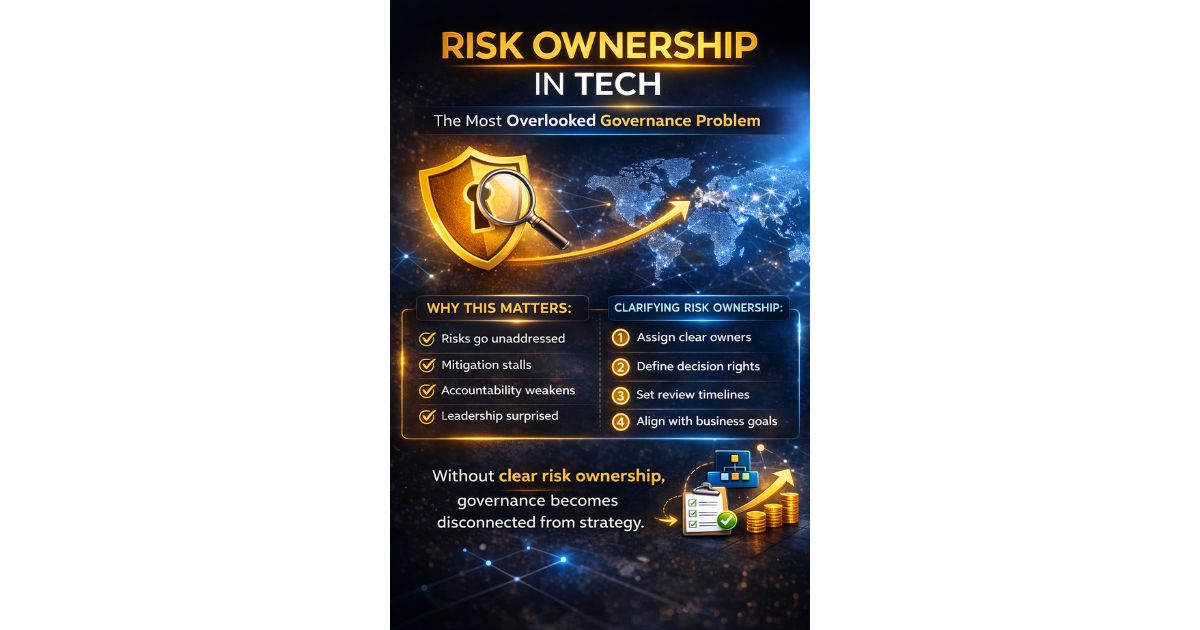
When risk ownership is unclear:
- Mitigation is slow.
- Escalation slows.
- Accountability weakens.
- Risk acceptance happens by default, not decision.
And default risk acceptance is rarely strategic.
Risk Ownership Is a Leadership Function
Here is the uncomfortable truth:
Risk ownership is not a technical role.
It is a business role.
If a customer data breach would impact revenue, reputation, and regulatory standing, the risk owner should sit at a level that understands those consequences.
Security teams identify and assess.
But business leaders decide.
When risk ownership stays inside security alone, governance becomes unbalanced.
What Clear Risk Ownership Changes
When ownership is clearly assigned:
- Risks are reviewed regularly.
- Decisions are documented.
- Mitigation timelines become realistic.
- Escalation paths are clear.
- Risk appetite becomes visible in action.
The risk register stops being a static document.
It becomes a decision-making tool.
That shift changes everything.
The Hidden Cost of No Ownership
Unowned risks create:
- Repeated audit findings.
- Control fatigue.
- Friction between security and engineering.
- Leadership surprises.
But the biggest cost is strategic blindness.
If leadership does not explicitly accept or reject risks, the organisation drifts.
Drift is dangerous in tech.
How Governance Fixes This
Good GRC does not just track risks.
It clarifies:
- Who owns the exposure.
- Who has authority to accept it.
- When it must be reviewed.
- How it aligns with risk appetite.
Governance is not about adding layers.
It is about removing ownership gaps.
Why This Matters Now
As tech companies scale, complexity increases.
Without strong ownership structures:
- Risk management becomes reactive.
- Security becomes overloaded.
- Business decisions lack visibility into exposure.
Risk ownership is not a spreadsheet column.
It is an operating model.
And without it, even the best risk scoring system cannot drive strategy.
Clear ownership turns risk from a warning into a decision.
And governance begins where accountability becomes explicit.