

AI cybersecurity in aviation; can AI make airlines more vulnerable to cyber attacks….. read on Beatrice was preparing the cabin for departure when she heard something that caught her attention. The airline was introducing a new AI powered system to help improve operations. It was designed to analyse information quickly, identify unusual patterns and help airline teams make better decisions. Everyone was excited about what the technology could do. But there was another question that did not receive quite as much attention. What happens if someone tries to attack the AI? Artificial Intelligence can bring enormous opportunities to aviation. It can help airlines analyse data, support customer service, improve operational planning and identify potential problems. But every new technology can also introduce new risks. As airlines become more dependent on AI, AI cybersecurity in aviation is becoming an increasingly important conversation. The question isn’t whether airlines should use AI. The question is whether they can use it securely and responsibly. Here are three AI cybersecurity risks aviation organisations need to consider. 1. Attackers Could Manipulate the Data AI Depends On AI needs data. A lot of it. Weather information. Operational information. Aircraft information. Passenger information. Maintenance information. Historical records. The AI uses this information to identify patterns and produce recommendations. But what happens if someone manages to manipulate the information going into the system? This is where a cybersecurity risk can become an AI risk. Imagine an AI system is designed to identify unusual patterns in aviation operations. If an attacker can deliberately introduce misleading or manipulated information into the system, the AI could potentially produce an unreliable result. This type of attack is often discussed in AI security as data poisoning. The basic idea is simple. If you deliberately corrupt the information an AI system learns from or relies upon, you may be able to influence what the system produces. This is one reason AI cybersecurity in aviation cannot be separated from Data Governance. Airlines need to understand where their data comes from, who can modify it, how it is protected and how unusual changes are detected. Good AI requires good data. Secure AI requires protected data. 2. AI Systems Can Create New Cybersecurity Attack Surfaces Every new technology introduced into an organisation creates something else that needs to be protected. AI is no different. An airline may have existing applications, databases, cloud platforms and operational systems. Now imagine adding AI systems that interact with some of those technologies. The AI may need access to information. It may communicate with other applications. It may process passenger information. It may connect to external services. Every connection needs to be properly secured. If an AI system is poorly configured, inadequately protected or given more access than it actually needs, it could potentially create another path for attackers to exploit. This is why cybersecurity teams need to understand not only: “What can this AI system do?” but also: “What can this AI system access?” That distinction is important. An AI system does not necessarily need access to everything within an airline’s technology environment. The principle of limiting access to what is actually required can help reduce unnecessary risk. 3. AI Can Be Manipulated Through Its Interactions Not every AI attack requires someone to physically access an airline’s computer system. Some AI systems interact directly with people through natural language. Think about an airline chatbot. A passenger asks: “What is the baggage allowance for my flight?” The AI responds. Now imagine someone deliberately creates instructions designed to manipulate the AI into ignoring its normal rules or revealing information it should not provide. This type of attack can be associated with prompt injection, particularly in Generative AI systems. The concept can sound complicated, but the basic idea is fairly simple. Someone tries to manipulate the instructions given to an AI system so that it behaves in a way it was not intended to behave. For an airline, this could create concerns around customer service, confidential information and the way AI interacts with connected systems. This is why AI systems need appropriate security testing, access controls, monitoring and governance. AI Is Not Automatically Secure This is one of the biggest lessons I am taking from learning about cybersecurity and AI Governance. It is easy to think: “AI is intelligent, so it must be secure.” But intelligence and security are two different things. An AI system can be highly capable and still have vulnerabilities. It can produce useful recommendations and still produce incorrect information. It can process enormous amounts of data and still be manipulated. It can automate tasks and still create new risks. This is why cybersecurity needs to be part of the conversation from the beginning. Not after an AI system has already been deployed. Where Does AI Governance Come In? This is where AI Governance becomes important. AI Governance is not simply about asking whether an organisation should use AI. It also involves establishing the policies, processes, controls and accountability needed to manage AI responsibly. For an airline, governance questions could include: Who is responsible for the AI system? What data does it use? Who has access to that data? How is the system secured? What happens if the AI behaves unexpectedly? How is the system monitored? Can a human intervene? What happens if the system is compromised? How are AI related incidents reported and investigated? These questions connect AI Governance with cybersecurity. AI Cybersecurity in Aviation Is Also About Passenger Data There is another important layer. Airlines handle enormous amounts of passenger information. Names. Contact details. Travel information. Booking information. Passport and travel document information. Loyalty programme information. Special assistance information. When AI systems interact with passenger data, cybersecurity and privacy become even more important. Imagine an airline chatbot helping a passenger change a booking. The system may need access to certain information to provide the service. But should it have access to everything? Probably not. This is where organisations need to consider both security and privacy. The goal should not
Can Airlines Trust AI With Safety Decisions? 5 Questions AI Governance Must Answer
Imagine an airline is preparing for a busy day. Hundreds of flights are scheduled. Thousands of passengers are travelling. Weather conditions are changing. Aircraft are moving between airports. Crew schedules are being coordinated. Behind all of this, artificial intelligence is quietly analysing information and identifying patterns. An AI system produces a recommendation. It looks convincing. The data looks convincing. The system has processed far more information than a human could reasonably analyse in the same amount of time. So someone asks a very simple question: Can we trust it? That question may become one of the most important questions aviation has to answer as Artificial Intelligence becomes more deeply integrated into airline operations. The issue is not whether AI can be useful. It clearly can. The bigger question is: How do airlines make sure AI is being used safely, responsibly and with the right human oversight? That is where AI Governance in aviation comes in. AI Is Already Becoming Part of Aviation’s Future Artificial Intelligence is no longer just something we hear about in technology conferences. It is becoming part of the aviation industry. Airlines and aviation organisations are exploring how AI can be used for areas such as flight operations, safety, air traffic management, aircraft maintenance and other parts of aviation. The International Civil Aviation Organization (ICAO) recognises both the benefits and risks of using AI in aviation. It says AI needs to be developed and used in a way that is safe, transparent, secure and accountable, with humans still playing an important role. In Europe, the European Union Aviation Safety Agency (EASA) is also working on how AI can be used safely in aviation. In June 2026, EASA released an updated AI Concept Paper that looks at newer AI technologies and more advanced forms of automation. Its approach focuses on making AI trustworthy while keeping aviation safety and human involvement at the centre. So this conversation is not simply about whether airlines might use AI one day. It is about how aviation can responsibly integrate increasingly capable AI systems. And that brings us to five questions. 1. Is the AI Using Accurate Data? This might sound like a technical question. It is actually one of the most important governance questions. AI is only as reliable as the information it is working with. Imagine an AI system is helping an airline analyse operational information. The system receives information from several different sources. But what if some of that information is incomplete? What if records are outdated? What if information has been entered incorrectly? What if two systems contain conflicting information? The AI may still produce an answer. And the answer may even sound extremely confident. But confidence does not equal accuracy. This is why Data Governance becomes such an important part of AI Governance. Organisations need to understand where data comes from, whether it is fit for purpose, how it is managed and who is responsible for it. ICAO has specifically highlighted the importance of information and data management for AI applications, noting that datasets used to train and validate AI need to be complete, representative and of high quality. This is a lesson I find particularly interesting as I learn more about AI Governance. Before asking: What can the AI do? we should also ask: What information is the AI learning from? 2. Can a Human Challenge the AI? Now imagine the AI has analysed the data and produced a recommendation. Should the airline simply follow it? Not necessarily. Aviation has always relied heavily on human expertise, procedures and professional judgement. AI does not change that overnight. Instead, the challenge is finding the right relationship between humans and AI. EASA’s work on Level 2 AI specifically addresses human AI teaming, where AI systems can perform certain decision making functions while remaining under human oversight. EASA also emphasises the importance of safe human AI interaction. In simple terms: The AI can make a recommendation, but the human needs to understand it, evaluate it and have the ability to intervene when appropriate. Think of the AI as an extremely sophisticated alarm clock. It can wake you up. It can tell you something needs attention. But it should not automatically decide what you do next. That distinction matters enormously when AI is used in aviation. 3. Can We Understand Why the AI Made Its Recommendation? Imagine an AI system tells an airline: There is a high risk associated with this situation. A natural question follows: Why? If nobody can explain what information influenced the recommendation, it becomes difficult to properly assess the result. This does not mean every AI system needs to reveal every mathematical calculation behind its output to every user. It means organisations need appropriate levels of explainability and transparency for the context in which the AI is being used. This becomes particularly important when AI is involved in safety related applications. EASA’s aviation AI work includes concepts such as AI explainability and learning assurance as part of developing trustworthy AI systems. The question therefore becomes: Can the people responsible for the decision understand enough about the AI’s output to use it safely? If the answer is no, that itself becomes a governance concern. 4. Who Is Accountable When AI Gets It Wrong? This may be one of the most uncomfortable questions. Imagine an AI system makes a recommendation. A human follows the recommendation. Later, the decision turns out to have been wrong. Who is responsible? The AI? The person who approved the recommendation? The airline? The team that developed the system? The organisation that supplied the technology? This is why AI Governance cannot simply be about whether the technology works. It must also establish accountability. People need to understand their responsibilities. There should be appropriate processes for monitoring the system. There should be mechanisms for reporting problems. And there should be clarity around who has authority to intervene. ICAO has identified accountability, fairness, human control and technical robustness among principles relevant to trustworthy AI in aviation. This
Can AI Help Prevent Flight Delays? Here is How Airlines Are Using Predictive Intelligence
Imagine this. Beatrice had just arrived at the airport for what she thought would be another routine flight. The departure boards were full of green “On Time” notifications, and passengers were already gathering at the boarding gate. Suddenly, one of the engineers walked past with a smile and said to a colleague, ‘Good thing the system flagged that issue yesterday. If it hadn’t, this aircraft might not have departed on time today.‘ Beatrice paused. ‘The system?’ She later discovered they were not talking about a person. They were talking about Artificial Intelligence. Not the kind of AI that flies an aircraft. Not the kind that replaces pilots or engineers. But an intelligent system that helps airlines spot patterns, predict potential problems, and make better operational decisions before those problems become costly delays. It made her wonder. Could AI actually help prevent flight delays before they happen? The answer is yes. But probably not in the way most people imagine. Why Do Flights Get Delayed? Most passengers assume every delay has the same cause. In reality, airlines deal with hundreds of variables every day. A flight could be delayed because of: Each delay affects the next flight, creating a chain reaction across an airline’s network. This is where predictive intelligence is becoming increasingly valuable. What Is Predictive Intelligence? Predictive intelligence uses Artificial Intelligence together with historical and real time data to identify patterns and estimate what is likely to happen next. Think of it like a weather forecast. A weather app cannot guarantee it will rain tomorrow. But by analysing years of weather data together with current conditions, it can make a reliable prediction. Airlines use similar technology. Instead of predicting rain, AI predicts operational risks that could disrupt flights. How Airlines Use AI to Reduce Flight Delays AI is not making decisions on its own. Instead, it acts like another member of the operations team, constantly analysing information that humans would struggle to process quickly. Here are some of the ways AI supports airline operations. Predicting Maintenance Needs Modern aircraft generate enormous amounts of operational data. Combined with maintenance records entered by engineers, AI can identify patterns suggesting that certain components may soon require inspection or replacement. This does not mean the aircraft is unsafe. It simply alerts maintenance teams that something deserves closer attention. Engineers then inspect the aircraft and decide what action, if any, should be taken. Think of AI as an early warning system rather than a mechanic. Supporting Crew Scheduling Airlines manage thousands of crew movements every day. Unexpected disruptions such as weather, delays, or crew illness can quickly affect schedules. AI can analyse available crew, legal duty time limits, aircraft availability, and flight schedules to suggest efficient solutions. However, airline operations teams still review those recommendations before making final decisions. Monitoring Weather Patterns Weather remains one of aviation’s biggest challenges. AI can analyse weather forecasts alongside historical flight data to identify routes that may experience disruption. This gives airlines more time to prepare alternative plans. Although AI provides useful insights, experienced dispatchers and operational teams remain responsible for making safety related decisions. Managing Airport Operations Large airports handle thousands of flights daily. AI can help airlines predict periods of heavy congestion, allowing operations teams to adjust gate assignments, turnaround planning, and ground handling activities more efficiently. Small improvements across multiple areas can reduce unnecessary delays. Does AI Eliminate Flight Delays? No. Some delays simply cannot be avoided. Thunderstorms. Snow. Air traffic restrictions. Medical emergencies. Unexpected technical issues. These situations will always require human judgement. AI cannot control the weather. It cannot remove every operational challenge. What it can do is help airlines prepare earlier and respond more effectively. Why Human Expertise Still Matters As Beatrice continued learning about AI in aviation, one thing became clear. Every prediction begins with human expertise. Engineers record maintenance findings. Pilots submit technical reports. Operations teams document delays. Ground staff provide operational updates. Without accurate human input, AI would have very little meaningful information to analyse. The predictions are only as reliable as the data people provide. This is why experienced aviation professionals remain central to every AI supported decision. Where AI Governance Fits In As airlines adopt more AI powered systems, another important question emerges. How can airlines trust the AI making these predictions? This is where AI Governance becomes essential. AI Governance helps airlines establish rules and oversight for responsible AI use by asking questions such as: AI Governance is not about replacing operational expertise. It is about ensuring AI supports safe, transparent, and accountable decision making. The Future of Aviation Is Collaborative The future of aviation is not humans competing against Artificial Intelligence. It is humans working alongside it. AI processes millions of data points in seconds. Engineers apply decades of technical expertise. Operations teams understand the bigger operational picture. Pilots make critical safety decisions. Together, they create a smarter and more resilient aviation system. On A Final Note Every delayed flight tells a story. Sometimes it is the weather. Sometimes it is maintenance. Sometimes it is an operational challenge that no one could have predicted. But thanks to Artificial Intelligence and predictive intelligence, airlines are becoming better at identifying potential disruptions before they grow into bigger problems. AI is not replacing aviation professionals. It is becoming another tool that helps them make faster, better informed decisions. And perhaps that is the future of aviation. Not aircraft that think for themselves. But intelligent systems working alongside skilled professionals to keep passengers moving safely, efficiently, and on time.
How AI Is Predicting Aircraft Maintenance Before Problems Happen
Why the Future of Aviation Still Depends on Human Engineers Beatrice had just settled into her jumpseat after passengers boarded when she noticed two aircraft engineers standing beneath the wing. One of them looked at a tablet while the other nodded thoughtfully. ‘There it is again,’ one engineer said. ‘What?’ Beatrice asked as she walked past. “The system flagged this aircraft this morning.” She looked puzzled. ‘But nothing is broken.’ The engineer smiled. ‘Exactly.’ That conversation stayed with her long after the flight. How could an aircraft know something needed attention before anything had actually gone wrong? As she continued learning about Artificial Intelligence and AI Governance, she discovered something fascinating. The aircraft was not predicting the future. Neither was the AI. The prediction came from years of engineering knowledge, maintenance records, aircraft sensor data, and human expertise working together. AI was simply helping engineers notice patterns much earlier. Can AI Really Predict Aircraft Problems? The answer is yes, but probably not in the way most people imagine. AI does not magically know that an aircraft component will fail tomorrow. Instead, AI analyses enormous amounts of information collected over time. This information may include: From these patterns, the AI can identify components that may soon require attention. Think of it as an intelligent early warning system. AI Does Not Replace Aircraft Engineers One of the biggest misconceptions about AI in aviation is that it replaces engineers. It doesn’t. As Beatrice learned more, she realised the engineers remain at the centre of every maintenance decision. The AI system simply gives them another source of information. Imagine your phone reminding you that your battery health is declining. Your phone doesn’t replace the technician. It simply alerts you before the battery becomes a bigger problem. Aircraft AI works in a similar way. Think of AI as an Alarm Clock One engineer explained it perfectly. ‘AI is like my alarm clock.’ The alarm doesn’t get you ready for work. It doesn’t brush your teeth. It doesn’t drive you to the office. It simply tells you it’s time to pay attention. That is exactly how many AI systems support aircraft maintenance. They alert engineers when data suggests something deserves closer inspection. The engineer then decides: The AI recommends. The engineer decides. Where Do These Predictions Come From? The predictions don’t appear out of nowhere. They are built on information that engineers and aircraft systems provide over time. Every inspection… Every maintenance check… Every replaced component… Every recorded fault…adds valuable information. The more high quality data available, the better the AI becomes at identifying patterns. Without engineers documenting their work accurately, the AI would have far less to learn from. In many ways, the engineers are teaching the AI. Why Human Oversight Still Matter Suppose an AI system flags an aircraft engine for inspection. Does that automatically mean the engine must be replaced? No. Experienced engineers still examine the aircraft. They inspect the component. They review maintenance records. They perform additional tests where necessary. Only after evaluating all available information do they make the final decision. This human oversight is one of aviation’s greatest strengths. AI supports safety. It does not replace professional judgement. Where AI Governance Fits In As Beatrice continued studying AI Governance, she realised something important. AI Governance is not about telling engineers how to repair aircraft. It is about ensuring AI systems are used responsibly. For aircraft maintenance, AI Governance asks questions such as: These questions help organisations build AI systems that engineers can trust. Better Planning, Not Just Better Safety One benefit of AI-powered maintenance is planning ahead. If the system identifies that a component is approaching the end of its service life, airlines can prepare. Maintenance teams can: Instead of reacting after something fails, engineers can prepare before it becomes an operational issue. AI and Engineers Are Better Together As Beatrice reflected on that conversation beneath the aircraft wing, she realised AI was not replacing engineers. It was helping them become even more proactive. The engineers contributed the expertise. The maintenance records provided the history. The aircraft generated operational data. The AI analysed patterns. Together, they formed a smarter maintenance process. Not because AI was making the final decision. But because it was helping humans make better informed ones. On A Final Note Artificial Intelligence is changing aviation in remarkable ways. From customer service and crew scheduling to predictive maintenance, AI is helping airlines become more efficient and proactive. But behind every intelligent system are skilled professionals who interpret the information, apply their expertise, and make the final decision. Perhaps the best way to think about AI in aircraft maintenance isn’t as a replacement for engineers. It is as their alarm clock. Quietly working in the background. Watching patterns. Raising an alert when something deserves attention. And helping keep the skies even safer.
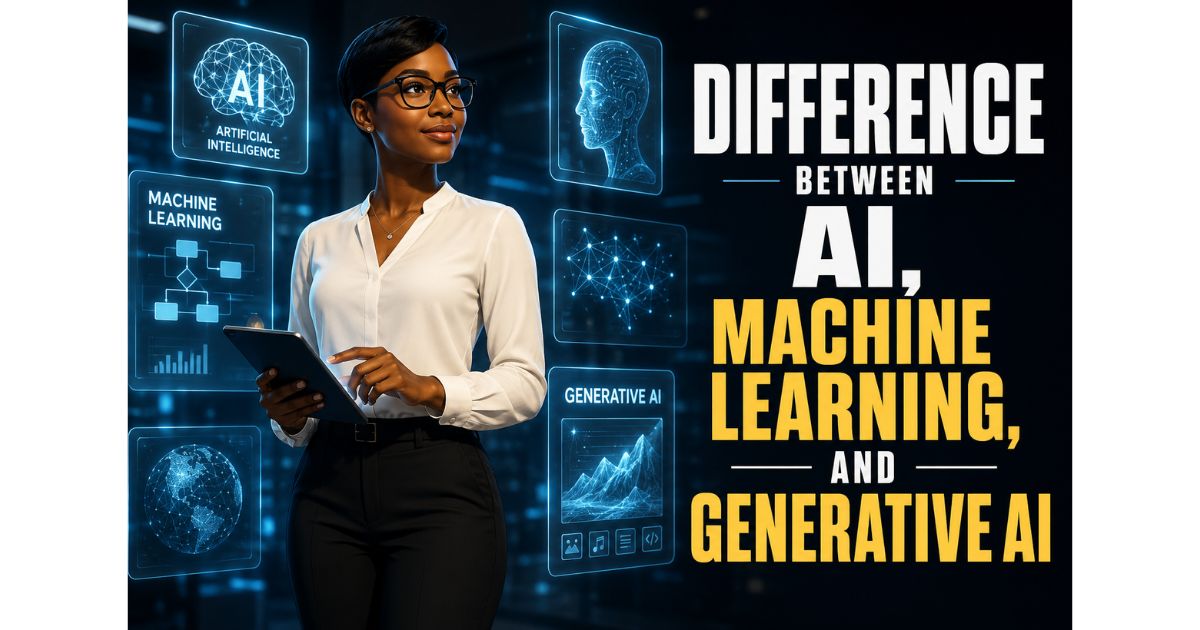
What is the Difference Between AI, Machine Learning, and Generative AI?
A Beginner’s Guide to Understanding the Technologies Shaping Our Future Beatrice had just finished reading an article about artificial intelligence when another headline caught her attention. “Machine Learning is transforming healthcare.” A few minutes later, she watched a video discussing Generative AI. She paused. “Aren’t they all the same thing?” Many beginners even me, Beatrice had been using the terms Artificial Intelligence (AI), Machine Learning (ML), and Generative AI interchangeably. They all sounded like different names for the same technology. But the more she learned about AI Governance, the more she realised these terms describe different concepts. Understanding the difference isn’t just useful for people working in technology. It’s becoming an essential skill for anyone interested in AI, cybersecurity, data governance, or the future of work. Let’s break it down. What Is Artificial Intelligence (AI)? Artificial Intelligence, or AI, is the broad field of creating computer systems that can perform tasks that normally require human intelligence. These tasks include: Think of AI as the largest umbrella. Everything else fits underneath it. If a computer performs tasks that usually require human intelligence, it falls within the field of AI. Imagine It Like a Family Tree As Beatrice continued learning, she found a simple way to remember the difference. Imagine a family. Artificial Intelligence is the parent. Under that parent is another family member called Machine Learning. Under Machine Learning is a newer member called Generative AI. In other words: Artificial Intelligence → Machine Learning → Generative AI Each builds on the one before it. What Is Machine Learning? Machine Learning is a branch of Artificial Intelligence. Instead of programming a computer with every possible instruction, Machine Learning allows systems to learn patterns from data. The more high quality data a model receives, the better it can recognise patterns and make predictions. For example, Machine Learning is used to: Machine Learning is excellent at recognising patterns. But it doesn’t create brand new content. What Is Generative AI? Generative AI is a specialised type of Machine Learning. Instead of simply recognising patterns or making predictions, Generative AI creates new content. That content may include: Popular examples include AI tools that can: If you have used ChatGPT, Gemini, Claude, or Microsoft Copilot, you have already experienced Generative AI. A Simple Example Beatrice imagined she worked for an airline. Here’s how each technology could be used. Artificial Intelligence An AI system helps improve airport operations by supporting multiple intelligent tasks across the airline. Machine Learning The airline uses Machine Learning to predict flight delays based on historical weather, maintenance records, and airport traffic. The system learns patterns from years of operational data. Generative AI A customer asks an AI chatbot to change a booking. The chatbot generates a personalised response, explains baggage policies, and drafts a confirmation email within seconds. It creates new content during the conversation. Why Does This Matter for AI Governance? As Beatrice studied AI Governance, she realised something important. Not every AI system carries the same level of risk. A Machine Learning model predicting maintenance schedules creates different governance challenges from a Generative AI chatbot producing customer responses. For example, organisations must ask questions such as: Understanding the type of AI being used helps organisations manage risks more effectively. Why Beginners Often Get Confused Many companies simply use the word “AI” to describe every intelligent technology. As a result, beginners naturally assume everything is the same. The reality is much simpler. Think of it like this: Artificial Intelligence is the broad field. Machine Learning teaches computers to learn from data. Generative AI creates entirely new content based on what it has learned. Once Beatrice understood this relationship, many other AI concepts became easier to understand. The Future Belongs to More Than Engineers One lesson Beatrice has learned throughout her journey is that understanding AI is no longer only for software developers. Professionals working in: are increasingly expected to understand the basics of AI. You don’t have to build AI systems. But understanding how they work helps you use them responsibly and ask better questions about privacy, security, fairness, and accountability. On A Final Note Before learning AI Governance, Beatrice thought Artificial Intelligence, Machine Learning, and Generative AI were simply different names for the same technology. Today, she knows they each play different roles. Artificial Intelligence is the broad field. Machine Learning helps computers learn from data. Generative AI creates new content. Understanding these differences is one of the first steps toward understanding responsible AI. And in a world where AI is becoming part of everyday life, that knowledge is more valuable than ever. If you are beginning your journey into AI Governance, don’t rush to learn everything at once. Start by understanding the fundamentals. The stronger your foundation, the easier it becomes to understand more advanced topics like AI Governance, Data Governance, cybersecurity, and responsible AI. Remember, every expert was once a beginner who simply decided to keep learning. SEO Keywords Naturally Included What is Artificial Intelligence, Artificial Intelligence vs Machine Learning, Machine Learning vs Generative AI, Generative AI explained, AI for beginners, AI Governance for beginners, AI basics, Machine Learning explained, responsible AI, AI terminology, difference between AI and Machine Learning, AI careers, Generative AI examples, AI concepts for beginners.
5 AI Myths I Believed Before Learning AI Governance
When Beatrice first became interested in artificial intelligence, she was both fascinated and intimidated. Everywhere she looked, people were talking about AI changing the world. Some claimed AI would replace millions of jobs. Others believed it was smarter than humans. The more videos she watched and articles she read, the more overwhelmed she became. She wondered if there was even a place for someone like her in this fast-growing field. As she began learning cybersecurity, Governance, Risk, and Compliance (GRC), and eventually AI Governance, she realised something surprising. Many of the things she believed about AI simply weren’t true. If you arejust beginning your AI Governance journey, you may have believed some of these myths too. Myth 1: AI Knows Everything When Beatrice first used an AI chatbot, she assumed every answer it gave was correct. After all, the responses sounded confident and well written. But as she continued learning, she discovered an important truth. AI does not “know” facts the way humans do. Instead, AI identifies patterns from the information it has been trained on and generates responses based on those patterns. That means AI can sometimes provide incomplete, outdated, or incorrect information. This is one reason why human oversight remains a key principle of AI Governance. The lesson? Always verify important information instead of assuming AI is always right. Myth 2: AI Thinks Like a Human One of Beatrice’s biggest misconceptions was believing AI actually thinks. It doesn’t. AI does not have emotions. It does not have personal experiences. It does not understand the world in the same way people do. Instead, AI predicts the most likely response based on patterns in data. That is very different from human reasoning. Understanding this distinction helps explain why AI sometimes produces unexpected or inaccurate answers. Myth 3: AI Governance Is Only for Programmer This myth almost stopped Beatrice from pursuing AI Governance. She assumed everyone in the field had a Computer Science degree and years of coding experience. As she researched further, she realised AI Governance brings together many different disciplines. It involves: Technical knowledge is valuable, but AI Governance also needs professionals who understand policies, accountability, and responsible decision-making. That discovery gave her the confidence to keep learning. Myth 4: Better AI Always Means Better Results At first, Beatrice believed that the more advanced an AI system became, the better its decisions would be. Then she learned one of the most important lessons in AI Governance. AI depends on data. If the data is poor, biased, incomplete, or inaccurate, even the most advanced AI system may produce poor results. This is why Data Governance has become so important. Good AI starts with good data. Without trustworthy data, trustworthy AI becomes much harder to achieve. Myth 5: Learning AI Means Learning Everything at Once The world of AI can feel overwhelming. Machine Learning. Large Language Models. Data Governance. Cybersecurity. Privacy. Risk Management. At first, Beatrice thought she needed to understand everything before she could even begin. She was wrong. She realised that every expert started somewhere. Her own journey began with Cisco Networking Essentials. Then Introduction to Cybersecurity. Then CyberOps. Then GRC. Now she is learning AI Governance one concept at a time. Progress came through consistency, not perfection. What These Myths Taught Me Looking back, Beatrice realised that learning AI Governance was not about memorising technical terms. It was about changing the way she thought about technology. She learned that responsible AI depends on: Most importantly, she learned that curiosity is one of the greatest strengths a beginner can have. On A Final Note If you are considering a career in AI Governance, don’t let common myths discourage you. You don’t need to know everything on your first day. You don’t need to have all the answers. You simply need the willingness to learn. Every article you read. Every course you complete. Every question you ask. Brings you one step closer to understanding one of the most important fields shaping the future of technology. Beatrice is still learning. So am I. And perhaps that’s the best place to begin. AI myths, AI Governance for beginners, common AI misconceptions, artificial intelligence explained, AI Governance career, responsible AI, Data Governance, AI bias, AI chatbot myths, cybersecurity and AI, AI learning journey, beginner’s guide to AI Governance, trustworthy AI, AI fundamentals.

Do You Need a Computer Science Degree to Start a Career in AI Governance?
Beatrice almost talked herself out of it. She had been reading about AI Governance for weeks. Every article she found mentioned artificial intelligence, machine learning, algorithms, and data. The more she read, the more one thought kept returning. “Maybe this field is not for someone like me.” After all, she wasn’t a software engineer. She didn’t have a Computer Science degree. Her background was aviation. She had spent years ensuring passenger safety, following procedures, managing emergencies, and making decisions under pressure. What place did she have in a field that seemed filled with programmers and data scientists? Then she started researching the people already working in AI Governance. To her surprise, not everyone had studied Computer Science. Some came from law. Others came from cybersecurity. Some worked in compliance, risk management, auditing, public policy, or data privacy. That was the moment she realised something important. AI Governance is not just about building AI. It is about governing how AI is used responsibly. Why So Many People Think You Need a Computer Science Degree It is an understandable assumption. Artificial Intelligence sounds highly technical. When people hear the words “AI,” they often imagine: Those professionals play an important role in developing AI systems. But building AI and governing AI are not the same thing. As organisations adopt AI across healthcare, aviation, finance, retail, education, and government, they also need people who can answer questions like: These are governance questions. Not programming questions. What Is AI Governance AI Governance is the process of ensuring that artificial intelligence is developed, deployed, and used responsibly. It brings together: The goal is not simply to make AI more intelligent. The goal is to make AI more trustworthy. So, Do You Need a Computer Science Degree? The short answer is: No, not necessarily. Many AI Governance roles value a combination of technical awareness and non-technical expertise. Employers may look for people who understand: A Computer Science degree can certainly be an advantage for some roles. But it is not the only pathway into AI Governance. Understanding how AI impacts people, organisations, and society is just as important. The Skills That Matter As Beatrice continued learning, she realised she had already developed many relevant skills through aviation. Without knowing it, years of working as a flight attendant had taught her to think like a governance professional. She already understood: Risk Awareness Every flight involves identifying and managing risks before they become problems. Compliance Following procedures is essential in aviation. The same mindset applies to AI Governance. Communication Complex situations often require clear, calm communication with passengers and colleagues. Governance professionals communicate policies, risks, and recommendations in much the same way. Decision Making AI may provide recommendations, but responsible organisations still rely on human judgement for important decisions. Accountability In aviation, every action has an owner. AI Governance follows the same principle. Someone must remain accountable for how AI systems are used. Where Should Beginners Start? One lesson I have learned during my own transition is that strong foundations matter. My journey started with Cisco Networking Essentials. That helped me understand how networks and digital systems work. I then completed Introduction to Cybersecurity and CyberOps, where I first discovered risk management. That curiosity eventually led me to Governance, Risk, and Compliance. Now, I am exploring AI Governance because artificial intelligence is changing the way organisations manage risk, privacy, and accountability. Every step built upon the previous one. I did not need to know everything on day one. I simply needed to keep learning. Why AI Governance Needs Diverse Backgrounds Artificial Intelligence affects almost every industry. That means organisations need professionals with different perspectives. People from: all bring valuable experience. Because AI Governance is ultimately about helping organisations use AI responsibly. Technology alone cannot solve governance challenges. People do. On A Final Note As Beatrice closed her notebook after another evening of studying, she realised the question she had been asking herself was the wrong one. She had been asking: “Do I have the right degree?” The better question was: “Am I willing to keep learning?” A Computer Science degree can be valuable. But curiosity, continuous learning, and an understanding of governance, risk, privacy, and accountability are equally important in this rapidly evolving field. If you are considering a career in AI Governance, don’t let the absence of a Computer Science degree stop you from exploring the field. Every expert started as a beginner. And every career transition begins with one decision to learn something new.

How to Start a Career in AI Governance: 7 Lessons I am Learning as a Career Changer
Not long ago, if someone had asked Beatrice what AI Governance was, she probably would have smiled politely and admitted she had no idea. She understood aviation. She understood safety. She understood following procedures, managing risks, and making decisions under pressure. But AI? That felt like a completely different world. Or so she thought. Her curiosity began with a simple cybersecurity course. She wanted to understand how digital systems worked. That journey led her from networking to CyberOps, where she first encountered a topic called risk management. Something about it caught her attention. She wanted to learn more. That curiosity eventually led her to Governance, Risk, and Compliance, commonly known as GRC. Then came another realisation. Artificial intelligence was becoming part of almost every industry. Healthcare. Banking. Retail. Aviation. The more she learned, the more she realised AI Governance was not just about technology. It was about ensuring AI systems were used responsibly. She was still learning. But every lesson was changing how she viewed the future of work. If you are thinking about starting a career in AI Governance, here are seven lessons she has learned along the way. 1. AI Governance Is About More Than AI When most people hear AI Governance, they immediately think about algorithms and programming. I made the same assumption. But AI Governance is really about creating policies, managing risks, ensuring compliance, protecting privacy, and making sure AI systems are used responsibly. It is where technology meets business, ethics, and accountability. That surprised me. 2. You Don’t Need to Be a Software Engineer This was one of my biggest fears. I thought everyone working in AI Governance had years of coding experience. The truth is, AI Governance is multidisciplinary. Professionals come from backgrounds including: Technical knowledge helps, but understanding governance and risk is equally valuable. 3. Good AI Starts With Good Data One lesson appears repeatedly. AI depends on data. If the data is inaccurate, biased, incomplete, or poorly managed, the AI system may also produce poor results. That is why Data Governance and AI Governance are so closely connected. You cannot build trustworthy AI without trustworthy data. 4. Human Oversight Still Matters One misconception is that AI will replace every human decision. The more I learn, the more I realise that human judgement remains essential. People still need to: Responsible AI is not about removing humans. It is about supporting better decisions while keeping humans accountable. 5. Regulations Are Becoming Increasingly Important As AI adoption grows, governments around the world are introducing new rules around privacy, transparency, and accountability. Frameworks such as the General Data Protection Regulation (GDPR) and Nigeria’s Data Protection Act demonstrate how seriously organisations are expected to protect personal information. Understanding these regulations is becoming an important skill for anyone entering AI Governance. 6. My Aviation Experience Was not Wasted This lesson surprised me the most. For years, I thought my aviation experience had nothing to do with technology. I couldn’t have been more wrong. Working as a flight attendant taught me: Those skills are highly transferable to governance-focused roles. Sometimes your previous career prepares you for your next one in ways you might immediately recognise. 7. Learning Never Really Stops One thing I have accepted is that AI evolves quickly. New regulations emerge. New technologies appear. New risks are identified. That means AI Governance professionals must continue learning throughout their careers. Instead of seeing that as overwhelming, I have started seeing it as exciting. Every new lesson makes me a little more prepared than I was yesterday. Why I am Sharing My Journey I am not writing this as someone who has all the answers. I am writing as someone who is learning. Someone who asks questions. Someone who enjoys translating complex AI Governance concepts into language beginners can understand. If you are transitioning from aviation, healthcare, banking, education, or another profession, know this: You don’t have to know everything before you begin. You simply have to be willing to learn. On A Final Note As Beatrice closed her notebook after another evening of studying, she smiled. Not because she had mastered AI Governance. But because she had started. Every expert was once a beginner. Every professional once asked their first question. And every meaningful career begins with the courage to learn something new. Perhaps the future of AI Governance is not reserved only for technology experts. Perhaps it is also for curious people who believe that responsible AI starts with responsible humans. SEO Keywords Naturally Included How to start a career in AI Governance, AI Governance for beginners, AI Governance career, AI Governance skills, Data Governance, GRC career, cybersecurity career transition, GDPR and AI, Nigeria Data Protection Act, responsible AI, AI compliance, AI risk management, AI Governance learning journey.
What Happens to Your Data When You Use an AI Chatbot?
Understanding AI, Privacy, and Data Governance in the Age of Intelligent Assistants Beatrice loved using AI chatbots. They helped her brainstorm ideas. Summarize articles. Draft emails. Explain complex topics. Sometimes, it felt like having a personal assistant available 24 hours a day. One evening, while using an AI chatbot to help organize a project, she pasted a lengthy document into the chat window. A few seconds later, the AI generated exactly what she needed. Efficient. Fast. Impressive. But as she closed her laptop, a thought suddenly crossed her mind. What just happened to the information I shared? Did the chatbot store it? Could someone else access it? Would it be used to improve future AI systems? For the first time, Beatrice wasn’t thinking about what the chatbot could do. She was thinking about what happened behind the scenes. And that question is becoming increasingly important as millions of people use AI chatbots every day. Why AI Chatbots Need Data AI chatbots are designed to understand and respond to human language. To do this, they process information provided by users. This may include: The chatbot analyses the information and generates a response based on patterns it has learned. Without data, AI chatbots would not be able to function effectively. Data is what allows AI to understand context and generate useful answers. What Happens When You Type a Prompt? When Beatrice typed a question into the chatbot, several things happened almost instantly. The system received her prompt. It processed the information. It generated a response. Depending on the platform, some information may also be stored for purposes such as: This does not mean every chatbot uses data in exactly the same way. Different providers have different policies and settings. That is why understanding how a platform handles data is so important. Can AI Chatbots See Everything You Share In many cases, AI systems can process the information users provide directly. If someone uploads a document, enters personal information, or shares business data, the system may analyse that content to generate a response. This is why cybersecurity professionals and privacy experts often advise caution when sharing: Just because a chatbot can process information does not mean every type of information should be shared. Does the AI Remember Your Conversations? This is one of the most common questions people ask. The answer depends on the platform. Some AI services may retain conversation history to improve the user experience. Others may offer settings that allow users to manage or delete conversations. Some platforms may use certain interactions to improve their systems, while others provide options to opt out. This is why users should always review: Understanding these settings helps users make informed decisions about what they share. Why Data Privacy Matters As Beatrice researched further, she realised that AI chatbots are not only technology tools. They are also data tools. Every conversation may involve information that has value. That information could include: Without proper safeguards, sensitive information could create privacy, security, or compliance concerns. This is where data governance becomes essential. The Role of GDPR and Nigeria’s Data Protection Act Around the world, privacy regulations are evolving to protect individuals and organisations. In Europe and the UK, the General Data Protection Regulation (GDPR) establishes rules for how personal information should be handled. In Nigeria, the Nigeria Data Protection Act provides a framework for protecting personal information and promoting responsible data practices. These regulations encourage organisations to: As AI adoption increases, these principles become even more important. Where AI Governance Comes In AI Governance helps organisations ensure that AI systems are used responsibly and ethically. It asks important questions such as: Good governance helps organisations balance innovation with accountability. Because trust is difficult to build and easy to lose. What Should Users Do? By this point, Beatrice had learned an important lesson. AI chatbots can be incredibly useful. But users should think carefully before sharing information. Good practices include: A little awareness can go a long way in protecting privacy. The Bigger Picture As AI chatbots become part of everyday life, the conversation is shifting. People are no longer asking only: What can AI do? They are also asking: What happens to my data when I use it? And that question is becoming one of the most important discussions in AI governance. On A Final Note As Beatrice reflected on everything she had learned, she realised that every interaction with an AI chatbot involves a degree of trust. Trust that information will be handled responsibly. Trust that privacy will be respected. Trust that organisations are governing AI systems properly. AI chatbots have the potential to transform how we work, learn, and communicate. But understanding what happens to our data is just as important as understanding what the technology can do. Because in the age of artificial intelligence, being informed is one of the best forms of protection.
Why Data Governance Will Be One of the Most Important Careers in the AI Era
Beatrice was fascinated by artificial intelligence. Every day, she seemed to hear a new story about AI transforming industries. AI was helping doctors detect diseases. AI was assisting banks in identifying fraud. AI was supporting airlines with scheduling, forecasting, and operational planning. The possibilities seemed endless. The more she learned, the more she believed that AI would shape the future. Then one day, she came across a quote that stopped her in her tracks: AI is only as good as the data it learns from. At first, it sounded simple. But the more she thought about it, the more she realised that behind every successful AI system was something most people rarely talked about. Data. Not the AI model. Not the chatbot. Not the algorithm. Data. And that discovery led her to a field she had never seriously considered before. Data Governance. The Hidden Foundation of AI When people talk about artificial intelligence, they usually focus on what AI can do. They talk about: What often gets overlooked is the information powering those systems. AI systems learn from data. They depend on data. They make decisions based on data. If the data is inaccurate, incomplete, outdated, or biased, the AI system may produce poor outcomes. In other words: Good data helps create trustworthy AI. Bad data creates risk. The Day Beatrice Understood the Problem Imagine a hospital using an AI system to help identify patients at risk of developing certain illnesses. The AI appears intelligent. The predictions seem impressive. But what if the patient records being used contain errors? What if important information is missing? What if the data was never properly reviewed? Suddenly, the issue is no longer about artificial intelligence. It becomes a data problem. And that is exactly why organisations are beginning to pay more attention to data governance. What Is Data Governance? Data Governance is the process of ensuring that data is: It establishes rules, policies, and responsibilities for how organisations collect, store, share, and protect information. Think of it as the framework that helps organisations trust their data. Without governance, data can quickly become disorganised, inconsistent, or unreliable. And if AI relies on poor-quality data, the results may also be poor. Why AI Is Creating More Demand for Data Governance As AI adoption increases, organisations are collecting and processing more information than ever before. This creates important questions: These questions are no longer optional. They are becoming essential business concerns. The more organisations invest in AI, the more they need professionals who understand how to govern data responsibly. Why Data Governance Is More Than a Technical Role One of the biggest misconceptions is that data governance is only for highly technical professionals. The reality is different. Data governance sits at the intersection of: Professionals in this field often work with: In many ways, data governance is as much about people and processes as it is about technology. Where AI Governance and Data Governance Meet As Beatrice continued exploring the field, she discovered something interesting. AI Governance and Data Governance are closely connected. AI Governance focuses on ensuring AI systems are: Data Governance focuses on ensuring the information feeding those systems is: One cannot succeed without the other. You cannot build responsible AI on poor-quality data. And you cannot govern AI effectively if you do not understand the data behind it. Why This Career Will Matter in the Future Many experts believe data will become one of the most valuable assets organisations own. At the same time, regulators around the world are increasing expectations around: Organisations will need professionals who can help them navigate these challenges. People who understand: This is why Data Governance is becoming one of the most important careers in the AI era. A Great Opportunity for Career Changer As Beatrice researched further, she realised something encouraging. Many skills required in data governance are transferable. Professionals from backgrounds such as: may already possess valuable skills that align with governance-focused careers. The field is not only about technology. It is about creating trust in how organisations manage information. On A Final Note When most people think about the future of AI, they imagine smarter algorithms and more powerful systems. But the future of AI depends on something much simpler. Data. And as organisations increasingly rely on AI to make decisions, the people who understand how to govern, protect, and manage that data will become more valuable than ever. Because in the AI era, success will not belong only to those who build intelligent systems. It will also belong to those who ensure the data behind those systems can be trusted.