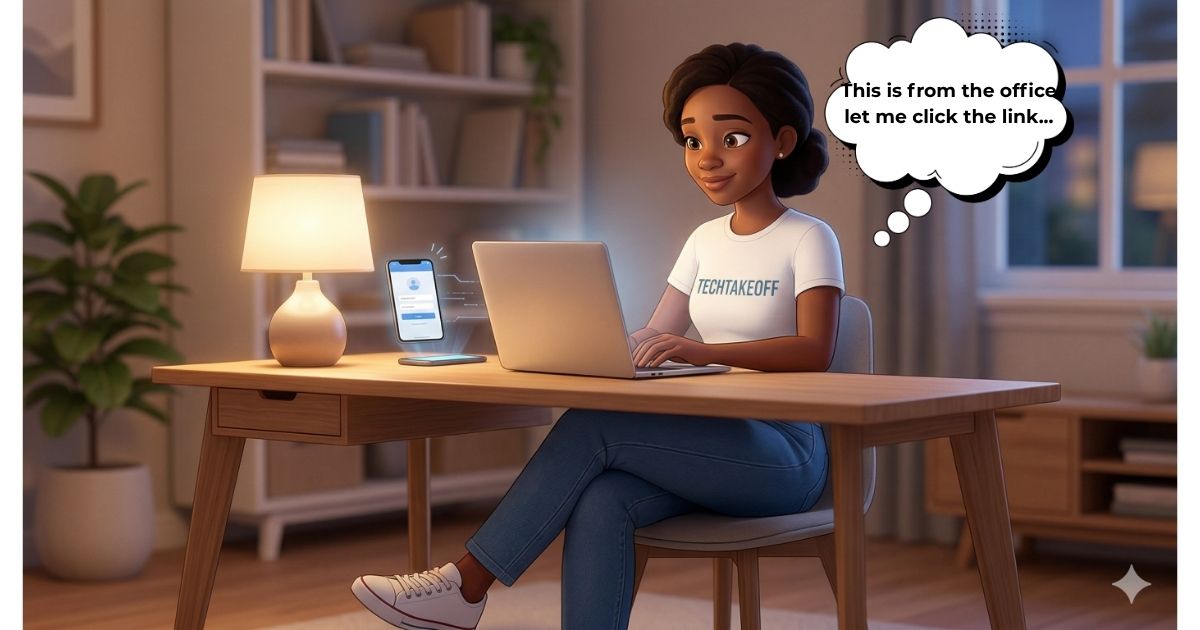
Beatrice almost ignored the email.
It looked routine.
“Urgent: Payroll verification required.”
The message was clear, professional, and written exactly the way her company usually communicated. No spelling mistakes. No strange formatting. Even the tone felt familiar.
She hesitated for a second.
Then she clicked the link.
Nothing unusual happened.
A login page appeared. Clean. Branded. Normal.
She entered her details and moved on with her day.
By 11:42 AM, someone else had logged into her account.
By 1:15 PM, internal emails were being accessed.
By 3:30 PM, sensitive files had been downloaded.
And by the end of the day, what started as a simple click had become a cybersecurity incident.
But this time, something was different.
This wasn’t just phishing.
This was AI-assisted phishing.
The Attack Didn’t Start With the Click
It started much earlier.
The attacker didn’t randomly send emails.
Instead, they used AI tools to:
- study company communication styles
- generate realistic email language
- personalise messages using publicly available data
- replicate internal tone and structure
The result?
An email that didn’t look suspicious.
It looked perfect.
In the past, phishing emails were easier to spot.
They contained:
- poor grammar
- awkward wording
- obvious red flags
Now, AI has changed the game.
Attackers no longer need to be skilled writers.
They just need the AI right tools.
Step by Step: What Actually Happened
Beatrice’s click was just one moment in a chain of events.
Here is how it all unfolded:
1. The Fake Page
The link led to a login page designed to look identical to her company’s system.
Every detail matched.
Because AI can now help replicate interfaces quickly and convincingly.
2. The Credential Capture
The moment she entered her login details, they were sent directly to the attacker.
No alarms. No warnings.
Just silent access.
3. The Silent Login
Within minutes, the attacker logged into her real account.
No hacking required.
Just valid credentials.
4. The Expansion
From there, access grew.
Emails were read. Contacts were mapped. Internal systems were explored.
In some cases, attackers use AI to analyse large amounts of data quickly, identifying what is valuable.
5. The Impact
What began as one compromised account quickly became a wider risk:
- sensitive information exposed
- internal trust broken
- operational disruption
Why AI Makes This More Dangerous
The goal of phishing hasn’t changed.
But AI has made it:
- faster to create attacks
- easier to personalise messages
- harder for humans to detect deception
In other words:
The attack is no longer obvious.
The mistake is no longer easy to avoid.
The Real Risk Isn’t Technology
It’s easy to think this is a technology problem.
But Beatrice didn’t fail because she lacked technical knowledge.
She made a decision based on what she saw.
And what she saw looked real.
This is where cybersecurity becomes human.
Because no matter how advanced systems become, people still have to:
- interpret information
- make decisions
- act under time pressure
A New Reality for Beginners
If you’re starting your cybersecurity journey, this is important to understand:
The risks are no longer just technical.
They are psychological, behavioural, and increasingly AI-driven.
You’re not just learning how systems work.
You’re learning how deception works at scale.
On a final note….
Beatrice’s story isn’t rare.
It’s becoming more common.
Because in 2026, cyber attacks are no longer just about breaking systems.
They are about convincing people.
And AI is making that easier than ever.
Because sometimes, the most dangerous part of a cyber attack…is not the code behind it.
It’s how real it looks.