
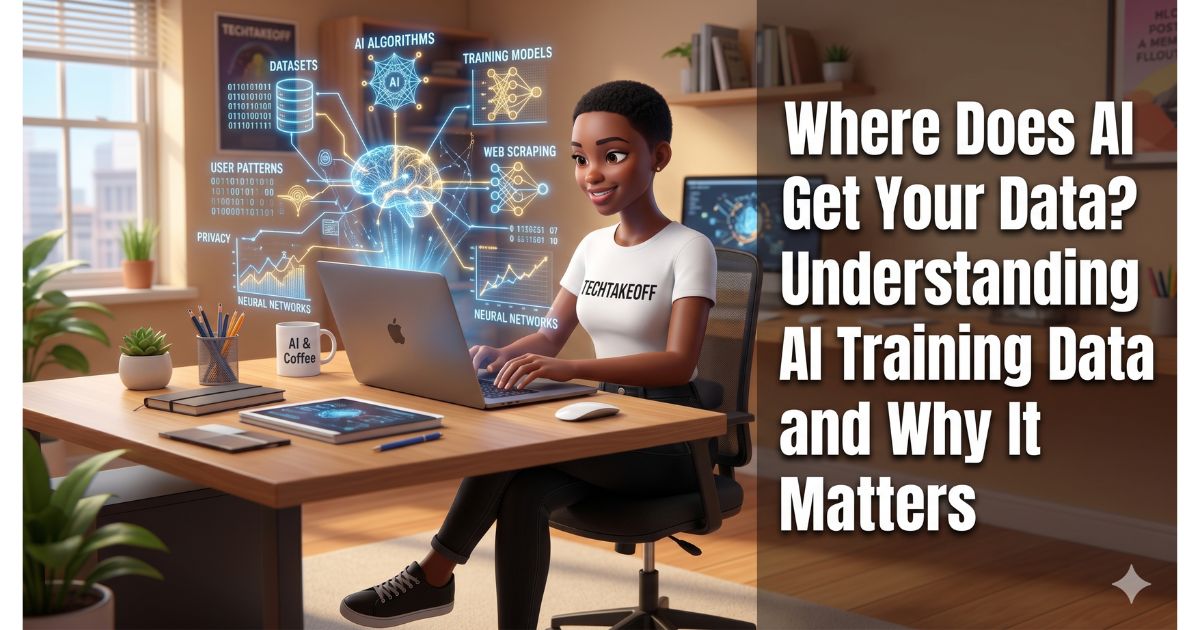
AI Training Data Explained for Beginners
Beatrice was impressed.
She had just asked an AI chatbot a question about aviation safety, and within seconds, it produced a detailed answer.
Not only was it fast.
It was surprisingly good.
The explanation was clear. The examples made sense. The information seemed accurate.
She sat back and thought for a moment.
Then a new question popped into her mind.
How does AI know all this?
After all, AI does not attend school.
It does not read books like humans do.
It does not spend years working in aviation, cybersecurity, healthcare, or finance.
So where does all that knowledge come from?
The answer begins with one word:
Data.
What Is AI Training Data?
Before an AI system can answer questions, write content, generate images, or analyse information, it must first learn from enormous amounts of data.
This information is known as training data.
Training data can include:
- books
- articles
- websites
- research papers
- publicly available information
- images
- videos
- code
- conversations
Think of it like teaching a child.
The more examples a child sees, the more patterns they begin to recognise.
AI learns in a similar way.
It studies patterns within data to predict the most likely response to a question.
Why AI Needs So Much Data
Beatrice imagined teaching someone how to identify an aircraft.
Showing one photograph would not be enough.
But showing thousands of aircraft images from different angles would help them recognise patterns much faster.
AI works in a similar way.
The more examples it receives, the better it becomes at:
- recognising language
- identifying patterns
- making predictions
- generating responses
Without data, AI simply cannot learn.
Data is the fuel that powers artificial intelligence.
Does AI Use Personal Data?
This is where many people become concerned.
When people hear the word data, they often think about:
- personal information
- emails
- private messages
- banking details
The reality is more complex.
AI developers are expected to follow data protection and privacy regulations when building AI systems.
However, organisations must carefully manage:
- data collection
- data storage
- data usage
- consent
- privacy protection
This is why conversations around AI and data privacy have become so important.
What Happens When AI Learns From Poor Data?
As Beatrice continued researching, she discovered another challenge.
AI is only as good as the data it learns from.
If the data contains:
- inaccuracies
- bias
- outdated information
- missing context
The AI may produce flawed results.
This is often called:
Garbage In, Garbage Out
Poor quality data can lead to:
- incorrect decisions
- biased outcomes
- misinformation
- reduced trust in AI systems
Which is why organisations spend significant time reviewing and managing data quality.
Where AI Governance Comes In
This is where AI Governance becomes essential.
AI Governance helps organisations answer important questions such as:
- Where did the training data come from?
- Was the data collected responsibly?
- Does the system protect privacy?
- Can decisions be explained?
- Are risks being monitored?
Without proper governance, organisations may struggle to build trustworthy AI systems.
Why Data Matters More Than Ever
Today, AI is being used in:
- aviation
- healthcare
- finance
- education
- cybersecurity
Every one of these industries relies on data.
And the quality of that data directly affects the quality of AI outcomes.
As organisations adopt more AI systems, managing data responsibly becomes just as important as building the technology itself.
The Bigger Picture
As Beatrice closed her laptop, she realised something important.
Most people focus on what AI can do.
But fewer people stop to think about what makes AI possible.
Behind every chatbot response, image generation, recommendation, or prediction is one critical ingredient:
Data.
Without data, AI cannot learn.
Without governance, AI cannot be trusted.
And without trust, even the most advanced AI system may struggle to deliver value.
On A Final Note
The next time you use an AI tool and receive an impressive answer in seconds, consider asking yourself the same question Beatrice asked:
Where did this AI learn that?
Because understanding AI starts with understanding the data behind it.
And as AI becomes part of everyday life, data governance, privacy, and accountability will become more important than ever.
2 Comments
[…] Read More → Where Does AI Get Your Data? Understanding AI Training Data and Why It Matters […]
[…] Read the article → Where Does AI Get Your Data? Understanding AI Training Data and Why It Matters […]