
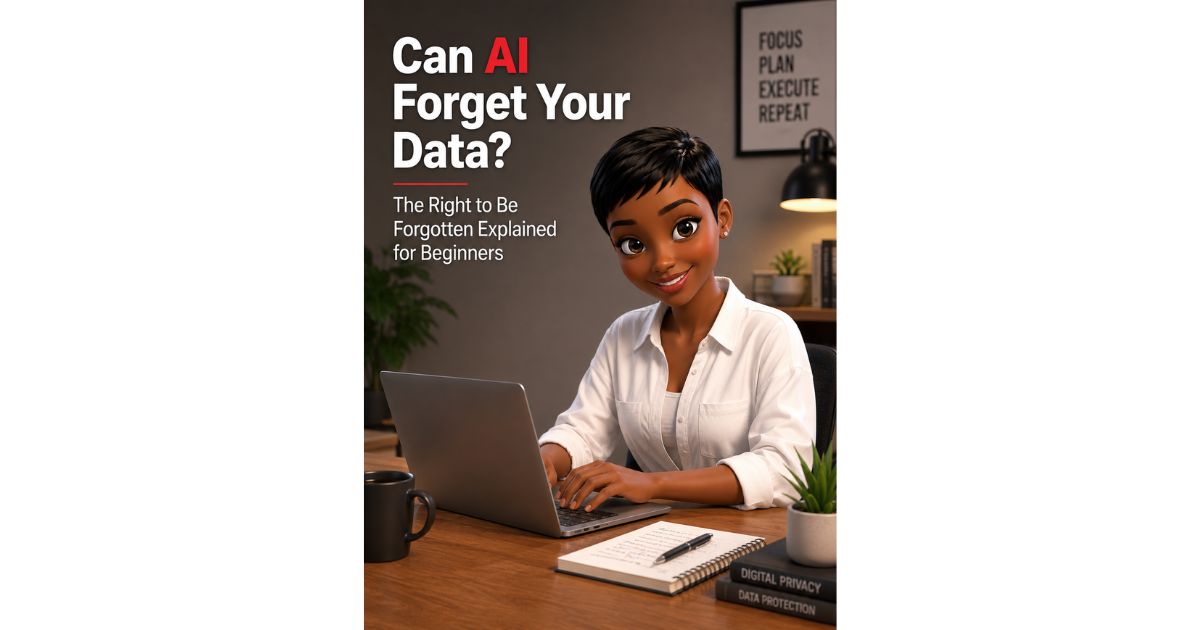
Beatrice felt relieved.
After years of neglecting an old social media account, she finally decided to delete it.
The photos were gone.
The old posts disappeared.
Her personal details were removed.
At least, that was what she thought.
Later that evening, while using an AI tool to summarize an article, a question suddenly crossed her mind.
What if my information had already been collected, shared, or used by an AI system?
Could it still be deleted?
Could AI forget it?
The question seemed simple.
The answer was not.
And that answer sits at the centre of one of today’s biggest conversations around AI governance, privacy, and data protection.
What Is the Right to Be Forgotten?
The Right to Be Forgotten refers to an individual’s ability to request the deletion of personal information under certain circumstances.
The idea is based on a simple principle:
People should have some level of control over their personal data.
If information is no longer needed, has been collected unlawfully, or is being processed without a valid reason, individuals may have the right to request its removal.
This concept is recognised under privacy regulations such as the GDPR in Europe and the UK.
It is also becoming increasingly relevant in countries like Nigeria as organisations collect and process more personal data.
For Beatrice, it sounded straightforward.
Delete the data.
Move on.
But artificial intelligence changes the conversation.
Why AI Makes Data Deletion More Difficult
Traditional databases are relatively easy to understand.
If a company stores your information in a database, that information can usually be located and deleted.
AI systems operate differently.
Before AI can generate answers, make predictions, or automate tasks, it learns from large amounts of information.
This process is known as training.
Imagine teaching someone how to ride a bicycle.
Once they learn the skill, you cannot simply remove one lesson from their memory.
AI models face a similar challenge.
Once data contributes to training, removing its influence may be significantly more complex than deleting a record from a database.
This is one reason why AI governance has become such an important field.
Can AI Really Delete Your Data?
This is one of the most common questions people ask.
The answer depends on several factors.
If personal information is stored in databases, logs, or user accounts, it can often be deleted according to company policies and applicable regulations.
However, if information has already been used to train an AI model, removing its influence may be more difficult depending on how the system was designed.
This is why organisations must think carefully about:
- data collection
- data retention
- model training
- privacy controls
before deploying AI systems.
Why GDPR Matters
The General Data Protection Regulation (GDPR) is one of the world’s most influential privacy laws.
It gives individuals important rights regarding their personal information, including:
- the right to access data
- the right to correct inaccurate information
- the right to delete certain personal data
- the right to understand how data is being used
For organisations using AI, GDPR creates accountability.
Companies must be transparent about how personal information is collected, processed, stored, and protected.
This becomes particularly important when AI systems rely heavily on user data.
What About Nigeria?
Many people assume data protection is only a European issue.
It is not.
Nigeria has made significant progress in data protection through the Nigeria Data Protection Act and the work of the Nigeria Data Protection Commission.
These frameworks aim to protect the privacy rights of individuals and establish responsibilities for organisations handling personal information.
Just like GDPR, Nigerian data protection laws encourage organisations to:
- process personal data responsibly
- protect sensitive information
- maintain transparency
- implement appropriate safeguards
As AI adoption grows across Nigeria, these protections become increasingly important.
Because AI systems are only as responsible as the data practices behind them.
Why This Matters for Businesses Using AI
As Beatrice continued researching, she realised that this issue affects far more than social media users.
Businesses are increasingly using AI for:
- customer service
- recruitment
- marketing
- fraud detection
- decision-making
- productivity
Many of these systems process personal information.
Without proper governance, organisations may expose themselves to:
- privacy violations
- regulatory penalties
- reputational damage
- loss of customer trust
This is why AI Governance and Data Governance must work together.
Organisations need clear policies that define:
- what data can be collected
- how long data should be retained
- who can access it
- how deletion requests are handled
Where AI Governance Comes In
AI Governance helps organisations use artificial intelligence responsibly.
It asks critical questions such as:
- Are privacy rights being respected?
- Is personal data protected?
- Can users exercise their rights?
- Are AI systems transparent and accountable?
- Are regulations being followed?
Good governance helps organisations build AI systems that people can trust.
Without governance, innovation can quickly create unintended risks.
The Bigger Question
As Beatrice reflected on everything she had learned, she realised something important.
The future of AI is not only about intelligence.
It is about responsibility.
People want to know:
- Who has access to their information?
- How is their data being used?
- Can it be deleted?
- Who is accountable?
These questions are becoming just as important as the technology itself.
On A Final Note
The next time you upload information into an AI tool, ask yourself the same question Beatrice asked:
Can AI forget my data?
The answer may depend on the technology, the organisation, and the regulations involved.
But one thing is certain.
As AI becomes more deeply integrated into everyday life, privacy, transparency, and governance will become increasingly important.
Because in the age of artificial intelligence, trust is built not only on what AI can remember, but also on how responsibly organisations manage what should be forgotten.