

When Payroll Stops: Lessons From a Ransomware Incident That Started With a Trusted Vendor At 08:15 on a Monday morning, the finance team noticed something strange. The payroll system would not load. At first, it looked like a simple outage. Systems fail sometimes. Servers reboot. IT fixes it. But within minutes, it became clear this was not a routine problem. Files across the finance server had been renamed. Critical payroll data was inaccessible. A message appeared on the screen demanding payment to restore access. What had started as a small technical issue was now a Severity 1 cybersecurity incident. And the most unsettling discovery came next. The attack did not begin inside the organisation.It started with a trusted third-party vendor. The Invisible Door Attackers Walk Through The organisation relied on a financial software provider to manage payroll processing and financial reporting. The system had been trusted for years. It handled sensitive employee data and critical operational functions. But trust in technology can create blind spots. Unknown to the company, the vendor’s software supply chain had been compromised. Attackers exploited a vulnerability in the vendor’s update mechanism, embedding ransomware into a routine software update. Once installed inside the organisation’s environment, the malicious code began spreading silently. By the time employees noticed something was wrong, the ransomware had already encrypted multiple systems. The attackers never had to break down the company’s front door. They simply walked through a door that had already been opened by a trusted supplier. This kind of incident is becoming increasingly common in modern cybersecurity. Supply-chain attacks have shown that organisations are often only as secure as the vendors they depend on. The breach itself was technical. But the underlying problem was governance. The First Four Hours That Decide Everything When a cyber incident begins, the first few hours often determine whether the damage spreads or is contained. In this case, the organisation activated its incident response process immediately. The response team initiated several critical actions: Communication became just as important as technical containment. Executives needed to understand the potential business impact. Finance teams needed clarity on payroll delays. Legal teams needed to evaluate regulatory obligations. Cybersecurity incidents rarely affect only one department. They ripple across the entire organisation. During these early hours, leadership decisions matter just as much as technical expertise. Poor communication can amplify confusion. Delayed decisions can allow attacks to spread further. In crisis moments, cybersecurity becomes less about technology and more about people coordinating under pressure. When Cybersecurity Becomes a Business Crisis The ransomware attack did more than disrupt IT systems. It threatened core business operations. Payroll systems store some of the most sensitive data in any organisation: employee identities, salaries, bank details, tax records. If compromised, the consequences can extend far beyond operational disruption. The organisation now faced multiple risks at once. Financial operations were interrupted. Employee payments were uncertain. Sensitive data exposure was a real possibility. And if personal data had been compromised, the organisation might be required to notify regulators under the General Data Protection Regulation, which requires organisations to report certain data breaches within strict timeframes. What started as a ransomware attack had quickly evolved into a potential regulatory and reputational crisis. This is why cybersecurity leaders increasingly emphasise a simple truth: Cybersecurity incidents are rarely just IT problems. They are business continuity problems. The Vendor Risk Most Organisations Underestimate The most important lesson from this incident was not about ransomware. It was about third-party risk. Modern organisations rely on dozens, sometimes hundreds, of external software providers. Each vendor introduces a potential entry point into the organisation’s systems. Yet vendor security often receives far less scrutiny than internal infrastructure. Questions that should be asked frequently are often overlooked: How secure are the vendor’s update mechanisms? How are software patches verified before installation? What monitoring exists for abnormal behaviour after system updates? Without strong governance around vendor risk management, organisations may unknowingly inherit vulnerabilities from the partners they trust the most. Incidents like this demonstrate that cybersecurity is no longer confined within organisational boundaries.Security now extends across entire digital supply chains. A Lesson From Aviation Safety This incident reminded me of something deeply embedded in aviation safety culture. In aviation, incidents are rarely blamed on a single failure. Investigators look for systemic causes. Was there a process gap? Was communication unclear? Was a critical risk underestimated? Cybersecurity incidents often follow the same pattern. The ransomware itself may have been the trigger, but the real issue lies deeper: governance, oversight, and risk awareness. Just as aviation learned that safety requires coordination across pilots, maintenance teams, regulators, and manufacturers, cybersecurity now requires coordination across organisations, vendors, and technology providers. Security is not simply about building stronger technical defenses. It is about building stronger systems of accountability. The Real Question Organisations Should Ask When organisations analyse cyber incidents, the focus often remains on the attacker. How did they gain access? What vulnerability did they exploit? How can we block it next time? Those are important questions. But a more powerful question may be this: What assumptions allowed this incident to happen? In this case, the assumption was trust. Trust in a vendor. Trust in software updates. Trust that someone else had already handled the risk. Cybersecurity incidents often expose the invisible assumptions embedded in organisational systems. And when those assumptions break, the consequences can ripple across an entire business. The Future of Cybersecurity Is Human-Centered As cyber threats grow more complex, one lesson is becoming clearer. Technology alone cannot solve cybersecurity. Behind every vulnerability is a decision. Behind every incident is a process. Behind every breach is a system of human choices. The future of cybersecurity will not only depend on better tools or stronger encryption. It will depend on organisations learning to see security as a shared responsibility across people, processes, and partners. Because sometimes the most dangerous vulnerability is not hidden in code. It is hidden in the systems we trust without questioning.

Why Many Companies Don’t Know Their Most Critical Cyber Risks
Why Many Companies Don’t Know Their Most Critical Cyber Risks On Monday morning, the security team gathered for their weekly risk meeting. A spreadsheet appeared on the screen. It was the company’s cyber risk register. It had everything. Dozens of risks. Columns for likelihood and impact. Risk scores in red, orange, and yellow. At first glance, it looked impressive. But something was wrong. When the Chief Technology Officer asked a simple question, the room became quiet. “Which of these risks could stop our business tomorrow?” No one answered immediately. The security analyst began scrolling through the list. There were many risks labeled “High”. Unpatched servers. Weak passwords. Outdated software. Cloud configuration issues. Everything looked important. But that was the problem. When everything is marked as high risk, nothing truly stands out. The meeting ended without a clear answer. This situation is more common than many organisations realise. Many companies do not have full visibility of their digital environment. New systems are added quickly. Cloud services are created by different teams. Applications are deployed without security teams always knowing about them. Over time, organisations lose track of what they actually need to protect. If a company does not clearly understand its systems, it becomes very difficult to understand its real cyber risks. Another common problem is that security teams focus heavily on technical vulnerabilities instead of business impact. A vulnerability scanner may report hundreds of issues. But not every vulnerability creates the same level of risk. For example, a vulnerability in an internal testing server may cause inconvenience, but a vulnerability in a payment processing system could stop revenue completely. Technically, both issues may appear severe. But from a business perspective, they are very different risks. When organisations fail to connect cybersecurity issues to business operations, it becomes difficult to identify what truly matters. In many organisations, the risk register also becomes a documentation exercise. Risks are listed, scores are assigned, and review meetings are scheduled. But the register is not actively used to guide decisions. Instead of helping leaders understand the most important risks, it becomes just another document that grows longer over time. Another issue is unclear ownership. Cyber risks often sit between different teams. IT teams manage systems. Security teams identify vulnerabilities. Business units depend on those systems to operate. But when a risk appears, it is not always clear who is responsible for fixing it. Without clear ownership, risks remain unresolved. Eventually organisations struggle to answer a very simple question: what cyber risk could hurt the business the most? Instead of focusing on a few critical risks, teams try to manage everything at once. Attention becomes spread too thin. Organisations that manage cyber risk well take a different approach. They focus on understanding how technology supports the business. They identify which systems are critical for operations. They connect cyber risks directly to financial impact, operational disruption, and customer trust. Most importantly, they ensure that every major risk has a clear owner. Because cybersecurity is not only about protecting systems. It is about protecting the business itself.
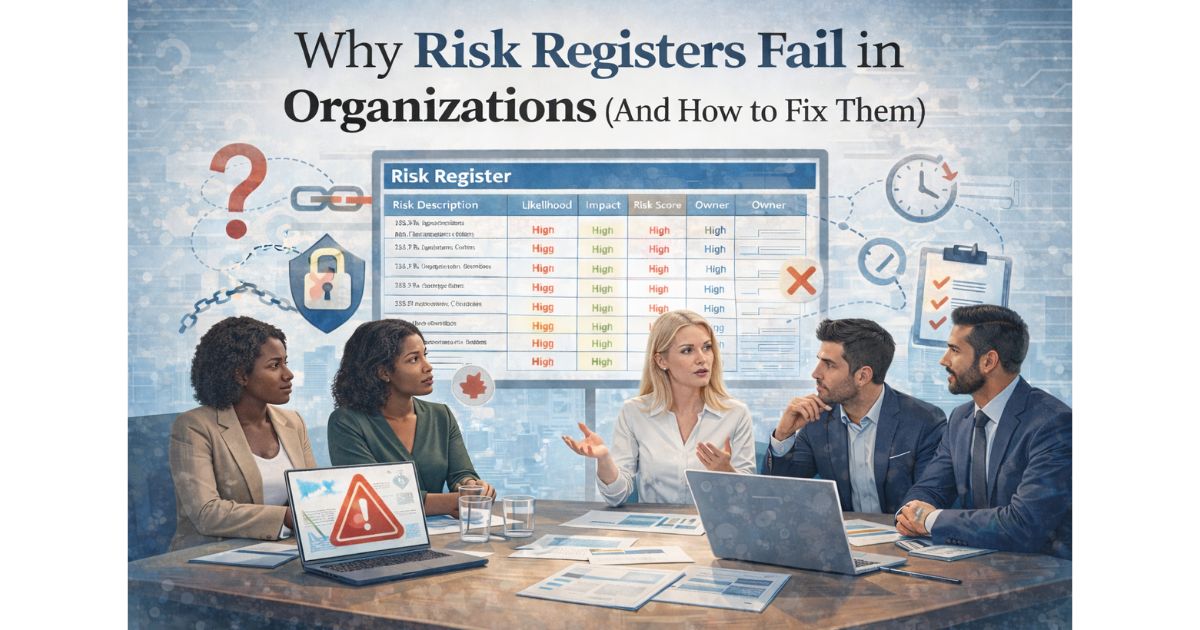
Why Risk Registers Fail in Organisations (And How to Fix Them)
One Monday morning, the security team gathered for their regular risk review meeting. The risk register was open on the screen. It was a long spreadsheet filled with risks, scores, and notes about possible controls. Everything looked organised. But after some time, the discussion slowed down. Some risks had been on the list for months. Many of them were marked as “High.” A few risks did not even have a clear owner. The team realised something important. The risk register existed, but it was not really helping them decide what to do. This situation happens in many organisations. Risk registers are created with good intentions, but over time they stop being useful. One common reason is that the risk register becomes just another document. Teams update it because governance processes require it or because auditors expect to see it. Instead of helping people manage risk, the register slowly becomes a record of problems that no one is actively solving. Another problem is that too many risks are marked as “High.” When teams score risks, they often want to be cautious, so they rate many issues as high priority. At first this seems responsible, but when almost every risk is labelled “High,” it becomes difficult to know which ones truly need urgent attention. When everything looks critical, nothing clearly stands out. Risk registers also fail when risks do not have clear owners. A risk might say that outdated systems could create security vulnerabilities. That sounds serious, but who is responsible for fixing it? If there is no clear owner, the risk stays in the register but no action is taken. Sometimes the way risks are described also causes problems. Many risks are written in technical language that business leaders may not fully understand. For example, a risk might mention outdated encryption protocols or system vulnerabilities. While these are technical issues, they do not clearly explain what could happen to the business. When risks are connected to real outcomes like financial loss, regulatory penalties, service disruption, or customer impact, leaders can better understand why they matter. In some organisations, the risk register is updated regularly but rarely used to guide decisions. The document exists, and teams review it occasionally, but it does not influence how security resources are prioritised or how risks are addressed. When that happens, the register becomes part of a process rather than a tool for action. A good risk register should help organisations focus on the risks that matter most. It should make it easier to see which risks require immediate attention, which risks need mitigation, and which ones the business may decide to accept. For a risk register to work properly, risks need clear scoring criteria, clear ownership, and regular review. Most importantly, the risks should be linked to real business consequences. When these elements are in place, the risk register becomes more than just a list of problems. It becomes a tool that helps organisations make better decisions about managing cyber risk.

How Women With No Tech Background Are Breaking Into Cybersecurity in 2026
Every year, the cybersecurity industry faces a growing problem: there are millions of unfilled jobs worldwide, yet many talented women still believe tech is “not for them.” For a long time, cybersecurity was seen as a field reserved for programmers and computer science graduates. But in 2026, that narrative is changing fast. More women from non-technical backgrounds teachers, nurses, marketers, customer service agents, and even flight attendants are successfully transitioning into cybersecurity careers. The truth is simple: cybersecurity needs diverse thinkers, not just technical experts. Many of the most valuable skills in security today come from backgrounds outside traditional tech. If you’ve ever thought about switching careers but felt intimidated by the tech barrier, this might surprise you, you may already have skills the cybersecurity industry desperately needs. Why Cybersecurity Is Attracting More Women Cybersecurity has become one of the most attractive career paths globally, and women are increasingly stepping into the field for several reasons. First, the demand for cybersecurity professionals is exploding. Organisations across finance, healthcare, aviation, government, and technology need experts to protect their systems from cyber threats. Second, cybersecurity offers flexible career paths. Unlike many tech roles, you don’t necessarily need a computer science degree to get started. Many professionals enter the field through certifications, training programs, and practical experience Third, cybersecurity careers often provide competitive salaries and global opportunities, making it appealing for women looking for financial independence and career growth. Most importantly, companies are beginning to realize that diverse teams build stronger security systems. Different perspectives help organisations identify risks that homogeneous teams might overlook. The Biggest Myth: “You Must Be a Tech Genius” One of the biggest misconceptions about cybersecurity is that you must know how to code or have an advanced technical background. While technical skills are helpful, many cybersecurity roles focus on risk management, policy development, compliance, and governance rather than deep programming. For example, roles such as: often rely more on analytical thinking, communication, and problem-solving skills than heavy technical expertise. This is exactly why women from non-technical backgrounds are increasingly finding their place in cybersecurity. Transferable Skills Women Already Have Many women underestimate how valuable their existing skills are in cybersecurity. Here are some examples of transferable skills that translate well into security roles: Communication SkillsCybersecurity professionals must explain complex security issues to non-technical stakeholders. Strong communication is essential. Risk AwarenessMany roles involve identifying and assessing risks something professionals in finance, aviation, healthcare, and management already do. Attention to DetailCybersecurity requires noticing patterns, anomalies, and vulnerabilities. Precision and careful observation are critical skills. Problem SolvingSecurity teams constantly analyze problems and develop strategies to prevent cyber threats. These skills are often developed in careers that have nothing to do with technology. Why 2026 Is the Best Time to Enter Cybersecurity The cybersecurity industry is evolving rapidly, and organisations are prioritizing diversity and inclusion more than ever before. Governments, technology companies, and security organisations are actively investing in programs designed to bring more women into cybersecurity roles. In addition, remote work opportunities have opened the door for professionals around the world to join the global cybersecurity workforce. This shift means women no longer need traditional tech backgrounds to build successful careers in security. Final Thoughts Cybersecurity is no longer an exclusive club for computer science graduates. It has become a field where problem solvers, communicators, and strategic thinkers can thrive. Women from non-technical backgrounds are proving that career reinvention is possible and often powerful. Breaking into cybersecurity may require learning new skills, gaining certifications, and building experience, but the opportunities are enormous for those willing to take the first step. In 2026, the question is no longer whether women can succeed in cybersecurity. The real question is how many more women will take the leap.
What 3,000 Cybersecurity Incidents Reveal About Risk (2015–2024)
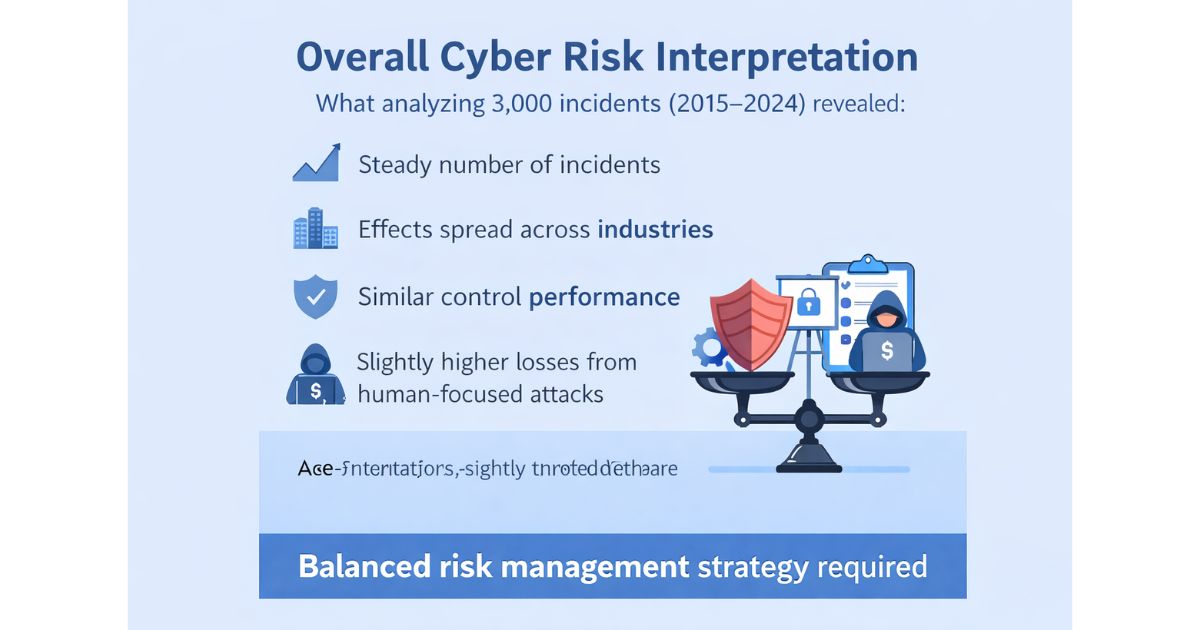
Cyber risk is often discussed in headlines rising attacks, record-breaking breaches, increasing losses. But what does the data actually say? To explore this, I analyzed 3,000 cybersecurity incidents across multiple industries between 2015 and 2024 using Python (Pandas and Matplotlib). The objective was to understand patterns in financial impact, sector exposure, and control effectiveness from a governance and risk perspective. Are Attacks Increasing? Interestingly, incident frequency remained relatively stable across the 10-year period. While there were natural fluctuations year to year, the dataset does not show sustained growth in attack volume. From a risk management standpoint, this suggests steady exposure rather than escalating frequency — at least within this dataset. Which Industries Are Most Affected? Financial losses were broadly distributed across sectors. Although IT recorded the highest total loss, the difference between industries was not dramatic. Banking, Government, Healthcare, Retail, and Telecommunications all showed comparable exposure levels. This indicates that cyber risk is systemic rather than concentrated in one high-risk sector. It is a cross-industry issue. Do Certain Controls Reduce Financial Impact? When comparing median financial losses across defense mechanisms, no single control dramatically reduced impact. Firewall-associated incidents showed slightly lower median loss, but the differences between controls were relatively small. This reinforces a key governance principle: layered security matters more than relying on one solution. Which Vulnerabilities Are Most Expensive? Social engineering incidents showed the highest median financial loss, closely followed by zero-day vulnerabilities. This highlights an important reality: Cyber risk is both technical and human. Organizations must invest not only in infrastructure and detection systems, but also in awareness, training, and behavioral risk management. Overall Risk Interpretation The data shows that: From a governance point of view, cyber risk is spread across sectors and comes from different sources. It is not caused by one single major threat. This means organizations need a balanced approach combining strong technical controls, user awareness, and clear oversight from leadership. The pictures are below If you are working in cyber risk or governance, I will be interested in your perspective: Are you seeing similar patterns in your sector? Write in the comments below The full Jupyter Notebook and supporting files are available on GitHub: https://github.com/Iyetunde/Cyber-risk-analysis-2015-2024

Why Most Cyber Risk Scores Are Wrong
Most cyber risk registers look structured. They have: On paper, it appears disciplined. But in practice, many of those scores are unreliable. Not because people are careless but because the scoring process itself is weak. The Illusion of Precision A risk rated: Likelihood: 4Impact: 5Risk Score: 20 Looks precise. But ask two simple questions: If those definitions are unclear, the score is only structured guesswork. Precision in format does not equal accuracy in assessment. Likelihood Is Often Misjudged In many organisations, likelihood is scored based on: But proper likelihood assessment should consider: Without structured criteria, likelihood becomes subjective. Two departments may score the same risk differently because they interpret probability differently. That creates inconsistency across the risk register. Impact Is Frequently Inflated Impact scoring is where distortion becomes obvious. Common patterns include: When too many risks are rated “High,” prioritisation collapses. If ten risks are critical, none of them truly are Impact scoring should be based on clear business consequences, such as: Without calibration, impact becomes emotional rather than analytical. If Controls Don’t Work, the Risk Score Is Misleading Another common issue is scoring inherent risk without properly assessing control effectiveness. Controls may exist on paper but: If control strength is overestimated, residual risk is underestimated. That creates false confidence. Mid-level analysts understand that control design and operating effectiveness matter just as much as the initial risk score. High-Risk Inflation Weakens Governance When too many risks are labelled as “High”: When everything is treated as critical, it becomes hard to see what truly needs action first. Good governance depends on clear differences between risks. Risk scoring should help organisations decide what to fix first not create confusion. But you ask why does it stop feeling urgent, is too many “High” not meant to make it more urgent? High” should trigger urgency. But here’s the problem, Urgency only works when it’s scarce. If When everything is urgent, nothing feels urgent. Why This Matters for Decision-Making Cyber risk scoring is not an academic exercise. It influences: If the scoring process is inconsistent, decisions built on those scores are also inconsistent. That is where governance begins to weaken. How to Improve Risk Scoring Without Overcomplicating It You do not need full quantitative modelling to improve accuracy. You need to; Consistency matters more than mathematical complexity. When scoring logic is transparent and defensible, risk registers become decision tools not reports that sits on the shelf. Final Thought Cyber risk scores are not wrong because people lack intelligence. They are wrong because scoring systems are often under-designed. A well-structured scoring framework forces clarity. And clarity is what enables confident risk decisions.
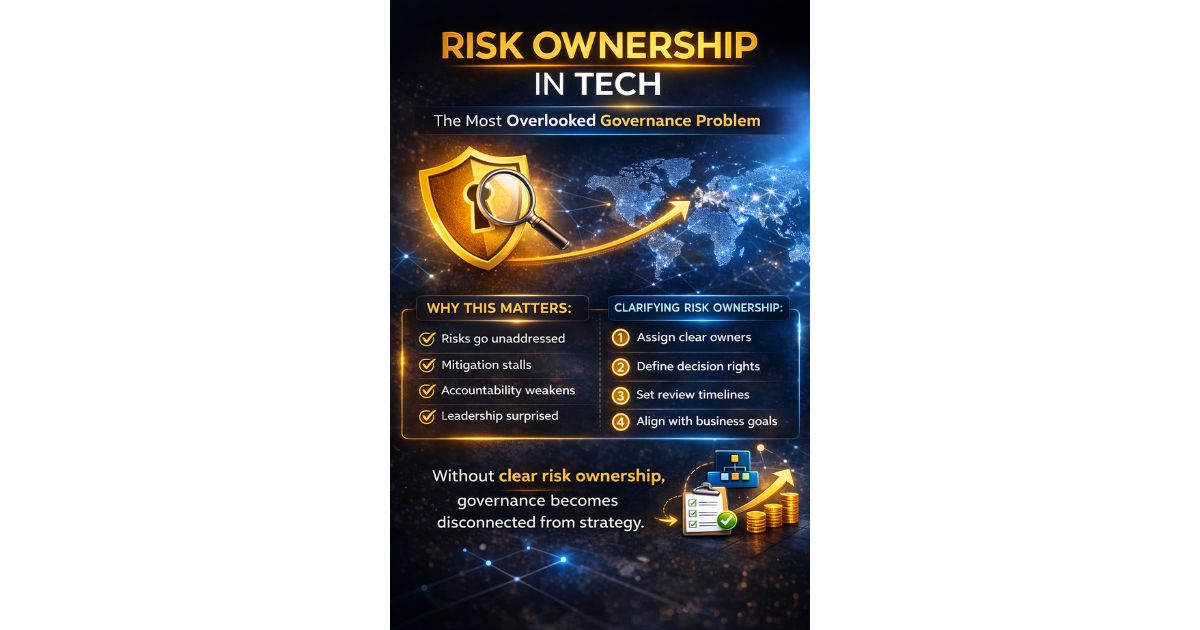
Risk Ownership in Tech: The Most Overlooked Governance Problem.
The risk was documented. It had a score.It had a description.It even had recommended controls. But no one owned it. Weeks passed.Then months. The risk didn’t disappear. It just became invisible.This is one of the most overlooked governance problems in tech companies:unclear risk ownership. The Illusion of “Someone Is Handling It” In many tech environments, risks are identified quickly. Security tools generate alerts.Engineers log vulnerabilities.Compliance teams update risk registers. Everything looks organised. But when you ask one simple question Who owns this risk?the room goes quiet. Sometimes the answer is: That is not ownership. That is diffusion of responsibility. Control Owner vs Risk Owner This is where confusion begins. A control owner manages a safeguard.For example: But a risk owner is different. A risk owner is accountable for the business impact if the risk materialises. That person: In many tech companies, this distinction is blurred. Controls exist. Ownership does not. Why This Happens in Tech Companies Tech organisations move fast. New features.New integrations.New markets. In this environment: When risk ownership is unclear: And default risk acceptance is rarely strategic. Risk Ownership Is a Leadership Function Here is the uncomfortable truth: Risk ownership is not a technical role. It is a business role. If a customer data breach would impact revenue, reputation, and regulatory standing, the risk owner should sit at a level that understands those consequences. Security teams identify and assess. But business leaders decide. When risk ownership stays inside security alone, governance becomes unbalanced. What Clear Risk Ownership Changes When ownership is clearly assigned: The risk register stops being a static document. It becomes a decision-making tool. That shift changes everything. The Hidden Cost of No Ownership Unowned risks create: But the biggest cost is strategic blindness. If leadership does not explicitly accept or reject risks, the organisation drifts. Drift is dangerous in tech. How Governance Fixes This Good GRC does not just track risks. It clarifies: Governance is not about adding layers. It is about removing ownership gaps. Why This Matters Now As tech companies scale, complexity increases. Without strong ownership structures: Risk ownership is not a spreadsheet column. It is an operating model. And without it, even the best risk scoring system cannot drive strategy. Clear ownership turns risk from a warning into a decision. And governance begins where accountability becomes explicit.
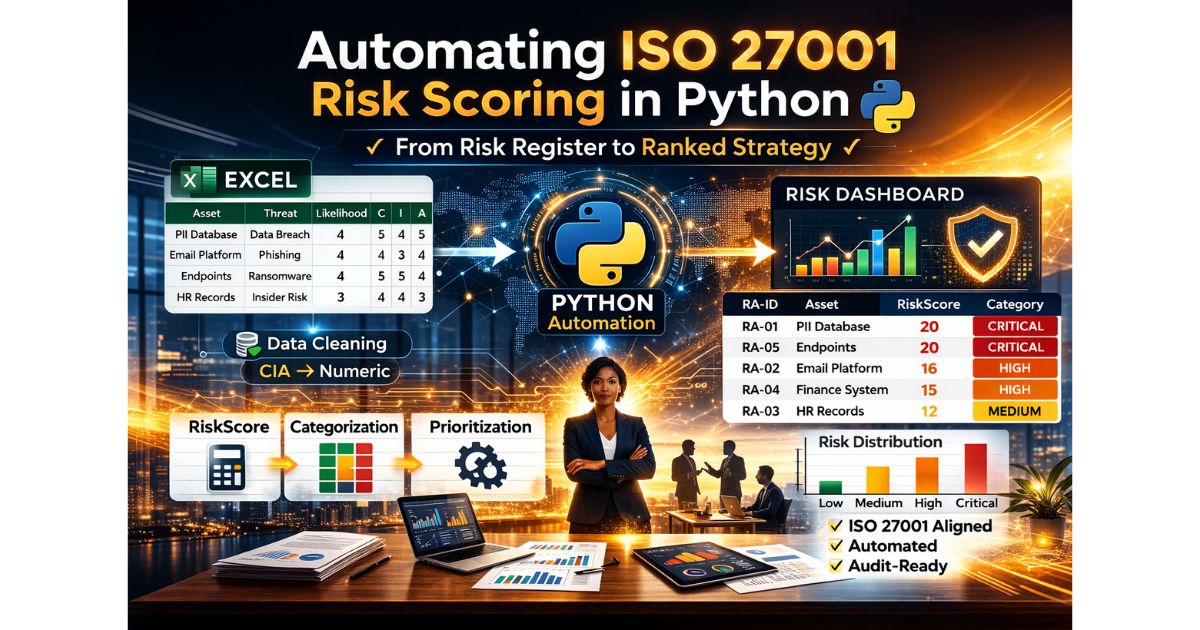
Automating ISO 27001 Risk Scoring in Python: From Risk Register to Ranked Strategy.
Spreadsheets are powerful. But they are also fragile. When I first worked on an ISO 27001-aligned risk register, it looked structured and complete. Assets were listed. Threats were documented. Likelihood and impact were scored. Controls were mapped to Annex A. Everything seemed organised. But something important was missing. Consistency. That’s when I decided to automate the scoring model using Python. Not to replace governance but to strengthen it. The Problem With Manual Risk Scoring Risk registers often rely on manual scoring: Even with good intentions, this introduces: Governance works best when it is defensible and repeatable. Automation helps achieve that. The Model: How the Risk Scoring Worked The goal was simple: Take a structured ISO 27001 risk register and build a consistent, automated scoring engine. The Python-based model: Instead of manually scanning rows, the model produced a prioritised risk list instantly. What changed was not just speed it was clarity. Why Impact Was Calculated Using the Worst-Case CIA Value In ISO 27001 risk assessments, impact is often linked to Confidentiality, Integrity, and Availability. Rather than averaging these values, I calculated impact using the maximum CIA score. Why? Because a severe impact in any one dimension can materially affect the business. For example: Using the maximum value aligns better with real-world risk severity. This small design decision makes the model more conservative and more realistic. From Risk Score to Risk Category After calculating RiskScore, the model categorized risks: This step matters. Leadership rarely responds to raw numbers.They respond to thresholds and priorities. By defining consistent scoring bands, the model ensures: Automation removes ambiguity from categorisation. What the Ranked Output Revealed Once automated and sorted, patterns became clearer. Assets such as: Scored among the highest risks. These are common enterprise risk drivers. The automation did not create new risks.It revealed them clearly. That clarity supports strategic decisions:
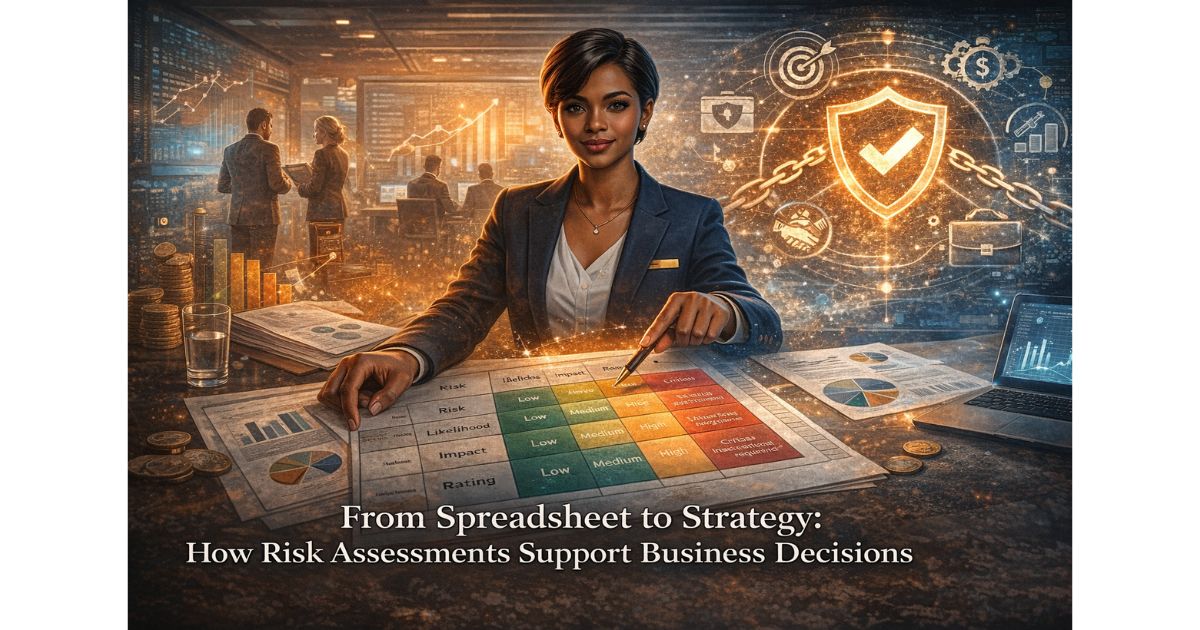
From Spreadsheet to Strategy: How Risk Assessments Support Business Decisions
Amara stared at the spreadsheet longer than she expected. Rows of risks.Columns for likelihood, impact, controls, ownership.Numbers that looked simple at first glance. But the more she worked through it, the more she realised something important: This wasn’t just documentation. It was a map of how a business could fail. And more importantly, how it could decide what to protect first. A Risk Assessment Is Not a Compliance Exercise Many people see risk assessments as: But when done properly, a risk assessment forces one hard question: What could hurt this business the most and are we prepared? That question shifts everything. Because risk is not technical first.It is business first. A vulnerability only becomes a risk when it threatens: That’s where strategy begins. When Numbers Turn Into Priorities In the spreadsheet, each risk had: On paper, it looked structured and calm. In reality, those numbers determine: This is where risk assessment becomes strategic. Because leadership does not act on fear.They act on prioritisation. A well-built risk assessment translates technical concerns into business language. The Power of Risk Ownership One column stood out to Amara more than the others: Risk Owner. This is where risk stops being abstract. When ownership is clear: Without ownership, risks sit in spreadsheets. With ownership, they enter conversations. And conversations drive strategy. Risk Appetite: The Silent Decision-Maker Another realisation came while scoring risks. Not all high risks are treated the same. Some are mitigated immediately.Some are monitored.Some are accepted. Why? Because every business has a risk appetite. A startup might accept more risk to move faster.A regulated company may tolerate far less. Risk assessment is not about eliminating all risk.It is about making conscious trade-offs. That’s strategy. Controls Are Investments Each risk in the spreadsheet required a decision: Controls cost time and money. So every mitigation choice is an investment decision. When risk assessments are done well, they help leadership answer: This is how GRC supports business objectives. Why This Matters in Tech Companies Tech companies move fast. New features.New integrations.New markets. Without structured risk visibility, growth creates blind spots. A risk assessment: It allows companies to scale without guessing. That’s not bureaucracy. That’s operational intelligence. From Spreadsheet to Strategy At first glance, a risk assessment looks like rows and formulas. But underneath, it represents: The spreadsheet is only the container. The real value is the thinking behind it. Risk assessments are not about filling templates. They are about helping organisations decide clearly and confidently what matters most. And that is where governance becomes strategy.

Why Good GRC Starts With Understanding How Work Really Happens
Amara followed the procedure. At least, she tried to. The manual said one thing.The situation in front of her was saying something else. There was pressure, limited time, and competing priorities. Everyone around her was doing their best to keep things moving safely. The procedure was not wrong but it was not written for this exact moment. In aviation, moments like this are taken seriously.Not to blame anyone, but to ask a better question: Is our governance aligned with real work? That question sits at the heart of good GRC. The Gap Between Work as Written and Work as Done Every organisation has policies, procedures, and rules.They describe how work should happen. But real work rarely follows a straight line. People: This is not carelessness.It is reality. In aviation, this gap is openly recognised. Procedures are reviewed, updated, tested, and adjusted based on how work actually happens not how it looks on paper. Good GRC works the same way. Why Policies Fail When They Ignore Reality Many security policies fail not because people don’t care, but because they don’t fit real workflows. When policies: people find ways around them. Not to be reckless but to get the job done. This is where GRC is often misunderstood. GRC is not about enforcing rules at all costs.It’s about designing governance that supports business objectives in the real world. Aviation Treats Procedures as Living System In aviation, procedures are not static documents. They are: If a procedure doesn’t work in practice, it’s the procedure that gets questioned not the person. This is governance done well. It recognises that: That mindset is powerful in cybersecurity. What This Means for GRC in Cybersecurity In cybersecurity, GRC sits between: To do that well, GRC must understand how work really happens across the organisation. That means: This is not weakness.This is good risk management. You cannot manage risks you don’t understand. Good GRC Translates Risk Into Real Action When GRC understands real work, it can: This is how GRC supports business goals. Just like aviation governance supports: GRC supports: Why This Perspective Matters Cybersecurity is becoming more complex every year. More tools.More alerts.More pressure on people. Without governance grounded in reality, security becomes fragile. But when GRC is built around how work actually happens, it becomes a strength not a burden. Why This Matters to Amara Coming from aviation, Amara learned early that safety is not created by perfect rules. It is created by: That’s why GRC feels familiar. At its best, GRC does not police people.It supports them. It connects governance to real work, real risks, and real business needs. And that is where good GRC always starts.