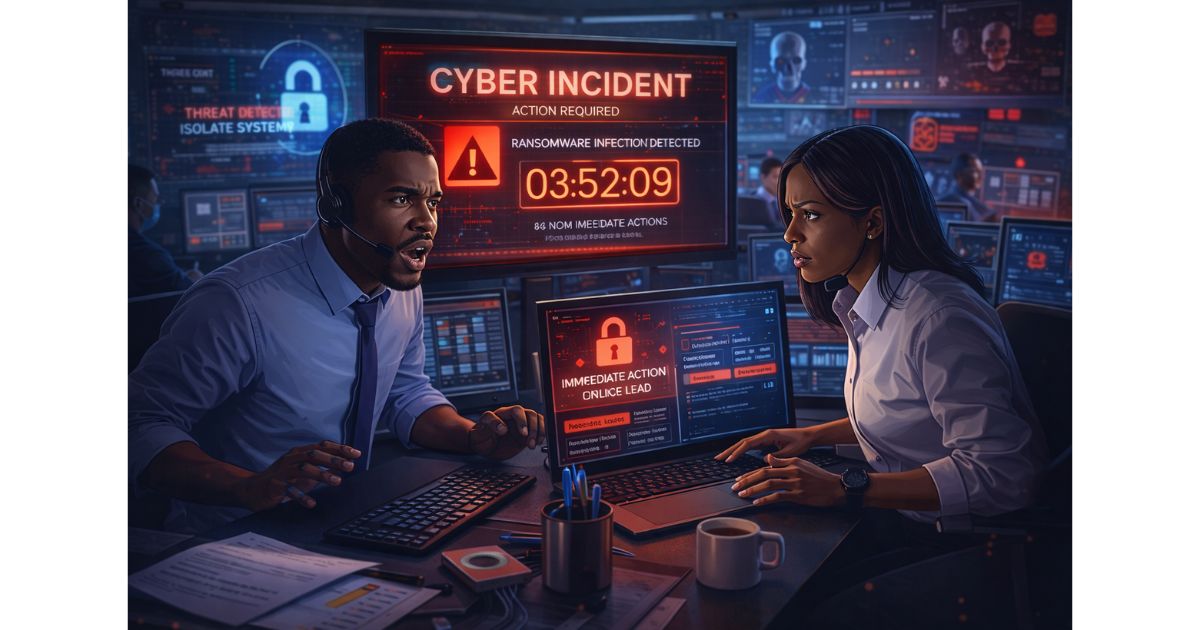
At 09:00 on a Monday morning, the security dashboard lit up with alerts.
Unusual network activity.
Multiple authentication failures.
Files suddenly becoming inaccessible.
Within minutes, the IT team realised something serious was happening. Systems that had worked perfectly the night before were now behaving unpredictably. Employees began reporting that shared folders would not open.
By 09:40, the first encrypted file appeared.
What had started as a strange technical glitch had now become a cybersecurity incident.
And the most important decisions had to be made quickly.
Because in cybersecurity, the first four hours often determine whether an incident becomes a contained disruption or a full-scale crisis.
Why the Early Hours Matter So Much
When people imagine cyberattacks, they often picture hackers typing lines of code in dark rooms. In reality, many attacks unfold quietly over time. Attackers may spend days or weeks inside a network before they are detected.
But once an incident becomes visible, the organisation enters a critical window of response.
These early hours are when teams must decide:
- whether systems should be shut down
- whether networks should be isolated
- whether backups should be activated
- whether regulators may need to be notified
- whether business operations must pause
Every one of these decisions carries risk.
Shutting down systems too early may disrupt operations unnecessarily. Waiting too long may allow attackers to spread further across the network.
In those first few hours, organisations are not just responding to technology.
They are responding to uncertainty.
Technology Detects Incidents. Humans Decide What Happens Next.
Modern cybersecurity tools are incredibly sophisticated. Security monitoring systems can detect anomalies across millions of network events. Artificial intelligence can flag suspicious behaviour faster than any human analyst.
But technology alone does not manage a cyber crisis.
People do.
When an incident begins, someone must decide:
- who leads the response
- which systems should be isolated
- how the incident should be communicated internally
- whether external security experts should be engaged
These decisions rarely happen in calm conditions.
They happen while teams are still trying to understand what is actually going on.
The pressure can be intense. Senior leadership wants answers. Employees want reassurance. Customers expect stability.
In these moments, the organisation is not just defending its network.
It is defending its ability to think clearly under pressure.
Communication Becomes the Real Battlefield
One of the most overlooked risks during cyber incidents is communication failure.
When teams operate in silos, confusion spreads quickly.
IT teams may focus on technical containment while business leaders worry about operational disruption. Legal teams may be considering regulatory obligations while communications teams prepare external statements.
Without clear coordination, even skilled teams can end up working against each other.
This is why mature organisations treat cybersecurity incidents as cross-departmental crises, not purely technical events.
Security teams must collaborate with:
- leadership and executive management
- legal and compliance teams
- communications and public relations teams
- operational departments
The speed and clarity of communication often determine whether the organisation regains control quickly or loses valuable time.
In aviation, this principle is deeply understood.
When something goes wrong in the cockpit, pilots rely on structured communication protocols to coordinate their response. Clear language, defined roles, and shared situational awareness prevent confusion during high-pressure moments.
Cybersecurity teams increasingly need the same kind of discipline.
The Hidden Risk: Decision Paralysis
During the early hours of a cyber incident, one of the greatest dangers is not making the wrong decision.
It is making no decision at all.
Teams may hesitate because they lack complete information. They may fear shutting down critical systems unnecessarily. They may hope the situation resolves itself.
But attackers rarely wait.
While teams debate their next steps, malicious software can spread across networks, escalate privileges, and exfiltrate data.
The organisations that recover fastest are not always the ones with the best technology.
They are the ones with the clearest decision frameworks.
Prepared organisations run incident simulations. They practice response scenarios. They define leadership roles before a crisis ever begins.
When incidents occur, they are ready to act.
Governance Is the Real Foundation of Incident Response
Strong incident response is not built in the moment of crisis.
It is built long before the incident begins.
Organisations that respond effectively usually have several governance elements already in place:
- defined incident response procedures
- clearly assigned leadership roles
- communication protocols across departments
- tested backup and recovery processes
- regular cybersecurity incident exercises
These structures provide guidance when uncertainty appears.
Without them, teams are forced to improvise under pressure.
And improvisation during a cyber crisis can be dangerous.
The Human Side of Cybersecurity
Many discussions about cybersecurity focus on tools, technologies, and vulnerabilities.
But behind every cyber incident is a series of human decisions.
Someone decides whether a suspicious alert is investigated.
Someone decides whether a system is isolated from the network.
Someone decides how the organisation communicates with employees and customers.
Cybersecurity is not only about protecting systems.
It is about enabling people to respond intelligently when systems fail.
The organisations that handle incidents best are not those that never experience attacks.
They are the ones that have built cultures of preparedness, accountability, and coordinated decision-making.
Because when a cyber incident begins, technology may raise the alarm.
But it is human judgement that determines the outcome.