
If you are new to cybersecurity, you have probably heard the term “cybersecurity risks” thrown around a lot.
But what does it actually mean?
Let’s break it down in the simplest way possible.
What Is a Cybersecurity Risk?
A cybersecurity risk is:
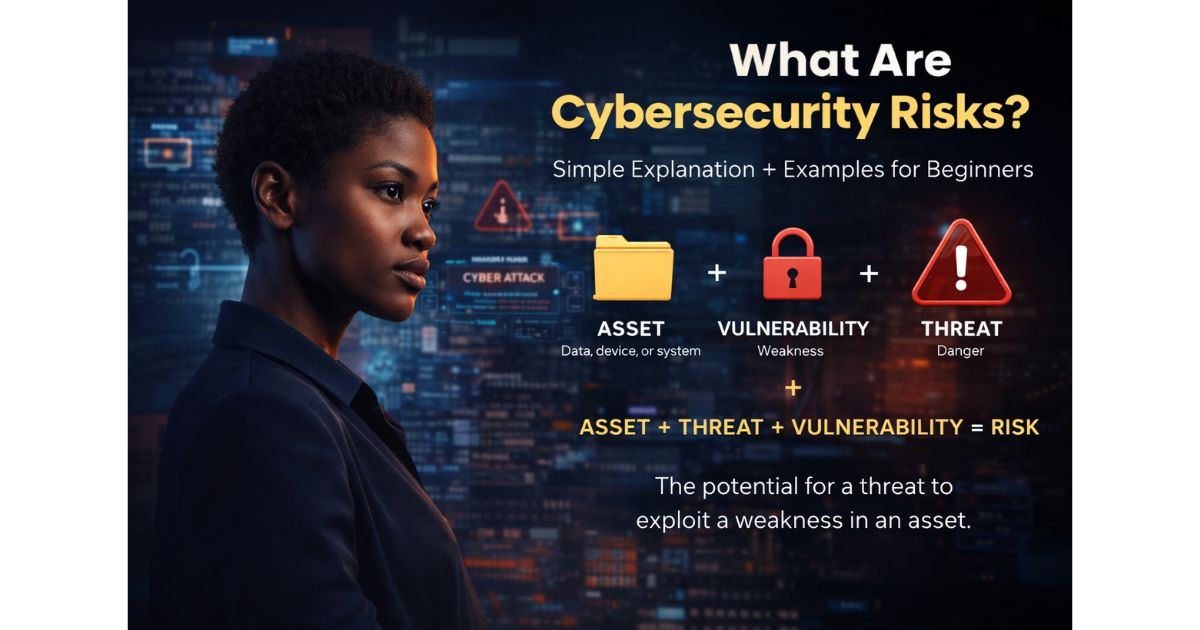
The possibility that a threat can exploit a vulnerability in an asset and cause harm.
To truly understand this, you need to know three key things:
- Asset → What you are trying to protect (data, systems, devices)
- Threat → Anything that can cause harm (hackers, malware, human error)
- Vulnerability → A weakness that can be exploited (weak passwords, outdated systems)
So in simple terms:
Asset + Threat + Vulnerability = Risk
If there is no asset, there is nothing to protect so there is no risk.
Think of It Like This
Imagine your house:
- Your house = Asset
- An unlocked door = Vulnerability
- A thief = Threat
The chance that the thief enters your house through the unlocked door = Risk
Common Types of Cybersecurity Risks (With Examples)
Let’s look at real-life examples so it becomes clear.
1. Weak Passwords
Asset: Your email or bank account
Vulnerability: Simple password like 123456
Threat: Hackers using password-cracking tools
Risk: Your account gets accessed and sensitive information is stolen
2. Phishing Attacks
Asset: Your personal or financial information
Vulnerability: Trusting fake emails or links
Threat: Cybercriminals pretending to be legitimate organizations
Risk: You unknowingly give away your login details
3. Malware (Viruses)
Asset: Your computer or smartphone
Vulnerability: Downloading from untrusted sources
Threat: Malicious software
Risk: Your data is stolen or your system is damaged
4. Third-Party (Vendor) Risk
Asset: Company or customer data
Vulnerability: Weak security in a vendor’s system
Threat: Attackers targeting that vendor
Risk: Your data is exposed through another company
5. Unsecured Data
Asset: Sensitive files (customer data, personal records)
Vulnerability: No encryption or access control
Threat: Unauthorized users or attackers
Risk: Anyone can access or leak the data
Why Cybersecurity Risks Matter
Cybersecurity risks are not just technical problems they affect real lives and businesses.
They can lead to:
- Financial loss
- Data breaches
- Reputational damage
- Legal consequences
For individuals, this could mean identity theft.
For businesses, it could mean losing millions.
How Can You Reduce Cybersecurity Risks?
You don’t need to be a tech expert to start protecting yourself.
Here are simple steps you can take:
- Use strong, unique passwords
- Enable two-factor authentication (2FA)
- Be cautious with emails and links
- Keep your software updated
- Avoid downloading from unknown sources
On a final note
Cybersecurity risks are everywhere but they become easier to understand when you break them down.
Always remember:
No asset = no risk
Risk exists when a threat can exploit a vulnerability in something valuable
And if you are planning to study or transition into cybersecurity, this is something you must understand early:
Cybersecurity is not just about tools or hacking it starts with risk management.
If you don’t understand risk, you won’t understand what you’re trying to protect or why it matters.
That’s why risk management is the foundation of careers in GRC, data privacy, and cybersecurity.