When Payroll Stops: Lessons From a Ransomware Incident That Started With a Trusted Vendor
At 08:15 on a Monday morning, the finance team noticed something strange.
The payroll system would not load.
At first, it looked like a simple outage. Systems fail sometimes. Servers reboot. IT fixes it.
But within minutes, it became clear this was not a routine problem.
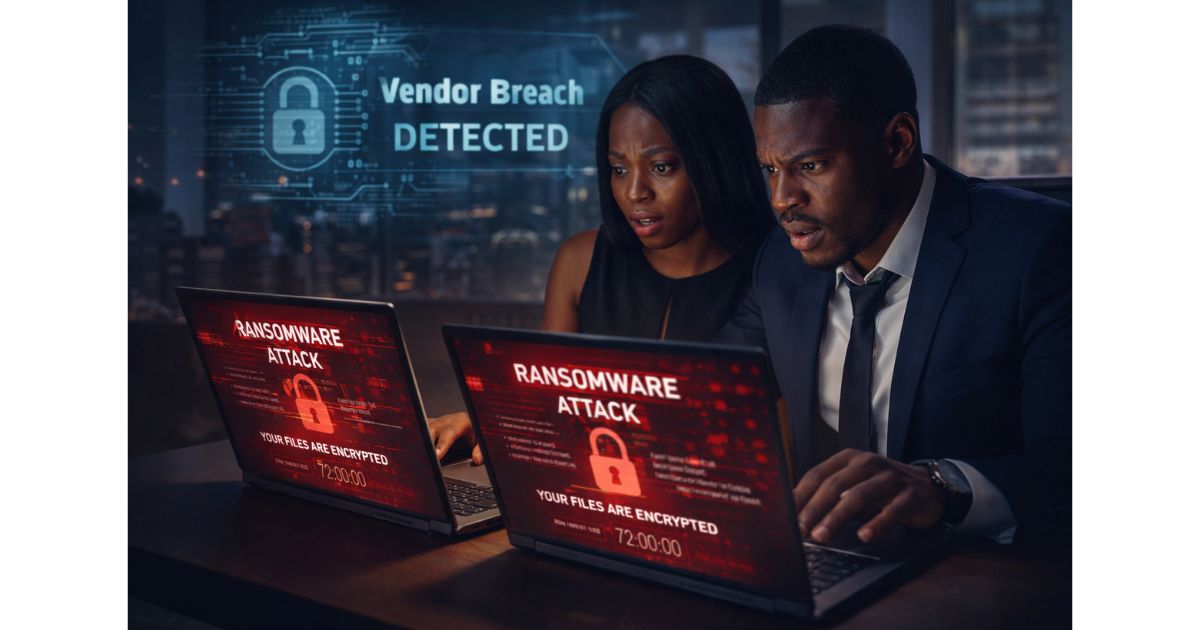
Files across the finance server had been renamed. Critical payroll data was inaccessible. A message appeared on the screen demanding payment to restore access.
What had started as a small technical issue was now a Severity 1 cybersecurity incident.
And the most unsettling discovery came next.
The attack did not begin inside the organisation.It started with a trusted third-party vendor.
The Invisible Door Attackers Walk Through
The organisation relied on a financial software provider to manage payroll processing and financial reporting. The system had been trusted for years. It handled sensitive employee data and critical operational functions.
But trust in technology can create blind spots.
Unknown to the company, the vendor’s software supply chain had been compromised. Attackers exploited a vulnerability in the vendor’s update mechanism, embedding ransomware into a routine software update.
Once installed inside the organisation’s environment, the malicious code began spreading silently.
By the time employees noticed something was wrong, the ransomware had already encrypted multiple systems.
The attackers never had to break down the company’s front door.
They simply walked through a door that had already been opened by a trusted supplier.
This kind of incident is becoming increasingly common in modern cybersecurity. Supply-chain attacks have shown that organisations are often only as secure as the vendors they depend on.
The breach itself was technical.
But the underlying problem was governance.
The First Four Hours That Decide Everything
When a cyber incident begins, the first few hours often determine whether the damage spreads or is contained.
In this case, the organisation activated its incident response process immediately.
The response team initiated several critical actions:
- isolating affected systems from the network
- preserving forensic evidence
- assessing the spread of ransomware
- coordinating with internal stakeholders and external security experts
Communication became just as important as technical containment.
Executives needed to understand the potential business impact. Finance teams needed clarity on payroll delays. Legal teams needed to evaluate regulatory obligations.
Cybersecurity incidents rarely affect only one department.
They ripple across the entire organisation.
During these early hours, leadership decisions matter just as much as technical expertise. Poor communication can amplify confusion. Delayed decisions can allow attacks to spread further.
In crisis moments, cybersecurity becomes less about technology and more about people coordinating under pressure.
When Cybersecurity Becomes a Business Crisis
The ransomware attack did more than disrupt IT systems.
It threatened core business operations.
Payroll systems store some of the most sensitive data in any organisation: employee identities, salaries, bank details, tax records. If compromised, the consequences can extend far beyond operational disruption.
The organisation now faced multiple risks at once.
Financial operations were interrupted.
Employee payments were uncertain.
Sensitive data exposure was a real possibility.
And if personal data had been compromised, the organisation might be required to notify regulators under the General Data Protection Regulation, which requires organisations to report certain data breaches within strict timeframes.
What started as a ransomware attack had quickly evolved into a potential regulatory and reputational crisis.
This is why cybersecurity leaders increasingly emphasise a simple truth:
Cybersecurity incidents are rarely just IT problems.
They are business continuity problems.
The Vendor Risk Most Organisations Underestimate
The most important lesson from this incident was not about ransomware.
It was about third-party risk.
Modern organisations rely on dozens, sometimes hundreds, of external software providers. Each vendor introduces a potential entry point into the organisation’s systems.
Yet vendor security often receives far less scrutiny than internal infrastructure.
Questions that should be asked frequently are often overlooked:
How secure are the vendor’s update mechanisms?
How are software patches verified before installation?
What monitoring exists for abnormal behaviour after system updates?
Without strong governance around vendor risk management, organisations may unknowingly inherit vulnerabilities from the partners they trust the most.
Incidents like this demonstrate that cybersecurity is no longer confined within organisational boundaries.Security now extends across entire digital supply chains.
A Lesson From Aviation Safety
This incident reminded me of something deeply embedded in aviation safety culture.
In aviation, incidents are rarely blamed on a single failure.
Investigators look for systemic causes.
Was there a process gap?
Was communication unclear?
Was a critical risk underestimated?
Cybersecurity incidents often follow the same pattern.
The ransomware itself may have been the trigger, but the real issue lies deeper: governance, oversight, and risk awareness.
Just as aviation learned that safety requires coordination across pilots, maintenance teams, regulators, and manufacturers, cybersecurity now requires coordination across organisations, vendors, and technology providers.
Security is not simply about building stronger technical defenses.
It is about building stronger systems of accountability.
The Real Question Organisations Should Ask
When organisations analyse cyber incidents, the focus often remains on the attacker.
How did they gain access?
What vulnerability did they exploit?
How can we block it next time?
Those are important questions.
But a more powerful question may be this:
What assumptions allowed this incident to happen?
In this case, the assumption was trust.
Trust in a vendor.
Trust in software updates.
Trust that someone else had already handled the risk.
Cybersecurity incidents often expose the invisible assumptions embedded in organisational systems.
And when those assumptions break, the consequences can ripple across an entire business.
The Future of Cybersecurity Is Human-Centered
As cyber threats grow more complex, one lesson is becoming clearer.
Technology alone cannot solve cybersecurity.
Behind every vulnerability is a decision.
Behind every incident is a process.
Behind every breach is a system of human choices.
The future of cybersecurity will not only depend on better tools or stronger encryption.
It will depend on organisations learning to see security as a shared responsibility across people, processes, and partners.
Because sometimes the most dangerous vulnerability is not hidden in code.
It is hidden in the systems we trust without questioning.