
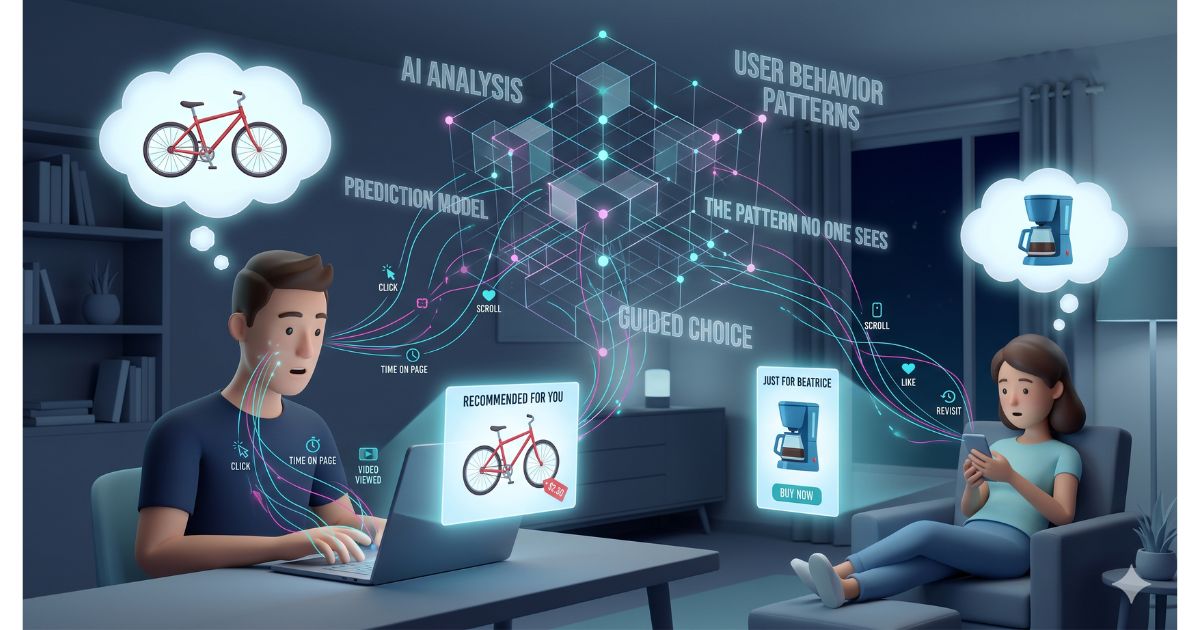
Beatrice didn’t search for it.
She didn’t type it.
She didn’t say it out loud.
But there it was.
An ad appeared on her screen.
Exactly what she had been thinking about the night before.
Same product. Same style. Even the same color.
She paused.
How did it know?
The Pattern No One Sees
Beatrice hadn’t searched for the item directly.
But over the past few days, she had:
- clicked on similar products
- spent a few extra seconds on certain pages
- watched a short video related to it
- scrolled past a few posts without realising
Individually, these actions felt meaningless.
But together, they told a story.
Not to her.
But to the system.
What Online Behaviour Really Means
Every time you use the internet, you leave small signals behind.
Things like:
- what you click
- how long you stay on a page
- what you ignore
- what you come back to
These signals may seem random.
But to AI systems, they are patterns.
And patterns can be learned.
When Data Becomes Prediction
AI doesn’t just collect information.
It studies behaviour.
Over time, it begins to understand:
- what you like
- what you might need
- what you’re likely to do next
In Beatrice’s case, the system didn’t need her to search.
It already had enough data to predict her interest.
The Quiet Shift
At first, this feels helpful.
Better recommendations.
More relevant content.
Less time searching.
But something changes.
Instead of you deciding what to explore…
The system starts deciding what to show you.
And slowly, your choices begin to narrow.
The Hidden Risk
Beatrice didn’t realise it, but her online experience was being shaped.
Not forced.
Just guided.
The more she interacted, the more the system learned.
And the more it learned, the more it influenced.
This creates a subtle shift:From user control
To system influence
Why This Matters
This isn’t just about ads.
It affects:
- what information you see
- what products you consider
- what decisions you make
AI systems are designed to predict behaviour.
But prediction can become influence.
And influence can affect outcomes.
A Question of Control
Beatrice wasn’t being watched in the way she imagined.
But her behaviour was being observed, analysed, and used.
Not to harm her.
But to understand her.
The question is: How much of your decisions are truly yours… and how much are being shaped for you?
A Cybersecurity and GRC Perspective
This is where things connect to cybersecurity and governance.
Because it’s not just about data collection.
It’s about:
- how data is used
- how decisions are influenced
- who is accountable for that influence
In GRC, this raises important concerns:
- transparency
- ethical use of data
- user awareness
- control over personal information
On A Final Note
Beatrice eventually clicked on the ad.
It was exactly what she wanted.
Or at least… what she thought she wanted.
AI didn’t force her decision.
It simply understood her well enough to guide it.
If you’re starting your journey in cybersecurity, this is something to remember:
Data is not just collected
It is used to predict, influence, and shape behaviour
Because sometimes, the most powerful systems don’t control what you do.
They simply make sure you see exactly what they want you to choose.