
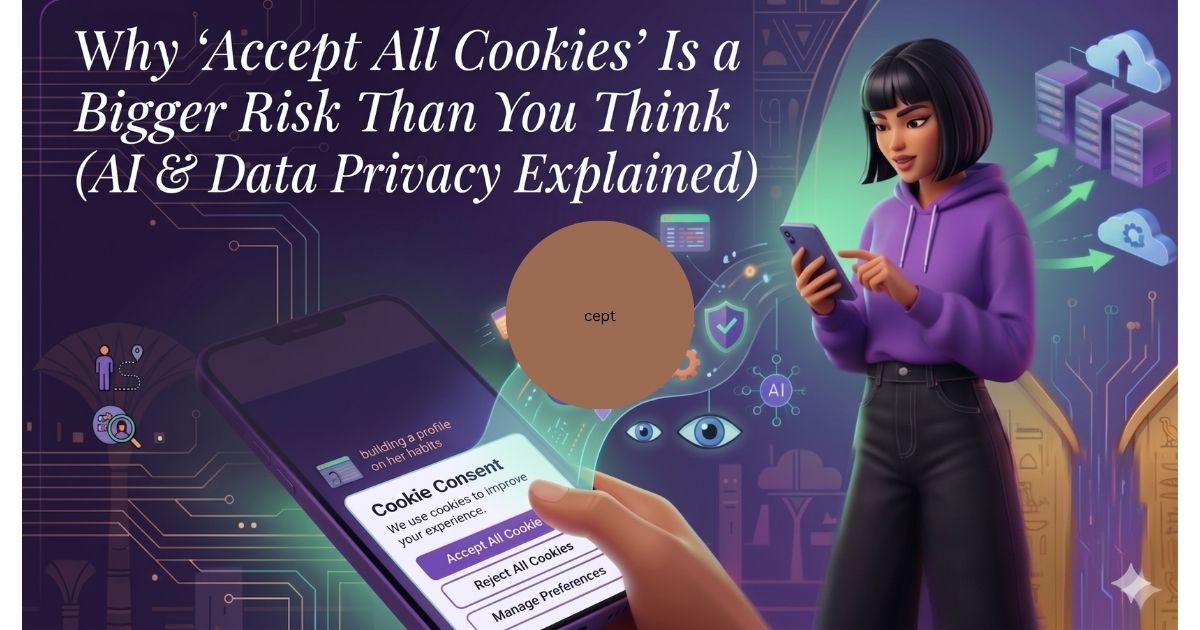
Beatrice didn’t even pause.
The pop-up appeared at the bottom of the screen:
“We use cookies to improve your experience.”
Two options.
Accept All
Manage Preferences
She clicked Accept All without thinking and continued scrolling.
It was quick. Easy. Harmless… or so it seemed.
A few days later, something felt different.
The ads she saw were unusually specific.
The content recommendations felt almost too accurate.
Even the products suggested matched things she had only thought about briefly.
It was as if the internet was watching her.
In a way, it was.
The Click That Feels Too Small to Matter
Most people think cybersecurity risks come from big actions:
- downloading suspicious files
- clicking strange links
- using weak passwords
But sometimes, the risk begins with something much smaller.
Something we barely notice. Like clicking “Accept All Cookies.”
What Cookies Actually Do (Simple Explanation)
Cookies are small pieces of data stored on your device when you visit a website.
They help websites remember things like:
- your login details
- your preferences
- your activity
On their own, cookies are not always harmful.
But when combined and shared across platforms, they begin to tell a story.
Your story.
What “Accept All” Really Means
When Beatrice clicked “Accept All,” she didn’t just accept one thing.
She gave permission for:
- tracking her activity across websites
- collecting her browsing behaviour
- sharing data with third parties
- building a profile based on her habits
And most importantly…
She allowed this data to be used in ways she didn’t fully understand.
Where AI Comes In
This is where things become more complex.
Cookies don’t just store data.
They feed AI systems.
AI uses this data to:
- predict what you might like
- personalise your experience
- influence what you see
- make decisions about your behaviour
Over time, these systems begin to understand patterns:
- what you click
- how long you stay
- what you ignore
And slowly, a digital version of you is created.
Not who you are.
But who the system thinks you are.
The Hidden Risk
Beatrice never saw this happening.
There was no alert. No warning.
Just a better “user experience.”
But behind the scenes:
- her data was being collected continuously
- her behaviour was being analysed
- her preferences were being shaped
The risk isn’t just that data is collected.
It is that control is quietly given away.
What Most People Don’t Realise
When people click “Accept All,” they assume:
It is just for this website.
But in reality, the data can travel.
It can be:
- shared with advertisers
- used across platforms
- combined with other data sources
This creates a much bigger picture than most people expect.
Where Data Privacy Comes In
This is why data protection laws like the General Data Protection Regulation (GDPR) exist.
They are designed to ensure that:
- users understand what they are agreeing to
- organisations are transparent about data use
- individuals have control over their information
In theory, Beatrice had a choice.
She could have:
- managed her preferences
- limited tracking
- controlled how her data was used
But like many people, she chose convenience.
A Familiar Pattern
Beatrice’s story is not unusual.
It happens every day.
A small decision.
A quick click.
A moment of convenience.
And over time, those small actions build something much bigger.
On A Final Note….
Clicking “Accept All Cookies” doesn’t feel like a cybersecurity decision.
But in today’s world, it is.
Because data is no longer just information.
It’s influence.
It’s prediction.
It’s power.
And understanding how it’s used is one of the most important steps in protecting yourself.
If you’re starting your journey in cybersecurity, remember this:
Not all risks look dangerous
Some look like convenience