
Beatrice settled into her jumpseat as passengers finished boarding. The cabin doors were closed, the safety demonstration had been completed, and the aircraft was almost ready to push back. From where she sat, everything looked routine. Passengers rarely see what happens behind the scenes before a flight departs. They don’t see engineers inspecting the aircraft. They don’t hear the conversations between pilots and dispatchers. They don’t watch operations teams monitoring weather, aircraft availability, crew schedules, and airport conditions all at once. Every safe flight depends on hundreds of decisions made long before passengers buckle their seatbelts. As airlines embrace Artificial Intelligence, another question naturally follows. Can AI make flying safer? The answer is yes, but not because AI replaces aviation professionals. It makes flying safer by helping people make better informed decisions, identify potential risks earlier, and process vast amounts of information faster than humans can alone. However, AI should never operate without oversight. That is where AI Governance plays one of the most important roles in the future of aviation. How AI Is Helping Improve Aviation Safety Artificial Intelligence is becoming part of everyday airline operations. Rather than replacing people, it acts as a powerful assistant that continuously analyses data and identifies patterns that might otherwise go unnoticed. Here are some ways airlines are already using AI to improve safety and operational efficiency. Identifying Potential Maintenance Issues Earlier Modern aircraft generate enormous amounts of operational data during every flight. When this information is combined with historical maintenance records, AI can identify unusual patterns that may suggest an aircraft component requires closer inspection. Instead of waiting for a fault to become more serious, maintenance teams receive an early alert that something deserves attention. The final inspection and maintenance decision always belongs to qualified engineers. AI simply provides another layer of operational awareness. Supporting Better Weather Decisions Weather remains one of aviation’s biggest challenges. Storms, turbulence, strong winds, and poor visibility can affect flight safety. AI can analyse weather forecasts together with historical flight information and operational data to help airlines prepare for possible disruptions. Pilots and dispatchers still make the final operational decisions, but AI provides valuable insights that support those choices. Improving Crew Scheduling Fatigue is one of the most important safety considerations in aviation. Airlines must ensure pilots and cabin crew receive adequate rest before operating flights. AI can help analyse complex crew schedules, legal duty limits, aircraft availability, and operational disruptions to identify more efficient scheduling options. Operations controllers then review those recommendations before implementing any changes. Monitoring Operational Risks Every day, airlines manage thousands of moving parts. Aircraft. Passengers. Crew. Airports. Weather. Connecting flights. AI helps operations centres identify potential risks earlier, giving teams more time to respond before small issues become major disruptions. Can AI Replace Human Judgement? No. And it should not. Artificial Intelligence is excellent at analysing large volumes of data. Humans remain better at applying judgement, experience, ethics, and accountability. Imagine an AI system identifies a potential issue with an aircraft based on operational data. Should the flight automatically be cancelled? Of course not. Qualified engineers investigate the alert. Pilots review the situation. Operations teams assess the impact. Only then is a decision made. This partnership between people and technology is what makes aviation stronger. Why AI Governance Matters in Aviation As more airlines adopt AI, another important question emerges. How can airlines trust the AI systems they use? This is where AI Governance becomes essential. AI Governance establishes the policies, oversight, and accountability needed to ensure AI operates responsibly. Instead of asking only whether AI is intelligent, AI Governance asks whether AI is trustworthy. Questions such as: These questions are becoming increasingly important as airlines adopt more intelligent technologies. AI Is Only as Good as the Data It Uses One lesson I have learned while studying AI Governance is this: AI cannot produce reliable outcomes without reliable data. If an AI system receives inaccurate, incomplete, or outdated information, its recommendations may also be inaccurate. This is why Data Governance is just as important as AI Governance. Data Governance helps ensure that the information AI relies on is accurate, consistent, secure, and properly managed. Without good data, even the most advanced AI system cannot perform effectively. Why Human Oversight Will Always Matter One of the biggest myths about Artificial Intelligence is that it can make every decision independently. In aviation, that would never be acceptable. Airline safety depends on accountability. Someone must always be responsible for the final decision. AI can recommend. Humans decide. This principle protects passengers while allowing airlines to benefit from AI’s speed and analytical capabilities. Human oversight remains one of the foundations of responsible AI. The Future of Aviation Will Be Human and AI Together The future of aviation is not about replacing pilots, engineers, cabin crew, or operations controllers. It is about giving them better tools. AI can analyse millions of data points in seconds. People contribute experience, judgement, ethics, communication, and accountability. Together, they create safer and more efficient airline operations. As AI continues to evolve, airlines that combine intelligent technology with strong AI Governance and Data Governance will be better positioned to earn passenger trust and improve safety. Why This Matters to Every Passenger Most passengers will never see AI working behind the scenes. They simply experience the outcome. A smoother journey. Fewer disruptions. Better communication. More efficient operations. Behind those improvements are people using AI responsibly, supported by governance frameworks that ensure technology remains transparent, accountable, and aligned with safety standards. The safest future for aviation is not one where AI replaces humans. It is one where AI helps humans make better decisions. On A Final Note The next time you board a flight, remember that safety begins long before the aircraft leaves the gate. Behind every departure are skilled professionals making countless decisions to keep passengers safe. Increasingly, they are supported by Artificial Intelligence that can analyse information faster, identify potential risks earlier, and provide valuable insights. Yet technology alone is not
Can AI Help Prevent Flight Delays? Here is How Airlines Are Using Predictive Intelligence
Imagine this. Beatrice had just arrived at the airport for what she thought would be another routine flight. The departure boards were full of green “On Time” notifications, and passengers were already gathering at the boarding gate. Suddenly, one of the engineers walked past with a smile and said to a colleague, ‘Good thing the system flagged that issue yesterday. If it hadn’t, this aircraft might not have departed on time today.‘ Beatrice paused. ‘The system?’ She later discovered they were not talking about a person. They were talking about Artificial Intelligence. Not the kind of AI that flies an aircraft. Not the kind that replaces pilots or engineers. But an intelligent system that helps airlines spot patterns, predict potential problems, and make better operational decisions before those problems become costly delays. It made her wonder. Could AI actually help prevent flight delays before they happen? The answer is yes. But probably not in the way most people imagine. Why Do Flights Get Delayed? Most passengers assume every delay has the same cause. In reality, airlines deal with hundreds of variables every day. A flight could be delayed because of: Each delay affects the next flight, creating a chain reaction across an airline’s network. This is where predictive intelligence is becoming increasingly valuable. What Is Predictive Intelligence? Predictive intelligence uses Artificial Intelligence together with historical and real time data to identify patterns and estimate what is likely to happen next. Think of it like a weather forecast. A weather app cannot guarantee it will rain tomorrow. But by analysing years of weather data together with current conditions, it can make a reliable prediction. Airlines use similar technology. Instead of predicting rain, AI predicts operational risks that could disrupt flights. How Airlines Use AI to Reduce Flight Delays AI is not making decisions on its own. Instead, it acts like another member of the operations team, constantly analysing information that humans would struggle to process quickly. Here are some of the ways AI supports airline operations. Predicting Maintenance Needs Modern aircraft generate enormous amounts of operational data. Combined with maintenance records entered by engineers, AI can identify patterns suggesting that certain components may soon require inspection or replacement. This does not mean the aircraft is unsafe. It simply alerts maintenance teams that something deserves closer attention. Engineers then inspect the aircraft and decide what action, if any, should be taken. Think of AI as an early warning system rather than a mechanic. Supporting Crew Scheduling Airlines manage thousands of crew movements every day. Unexpected disruptions such as weather, delays, or crew illness can quickly affect schedules. AI can analyse available crew, legal duty time limits, aircraft availability, and flight schedules to suggest efficient solutions. However, airline operations teams still review those recommendations before making final decisions. Monitoring Weather Patterns Weather remains one of aviation’s biggest challenges. AI can analyse weather forecasts alongside historical flight data to identify routes that may experience disruption. This gives airlines more time to prepare alternative plans. Although AI provides useful insights, experienced dispatchers and operational teams remain responsible for making safety related decisions. Managing Airport Operations Large airports handle thousands of flights daily. AI can help airlines predict periods of heavy congestion, allowing operations teams to adjust gate assignments, turnaround planning, and ground handling activities more efficiently. Small improvements across multiple areas can reduce unnecessary delays. Does AI Eliminate Flight Delays? No. Some delays simply cannot be avoided. Thunderstorms. Snow. Air traffic restrictions. Medical emergencies. Unexpected technical issues. These situations will always require human judgement. AI cannot control the weather. It cannot remove every operational challenge. What it can do is help airlines prepare earlier and respond more effectively. Why Human Expertise Still Matters As Beatrice continued learning about AI in aviation, one thing became clear. Every prediction begins with human expertise. Engineers record maintenance findings. Pilots submit technical reports. Operations teams document delays. Ground staff provide operational updates. Without accurate human input, AI would have very little meaningful information to analyse. The predictions are only as reliable as the data people provide. This is why experienced aviation professionals remain central to every AI supported decision. Where AI Governance Fits In As airlines adopt more AI powered systems, another important question emerges. How can airlines trust the AI making these predictions? This is where AI Governance becomes essential. AI Governance helps airlines establish rules and oversight for responsible AI use by asking questions such as: AI Governance is not about replacing operational expertise. It is about ensuring AI supports safe, transparent, and accountable decision making. The Future of Aviation Is Collaborative The future of aviation is not humans competing against Artificial Intelligence. It is humans working alongside it. AI processes millions of data points in seconds. Engineers apply decades of technical expertise. Operations teams understand the bigger operational picture. Pilots make critical safety decisions. Together, they create a smarter and more resilient aviation system. On A Final Note Every delayed flight tells a story. Sometimes it is the weather. Sometimes it is maintenance. Sometimes it is an operational challenge that no one could have predicted. But thanks to Artificial Intelligence and predictive intelligence, airlines are becoming better at identifying potential disruptions before they grow into bigger problems. AI is not replacing aviation professionals. It is becoming another tool that helps them make faster, better informed decisions. And perhaps that is the future of aviation. Not aircraft that think for themselves. But intelligent systems working alongside skilled professionals to keep passengers moving safely, efficiently, and on time.
How AI Is Predicting Aircraft Maintenance Before Problems Happen
Why the Future of Aviation Still Depends on Human Engineers Beatrice had just settled into her jumpseat after passengers boarded when she noticed two aircraft engineers standing beneath the wing. One of them looked at a tablet while the other nodded thoughtfully. ‘There it is again,’ one engineer said. ‘What?’ Beatrice asked as she walked past. “The system flagged this aircraft this morning.” She looked puzzled. ‘But nothing is broken.’ The engineer smiled. ‘Exactly.’ That conversation stayed with her long after the flight. How could an aircraft know something needed attention before anything had actually gone wrong? As she continued learning about Artificial Intelligence and AI Governance, she discovered something fascinating. The aircraft was not predicting the future. Neither was the AI. The prediction came from years of engineering knowledge, maintenance records, aircraft sensor data, and human expertise working together. AI was simply helping engineers notice patterns much earlier. Can AI Really Predict Aircraft Problems? The answer is yes, but probably not in the way most people imagine. AI does not magically know that an aircraft component will fail tomorrow. Instead, AI analyses enormous amounts of information collected over time. This information may include: From these patterns, the AI can identify components that may soon require attention. Think of it as an intelligent early warning system. AI Does Not Replace Aircraft Engineers One of the biggest misconceptions about AI in aviation is that it replaces engineers. It doesn’t. As Beatrice learned more, she realised the engineers remain at the centre of every maintenance decision. The AI system simply gives them another source of information. Imagine your phone reminding you that your battery health is declining. Your phone doesn’t replace the technician. It simply alerts you before the battery becomes a bigger problem. Aircraft AI works in a similar way. Think of AI as an Alarm Clock One engineer explained it perfectly. ‘AI is like my alarm clock.’ The alarm doesn’t get you ready for work. It doesn’t brush your teeth. It doesn’t drive you to the office. It simply tells you it’s time to pay attention. That is exactly how many AI systems support aircraft maintenance. They alert engineers when data suggests something deserves closer inspection. The engineer then decides: The AI recommends. The engineer decides. Where Do These Predictions Come From? The predictions don’t appear out of nowhere. They are built on information that engineers and aircraft systems provide over time. Every inspection… Every maintenance check… Every replaced component… Every recorded fault…adds valuable information. The more high quality data available, the better the AI becomes at identifying patterns. Without engineers documenting their work accurately, the AI would have far less to learn from. In many ways, the engineers are teaching the AI. Why Human Oversight Still Matter Suppose an AI system flags an aircraft engine for inspection. Does that automatically mean the engine must be replaced? No. Experienced engineers still examine the aircraft. They inspect the component. They review maintenance records. They perform additional tests where necessary. Only after evaluating all available information do they make the final decision. This human oversight is one of aviation’s greatest strengths. AI supports safety. It does not replace professional judgement. Where AI Governance Fits In As Beatrice continued studying AI Governance, she realised something important. AI Governance is not about telling engineers how to repair aircraft. It is about ensuring AI systems are used responsibly. For aircraft maintenance, AI Governance asks questions such as: These questions help organisations build AI systems that engineers can trust. Better Planning, Not Just Better Safety One benefit of AI-powered maintenance is planning ahead. If the system identifies that a component is approaching the end of its service life, airlines can prepare. Maintenance teams can: Instead of reacting after something fails, engineers can prepare before it becomes an operational issue. AI and Engineers Are Better Together As Beatrice reflected on that conversation beneath the aircraft wing, she realised AI was not replacing engineers. It was helping them become even more proactive. The engineers contributed the expertise. The maintenance records provided the history. The aircraft generated operational data. The AI analysed patterns. Together, they formed a smarter maintenance process. Not because AI was making the final decision. But because it was helping humans make better informed ones. On A Final Note Artificial Intelligence is changing aviation in remarkable ways. From customer service and crew scheduling to predictive maintenance, AI is helping airlines become more efficient and proactive. But behind every intelligent system are skilled professionals who interpret the information, apply their expertise, and make the final decision. Perhaps the best way to think about AI in aircraft maintenance isn’t as a replacement for engineers. It is as their alarm clock. Quietly working in the background. Watching patterns. Raising an alert when something deserves attention. And helping keep the skies even safer.
AI vs Automation: What is the Difference?
A Beginner’s Guide to Understanding Two Technologies That Are Transforming the Workplace Beatrice smiled as she watched a short video online. It showed a robot sorting packages inside a warehouse. The caption read: “Artificial Intelligence is replacing human workers.” A few minutes later, she watched another video showing an automatic supermarket checkout. Again, people in the comments called it AI. Then she saw a coffee machine that prepared drinks at the press of a button. Someone called that AI too. By the end of the day, Beatrice was confused. Is everything automated considered Artificial Intelligence? she wondered. As she continued learning AI Governance, she discovered something many beginners misunderstand. Automation and Artificial Intelligence are not the same thing. They often work together, but they solve different problems. Understanding the difference is becoming increasingly important as organisations adopt more intelligent technologies. What Is Automation? Automation is the use of technology to perform repetitive tasks without constant human involvement. The important thing about automation is that it follows predefined rules. It does exactly what it has been programmed to do. Nothing more. Nothing less. Examples of automation include: Automation makes work faster by repeating the same task consistently. It does not learn. It does not adapt. It simply follows instructions. What Is Artificial Intelligence? Artificial Intelligence goes a step further. Instead of simply following instructions, AI analyses information, identifies patterns, and makes predictions based on data. Unlike traditional automation, AI can improve its responses as it processes more information. Examples include: AI attempts to perform tasks that normally require human intelligence. The Difference Is Easier Than You Think As Beatrice continued studying, she found a simple way to remember the difference. Imagine making a cup of tea. An automated kettle boils water when you press the button. It follows one instruction. That is automation. Now imagine an AI assistant that notices you usually drink tea at 7 a.m. It reminds you before you ask. It suggests a different tea because the weather is cold. It automatically orders more tea bags when you’re running low. That is Artificial Intelligence. Automation follows rules. AI learns patterns. AI and Automation Often Work Together One of the biggest surprises for Beatrice was discovering that organisations rarely choose between AI and automation. Instead, they combine both. For example, in aviation: Automation can: Artificial Intelligence can: Automation completes repetitive tasks. AI helps make smarter decisions. Together, they improve efficiency across airline operations. Why This Difference Matters Many businesses are investing heavily in Artificial Intelligence. However, not every business problem requires AI. Sometimes simple automation is enough. Using AI where automation would work perfectly may increase costs and complexity without providing additional value. Understanding the difference helps organisations make better technology decisions. Where AI Governance Comes In As Beatrice learned more about AI Governance, she realised another important distinction. Automation usually follows predictable rules. AI systems can learn, adapt, and produce different outputs depending on the data they receive. That creates new risks. Organisations using AI must think about: These governance considerations are far less complex with traditional automation. This is why AI Governance has become such an important field. It helps organisations ensure AI systems are used responsibly while managing the risks that intelligent technologies introduce. Will AI Replace Automation? Not necessarily. Automation has existed for decades. Artificial Intelligence is making automation more intelligent rather than replacing it completely. Many organisations now use intelligent automation, where AI and automation work together. For example: An automated system may process customer requests. An AI system then analyses those requests, identifies patterns, and recommends improvements. Together they create faster, smarter workflows. What This Means for the Future of Work As AI continues to evolve, understanding the difference between AI and automation is becoming an important digital skill. Whether you work in aviation, healthcare, finance, education, cybersecurity, or business, these technologies will increasingly become part of everyday operations. Learning the basics today will help you understand the opportunities and challenges they bring tomorrow. On A Final Note As Beatrice closed her notebook after another evening of studying, she realised something important. Automation and Artificial Intelligence are partners. Automation handles repetitive work. Artificial Intelligence helps solve more complex problems by learning from data. Understanding this difference changed the way she viewed technology. More importantly, it helped her understand why AI Governance exists. Because once technology begins learning, predicting, and influencing decisions, organisations need governance to ensure those systems remain trustworthy, transparent, and accountable. Artificial Intelligence and automation are transforming the way we live and work. But they are not the same technology. The next time someone calls every automated system “AI,” you will know the difference. And understanding that difference is one more step toward becoming an informed user of Artificial Intelligence.

Can AI Be Wrong? Why AI Sometimes Gives Incorrect Answers
Beatrice stared at her laptop screen, confused. She had asked an AI chatbot a question she thought would be easy. “What are the world’s busiest airports?” Within seconds, the chatbot produced a detailed answer. It listed airports, passenger numbers, and even included what looked like reliable statistics. The response sounded convincing. It was neatly organised. It looked professional. Satisfied, she copied the information into her notes. Later that evening, something made her double check the facts. She visited official aviation websites and compared the figures. To her surprise, some of the numbers didn’t match. One airport had been ranked incorrectly. Another statistic was outdated. One source the chatbot mentioned didn’t even exist. Beatrice wasn’t angry. She was curious. “If artificial intelligence is so smart, how can it get something so wrong?” That simple question led her to discover one of the most important lessons in AI Governance. Artificial intelligence is powerful, but it is not perfect. Understanding why AI sometimes gives incorrect answers is becoming increasingly important as more people use AI tools at work, in school, and in everyday life. Can AI Really Be Wrong? Yes. Artificial Intelligence can produce incorrect answers. In fact, AI researchers, developers, and organisations building AI systems are well aware of this challenge. The important thing to understand is that AI does not think like a human. It doesn’t understand facts in the same way people do. Instead, AI identifies patterns in enormous amounts of data and predicts the most likely response to your question. Most of the time, those predictions are useful. Sometimes, however, they are wrong. Why Does AI Sometimes Give Incorrect Answers? As Beatrice continued learning about AI, she discovered there wasn’t just one reason. Several factors can affect the quality of an AI’s response. 1. AI Learns From Data Artificial Intelligence depends on data. The information used to train AI models influences the answers they produce. If the training data contains errors, outdated information, missing context, or bias, the AI may reflect those problems in its responses. This is why people often say: Good AI starts with good data. It is also why Data Governance plays such an important role in developing trustworthy AI systems. 2. Your Prompt May Be Too Broad Sometimes the problem is not the AI. It is the question. For example, asking: “Tell me about Java.” Could refer to: The AI tries to predict what you mean. If your question lacks context, the response may not match your intention. One way to improve AI responses is by asking more specific questions. 3. AI Does not Know Everything Many people assume AI has access to every fact ever written. That is not true. Some AI systems rely on information available during training. Others can access current information through additional tools or connected data sources. Even then, no AI system knows everything. This is why important decisions should never rely solely on AI-generated responses. 4. AI Can Hallucinate One of the most discussed topics in artificial intelligence today is something called an AI hallucination. Despite its unusual name, it has nothing to do with human hallucinations. An AI hallucination happens when an AI system generates information that sounds believable but is inaccurate, misleading, or completely made up. For example, an AI chatbot might: Because the response sounds natural and convincing, many users do not realise it contains mistakes. This is one reason experts recommend verifying important information with trusted sources. Why This Matters for AI Governance As Beatrice continued her AI Governance studies, she realised something important. The goal of AI Governance is not to make AI perfect. The goal is to make AI trustworthy. Organisations using AI need processes that help ensure AI systems are: If an organisation uses AI to support decisions involving healthcare, finance, aviation, recruitment, or cybersecurity, inaccurate information could have serious consequences. That is why AI Governance encourages organisations to ask questions such as: These questions help organisations use AI responsibly while reducing potential harm. Does This Mean AI Is not Useful? Not at all. Artificial Intelligence remains one of the most powerful technologies available today. It can help people: The key is understanding what AI does well and where humans still play an essential role. Think of AI as an intelligent assistant rather than an all knowing expert. The best results often come from combining AI with human judgement. How Can You Use AI More Responsibly? After discovering that AI could make mistakes, Beatrice changed the way she used AI tools. Today, she follows a few simple habits. She: These small habits help her use AI more confidently and responsibly. Why This Matters for Beginners If you are just starting to explore Artificial Intelligence, Cybersecurity, Data Governance, or AI Governance, one of the most valuable lessons you can learn is this: AI is a tool. Like every tool, it has strengths and limitations. Understanding those limitations makes you a better AI user. It also helps organisations build AI systems that people can trust. On A Final Note As Beatrice closed her laptop that evening, she realised she had asked the wrong question. She had asked, Can AI make mistakes? The better question was, How should humans use AI when mistakes are possible? That question sits at the heart of AI Governance. Responsible AI is not about expecting perfection from machines. It is about creating systems where technology and human judgement work together. Because in the age of artificial intelligence, knowing when to question an answer may be just as valuable as getting one. Artificial Intelligence is transforming the way we work, learn, and solve problems. But understanding its limitations is just as important as understanding its capabilities. The next time an AI chatbot gives you an answer, take a moment to ask yourself: Is this accurate? That simple habit could make you a more informed AI user and a stronger advocate for responsible AI. SEO Keywords Naturally Included Can AI be wrong, why AI gives incorrect answers, AI hallucinations explained, AI
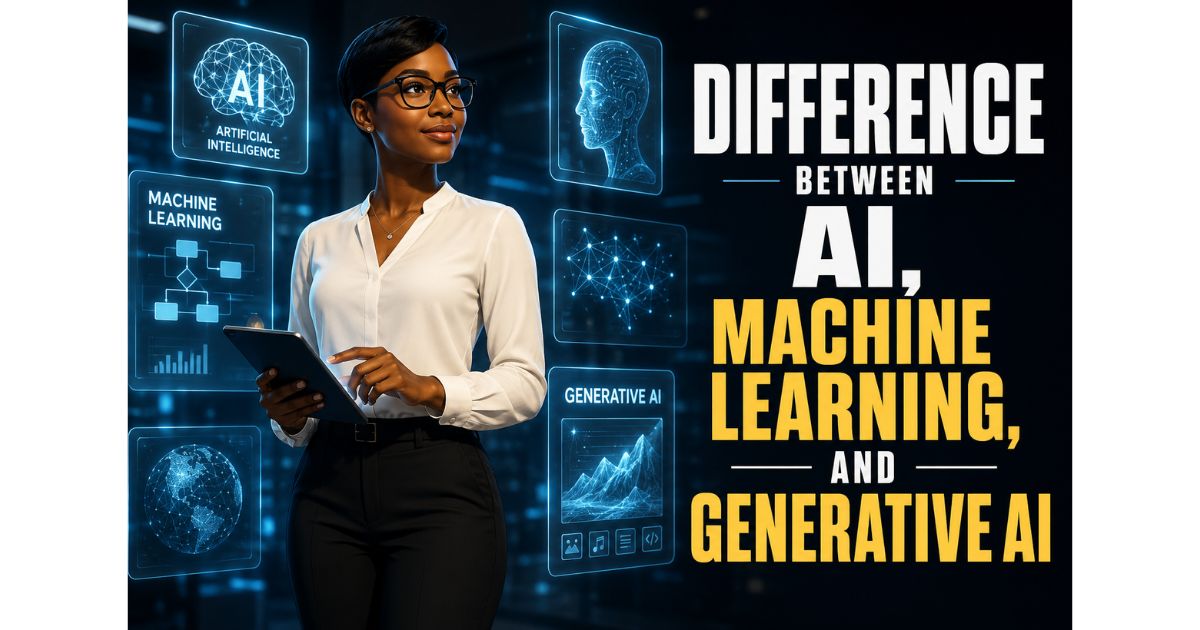
What is the Difference Between AI, Machine Learning, and Generative AI?
A Beginner’s Guide to Understanding the Technologies Shaping Our Future Beatrice had just finished reading an article about artificial intelligence when another headline caught her attention. “Machine Learning is transforming healthcare.” A few minutes later, she watched a video discussing Generative AI. She paused. “Aren’t they all the same thing?” Many beginners even me, Beatrice had been using the terms Artificial Intelligence (AI), Machine Learning (ML), and Generative AI interchangeably. They all sounded like different names for the same technology. But the more she learned about AI Governance, the more she realised these terms describe different concepts. Understanding the difference isn’t just useful for people working in technology. It’s becoming an essential skill for anyone interested in AI, cybersecurity, data governance, or the future of work. Let’s break it down. What Is Artificial Intelligence (AI)? Artificial Intelligence, or AI, is the broad field of creating computer systems that can perform tasks that normally require human intelligence. These tasks include: Think of AI as the largest umbrella. Everything else fits underneath it. If a computer performs tasks that usually require human intelligence, it falls within the field of AI. Imagine It Like a Family Tree As Beatrice continued learning, she found a simple way to remember the difference. Imagine a family. Artificial Intelligence is the parent. Under that parent is another family member called Machine Learning. Under Machine Learning is a newer member called Generative AI. In other words: Artificial Intelligence → Machine Learning → Generative AI Each builds on the one before it. What Is Machine Learning? Machine Learning is a branch of Artificial Intelligence. Instead of programming a computer with every possible instruction, Machine Learning allows systems to learn patterns from data. The more high quality data a model receives, the better it can recognise patterns and make predictions. For example, Machine Learning is used to: Machine Learning is excellent at recognising patterns. But it doesn’t create brand new content. What Is Generative AI? Generative AI is a specialised type of Machine Learning. Instead of simply recognising patterns or making predictions, Generative AI creates new content. That content may include: Popular examples include AI tools that can: If you have used ChatGPT, Gemini, Claude, or Microsoft Copilot, you have already experienced Generative AI. A Simple Example Beatrice imagined she worked for an airline. Here’s how each technology could be used. Artificial Intelligence An AI system helps improve airport operations by supporting multiple intelligent tasks across the airline. Machine Learning The airline uses Machine Learning to predict flight delays based on historical weather, maintenance records, and airport traffic. The system learns patterns from years of operational data. Generative AI A customer asks an AI chatbot to change a booking. The chatbot generates a personalised response, explains baggage policies, and drafts a confirmation email within seconds. It creates new content during the conversation. Why Does This Matter for AI Governance? As Beatrice studied AI Governance, she realised something important. Not every AI system carries the same level of risk. A Machine Learning model predicting maintenance schedules creates different governance challenges from a Generative AI chatbot producing customer responses. For example, organisations must ask questions such as: Understanding the type of AI being used helps organisations manage risks more effectively. Why Beginners Often Get Confused Many companies simply use the word “AI” to describe every intelligent technology. As a result, beginners naturally assume everything is the same. The reality is much simpler. Think of it like this: Artificial Intelligence is the broad field. Machine Learning teaches computers to learn from data. Generative AI creates entirely new content based on what it has learned. Once Beatrice understood this relationship, many other AI concepts became easier to understand. The Future Belongs to More Than Engineers One lesson Beatrice has learned throughout her journey is that understanding AI is no longer only for software developers. Professionals working in: are increasingly expected to understand the basics of AI. You don’t have to build AI systems. But understanding how they work helps you use them responsibly and ask better questions about privacy, security, fairness, and accountability. On A Final Note Before learning AI Governance, Beatrice thought Artificial Intelligence, Machine Learning, and Generative AI were simply different names for the same technology. Today, she knows they each play different roles. Artificial Intelligence is the broad field. Machine Learning helps computers learn from data. Generative AI creates new content. Understanding these differences is one of the first steps toward understanding responsible AI. And in a world where AI is becoming part of everyday life, that knowledge is more valuable than ever. If you are beginning your journey into AI Governance, don’t rush to learn everything at once. Start by understanding the fundamentals. The stronger your foundation, the easier it becomes to understand more advanced topics like AI Governance, Data Governance, cybersecurity, and responsible AI. Remember, every expert was once a beginner who simply decided to keep learning. SEO Keywords Naturally Included What is Artificial Intelligence, Artificial Intelligence vs Machine Learning, Machine Learning vs Generative AI, Generative AI explained, AI for beginners, AI Governance for beginners, AI basics, Machine Learning explained, responsible AI, AI terminology, difference between AI and Machine Learning, AI careers, Generative AI examples, AI concepts for beginners.
5 AI Myths I Believed Before Learning AI Governance
When Beatrice first became interested in artificial intelligence, she was both fascinated and intimidated. Everywhere she looked, people were talking about AI changing the world. Some claimed AI would replace millions of jobs. Others believed it was smarter than humans. The more videos she watched and articles she read, the more overwhelmed she became. She wondered if there was even a place for someone like her in this fast-growing field. As she began learning cybersecurity, Governance, Risk, and Compliance (GRC), and eventually AI Governance, she realised something surprising. Many of the things she believed about AI simply weren’t true. If you arejust beginning your AI Governance journey, you may have believed some of these myths too. Myth 1: AI Knows Everything When Beatrice first used an AI chatbot, she assumed every answer it gave was correct. After all, the responses sounded confident and well written. But as she continued learning, she discovered an important truth. AI does not “know” facts the way humans do. Instead, AI identifies patterns from the information it has been trained on and generates responses based on those patterns. That means AI can sometimes provide incomplete, outdated, or incorrect information. This is one reason why human oversight remains a key principle of AI Governance. The lesson? Always verify important information instead of assuming AI is always right. Myth 2: AI Thinks Like a Human One of Beatrice’s biggest misconceptions was believing AI actually thinks. It doesn’t. AI does not have emotions. It does not have personal experiences. It does not understand the world in the same way people do. Instead, AI predicts the most likely response based on patterns in data. That is very different from human reasoning. Understanding this distinction helps explain why AI sometimes produces unexpected or inaccurate answers. Myth 3: AI Governance Is Only for Programmer This myth almost stopped Beatrice from pursuing AI Governance. She assumed everyone in the field had a Computer Science degree and years of coding experience. As she researched further, she realised AI Governance brings together many different disciplines. It involves: Technical knowledge is valuable, but AI Governance also needs professionals who understand policies, accountability, and responsible decision-making. That discovery gave her the confidence to keep learning. Myth 4: Better AI Always Means Better Results At first, Beatrice believed that the more advanced an AI system became, the better its decisions would be. Then she learned one of the most important lessons in AI Governance. AI depends on data. If the data is poor, biased, incomplete, or inaccurate, even the most advanced AI system may produce poor results. This is why Data Governance has become so important. Good AI starts with good data. Without trustworthy data, trustworthy AI becomes much harder to achieve. Myth 5: Learning AI Means Learning Everything at Once The world of AI can feel overwhelming. Machine Learning. Large Language Models. Data Governance. Cybersecurity. Privacy. Risk Management. At first, Beatrice thought she needed to understand everything before she could even begin. She was wrong. She realised that every expert started somewhere. Her own journey began with Cisco Networking Essentials. Then Introduction to Cybersecurity. Then CyberOps. Then GRC. Now she is learning AI Governance one concept at a time. Progress came through consistency, not perfection. What These Myths Taught Me Looking back, Beatrice realised that learning AI Governance was not about memorising technical terms. It was about changing the way she thought about technology. She learned that responsible AI depends on: Most importantly, she learned that curiosity is one of the greatest strengths a beginner can have. On A Final Note If you are considering a career in AI Governance, don’t let common myths discourage you. You don’t need to know everything on your first day. You don’t need to have all the answers. You simply need the willingness to learn. Every article you read. Every course you complete. Every question you ask. Brings you one step closer to understanding one of the most important fields shaping the future of technology. Beatrice is still learning. So am I. And perhaps that’s the best place to begin. AI myths, AI Governance for beginners, common AI misconceptions, artificial intelligence explained, AI Governance career, responsible AI, Data Governance, AI bias, AI chatbot myths, cybersecurity and AI, AI learning journey, beginner’s guide to AI Governance, trustworthy AI, AI fundamentals.

Do You Need a Computer Science Degree to Start a Career in AI Governance?
Beatrice almost talked herself out of it. She had been reading about AI Governance for weeks. Every article she found mentioned artificial intelligence, machine learning, algorithms, and data. The more she read, the more one thought kept returning. “Maybe this field is not for someone like me.” After all, she wasn’t a software engineer. She didn’t have a Computer Science degree. Her background was aviation. She had spent years ensuring passenger safety, following procedures, managing emergencies, and making decisions under pressure. What place did she have in a field that seemed filled with programmers and data scientists? Then she started researching the people already working in AI Governance. To her surprise, not everyone had studied Computer Science. Some came from law. Others came from cybersecurity. Some worked in compliance, risk management, auditing, public policy, or data privacy. That was the moment she realised something important. AI Governance is not just about building AI. It is about governing how AI is used responsibly. Why So Many People Think You Need a Computer Science Degree It is an understandable assumption. Artificial Intelligence sounds highly technical. When people hear the words “AI,” they often imagine: Those professionals play an important role in developing AI systems. But building AI and governing AI are not the same thing. As organisations adopt AI across healthcare, aviation, finance, retail, education, and government, they also need people who can answer questions like: These are governance questions. Not programming questions. What Is AI Governance AI Governance is the process of ensuring that artificial intelligence is developed, deployed, and used responsibly. It brings together: The goal is not simply to make AI more intelligent. The goal is to make AI more trustworthy. So, Do You Need a Computer Science Degree? The short answer is: No, not necessarily. Many AI Governance roles value a combination of technical awareness and non-technical expertise. Employers may look for people who understand: A Computer Science degree can certainly be an advantage for some roles. But it is not the only pathway into AI Governance. Understanding how AI impacts people, organisations, and society is just as important. The Skills That Matter As Beatrice continued learning, she realised she had already developed many relevant skills through aviation. Without knowing it, years of working as a flight attendant had taught her to think like a governance professional. She already understood: Risk Awareness Every flight involves identifying and managing risks before they become problems. Compliance Following procedures is essential in aviation. The same mindset applies to AI Governance. Communication Complex situations often require clear, calm communication with passengers and colleagues. Governance professionals communicate policies, risks, and recommendations in much the same way. Decision Making AI may provide recommendations, but responsible organisations still rely on human judgement for important decisions. Accountability In aviation, every action has an owner. AI Governance follows the same principle. Someone must remain accountable for how AI systems are used. Where Should Beginners Start? One lesson I have learned during my own transition is that strong foundations matter. My journey started with Cisco Networking Essentials. That helped me understand how networks and digital systems work. I then completed Introduction to Cybersecurity and CyberOps, where I first discovered risk management. That curiosity eventually led me to Governance, Risk, and Compliance. Now, I am exploring AI Governance because artificial intelligence is changing the way organisations manage risk, privacy, and accountability. Every step built upon the previous one. I did not need to know everything on day one. I simply needed to keep learning. Why AI Governance Needs Diverse Backgrounds Artificial Intelligence affects almost every industry. That means organisations need professionals with different perspectives. People from: all bring valuable experience. Because AI Governance is ultimately about helping organisations use AI responsibly. Technology alone cannot solve governance challenges. People do. On A Final Note As Beatrice closed her notebook after another evening of studying, she realised the question she had been asking herself was the wrong one. She had been asking: “Do I have the right degree?” The better question was: “Am I willing to keep learning?” A Computer Science degree can be valuable. But curiosity, continuous learning, and an understanding of governance, risk, privacy, and accountability are equally important in this rapidly evolving field. If you are considering a career in AI Governance, don’t let the absence of a Computer Science degree stop you from exploring the field. Every expert started as a beginner. And every career transition begins with one decision to learn something new.
How to Start a Career in AI Governance: 7 Lessons I am Learning as a Career Changer
Not long ago, if someone had asked Beatrice what AI Governance was, she probably would have smiled politely and admitted she had no idea. She understood aviation. She understood safety. She understood following procedures, managing risks, and making decisions under pressure. But AI? That felt like a completely different world. Or so she thought. Her curiosity began with a simple cybersecurity course. She wanted to understand how digital systems worked. That journey led her from networking to CyberOps, where she first encountered a topic called risk management. Something about it caught her attention. She wanted to learn more. That curiosity eventually led her to Governance, Risk, and Compliance, commonly known as GRC. Then came another realisation. Artificial intelligence was becoming part of almost every industry. Healthcare. Banking. Retail. Aviation. The more she learned, the more she realised AI Governance was not just about technology. It was about ensuring AI systems were used responsibly. She was still learning. But every lesson was changing how she viewed the future of work. If you are thinking about starting a career in AI Governance, here are seven lessons she has learned along the way. 1. AI Governance Is About More Than AI When most people hear AI Governance, they immediately think about algorithms and programming. I made the same assumption. But AI Governance is really about creating policies, managing risks, ensuring compliance, protecting privacy, and making sure AI systems are used responsibly. It is where technology meets business, ethics, and accountability. That surprised me. 2. You Don’t Need to Be a Software Engineer This was one of my biggest fears. I thought everyone working in AI Governance had years of coding experience. The truth is, AI Governance is multidisciplinary. Professionals come from backgrounds including: Technical knowledge helps, but understanding governance and risk is equally valuable. 3. Good AI Starts With Good Data One lesson appears repeatedly. AI depends on data. If the data is inaccurate, biased, incomplete, or poorly managed, the AI system may also produce poor results. That is why Data Governance and AI Governance are so closely connected. You cannot build trustworthy AI without trustworthy data. 4. Human Oversight Still Matters One misconception is that AI will replace every human decision. The more I learn, the more I realise that human judgement remains essential. People still need to: Responsible AI is not about removing humans. It is about supporting better decisions while keeping humans accountable. 5. Regulations Are Becoming Increasingly Important As AI adoption grows, governments around the world are introducing new rules around privacy, transparency, and accountability. Frameworks such as the General Data Protection Regulation (GDPR) and Nigeria’s Data Protection Act demonstrate how seriously organisations are expected to protect personal information. Understanding these regulations is becoming an important skill for anyone entering AI Governance. 6. My Aviation Experience Was not Wasted This lesson surprised me the most. For years, I thought my aviation experience had nothing to do with technology. I couldn’t have been more wrong. Working as a flight attendant taught me: Those skills are highly transferable to governance-focused roles. Sometimes your previous career prepares you for your next one in ways you might immediately recognise. 7. Learning Never Really Stops One thing I have accepted is that AI evolves quickly. New regulations emerge. New technologies appear. New risks are identified. That means AI Governance professionals must continue learning throughout their careers. Instead of seeing that as overwhelming, I have started seeing it as exciting. Every new lesson makes me a little more prepared than I was yesterday. Why I am Sharing My Journey I am not writing this as someone who has all the answers. I am writing as someone who is learning. Someone who asks questions. Someone who enjoys translating complex AI Governance concepts into language beginners can understand. If you are transitioning from aviation, healthcare, banking, education, or another profession, know this: You don’t have to know everything before you begin. You simply have to be willing to learn. On A Final Note As Beatrice closed her notebook after another evening of studying, she smiled. Not because she had mastered AI Governance. But because she had started. Every expert was once a beginner. Every professional once asked their first question. And every meaningful career begins with the courage to learn something new. Perhaps the future of AI Governance is not reserved only for technology experts. Perhaps it is also for curious people who believe that responsible AI starts with responsible humans. SEO Keywords Naturally Included How to start a career in AI Governance, AI Governance for beginners, AI Governance career, AI Governance skills, Data Governance, GRC career, cybersecurity career transition, GDPR and AI, Nigeria Data Protection Act, responsible AI, AI compliance, AI risk management, AI Governance learning journey.
What Happens to Your Data When You Use an AI Chatbot?
Understanding AI, Privacy, and Data Governance in the Age of Intelligent Assistants Beatrice loved using AI chatbots. They helped her brainstorm ideas. Summarize articles. Draft emails. Explain complex topics. Sometimes, it felt like having a personal assistant available 24 hours a day. One evening, while using an AI chatbot to help organize a project, she pasted a lengthy document into the chat window. A few seconds later, the AI generated exactly what she needed. Efficient. Fast. Impressive. But as she closed her laptop, a thought suddenly crossed her mind. What just happened to the information I shared? Did the chatbot store it? Could someone else access it? Would it be used to improve future AI systems? For the first time, Beatrice wasn’t thinking about what the chatbot could do. She was thinking about what happened behind the scenes. And that question is becoming increasingly important as millions of people use AI chatbots every day. Why AI Chatbots Need Data AI chatbots are designed to understand and respond to human language. To do this, they process information provided by users. This may include: The chatbot analyses the information and generates a response based on patterns it has learned. Without data, AI chatbots would not be able to function effectively. Data is what allows AI to understand context and generate useful answers. What Happens When You Type a Prompt? When Beatrice typed a question into the chatbot, several things happened almost instantly. The system received her prompt. It processed the information. It generated a response. Depending on the platform, some information may also be stored for purposes such as: This does not mean every chatbot uses data in exactly the same way. Different providers have different policies and settings. That is why understanding how a platform handles data is so important. Can AI Chatbots See Everything You Share In many cases, AI systems can process the information users provide directly. If someone uploads a document, enters personal information, or shares business data, the system may analyse that content to generate a response. This is why cybersecurity professionals and privacy experts often advise caution when sharing: Just because a chatbot can process information does not mean every type of information should be shared. Does the AI Remember Your Conversations? This is one of the most common questions people ask. The answer depends on the platform. Some AI services may retain conversation history to improve the user experience. Others may offer settings that allow users to manage or delete conversations. Some platforms may use certain interactions to improve their systems, while others provide options to opt out. This is why users should always review: Understanding these settings helps users make informed decisions about what they share. Why Data Privacy Matters As Beatrice researched further, she realised that AI chatbots are not only technology tools. They are also data tools. Every conversation may involve information that has value. That information could include: Without proper safeguards, sensitive information could create privacy, security, or compliance concerns. This is where data governance becomes essential. The Role of GDPR and Nigeria’s Data Protection Act Around the world, privacy regulations are evolving to protect individuals and organisations. In Europe and the UK, the General Data Protection Regulation (GDPR) establishes rules for how personal information should be handled. In Nigeria, the Nigeria Data Protection Act provides a framework for protecting personal information and promoting responsible data practices. These regulations encourage organisations to: As AI adoption increases, these principles become even more important. Where AI Governance Comes In AI Governance helps organisations ensure that AI systems are used responsibly and ethically. It asks important questions such as: Good governance helps organisations balance innovation with accountability. Because trust is difficult to build and easy to lose. What Should Users Do? By this point, Beatrice had learned an important lesson. AI chatbots can be incredibly useful. But users should think carefully before sharing information. Good practices include: A little awareness can go a long way in protecting privacy. The Bigger Picture As AI chatbots become part of everyday life, the conversation is shifting. People are no longer asking only: What can AI do? They are also asking: What happens to my data when I use it? And that question is becoming one of the most important discussions in AI governance. On A Final Note As Beatrice reflected on everything she had learned, she realised that every interaction with an AI chatbot involves a degree of trust. Trust that information will be handled responsibly. Trust that privacy will be respected. Trust that organisations are governing AI systems properly. AI chatbots have the potential to transform how we work, learn, and communicate. But understanding what happens to our data is just as important as understanding what the technology can do. Because in the age of artificial intelligence, being informed is one of the best forms of protection.