
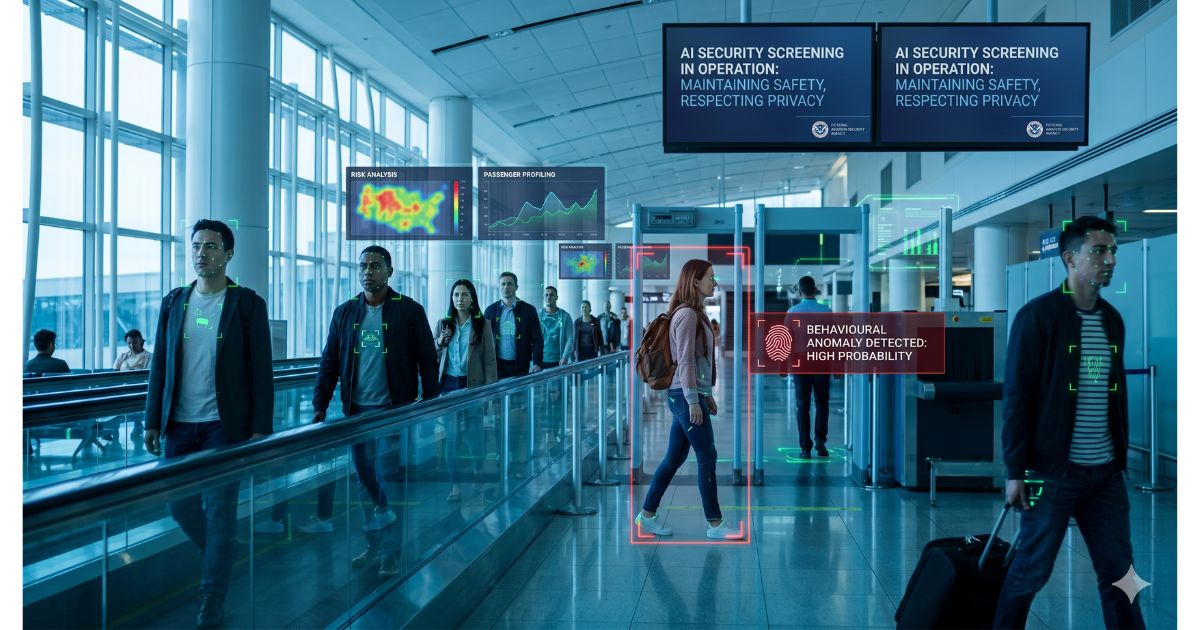
Beatrice noticed the cameras immediately.
As she walked through the airport terminal during a layover, she realised something had changed.
The security process felt faster. Smoother. More automated.
Passengers moved through checkpoints with minimal interaction. Some gates opened automatically after facial scans. Screens tracked movement quietly in the background.
Most travelers barely noticed.
But Beatrice did.
As a flight attendant, airports were familiar environments. Yet this time, it felt different.
Less human.
More intelligent.
Later that evening, she began wondering:
How much is AI actually watching inside airports?
The answer was more complex than she expected.
How AI Is Used in Modern Airports
Today, airports across the UK and Europe increasingly use AI-powered systems to improve security and operational efficiency.
These systems can help:
- verify passenger identity
- detect suspicious behaviour
- analyse movement patterns
- improve border security
- reduce wait times
AI is now integrated into technologies like:
Facial Recognition Systems
Used to compare passenger faces with identification documents or watchlists.
Behaviour Analysis Systems
Designed to identify unusual movement patterns or suspicious activity.
Smart Security Screening
AI-assisted scanning systems that help identify prohibited items more efficiently.
For airports handling millions of passengers yearly, automation helps process people faster and more consistently.
The Security Advantage
From an aviation safety perspective, the benefits are clear.
Airports face enormous pressure to maintain security while managing large passenger volumes.
AI systems can help by:
- detecting anomalies faster
- reducing manual workload
- improving screening efficiency
- supporting real-time monitoring
For example, AI may identify:
- unattended luggage
- restricted area access
- unusual passenger behaviour patterns
All within seconds.
This creates a safer and more responsive environment.
But Here is the Hidden Question
As Beatrice continued thinking about it, another question appeared.
What happens if the system gets it wrong?
Because AI systems don’t think like humans.
They rely on:
- data
- patterns
- probability
And human behaviour is not always predictable.
A nervous passenger may simply fear flying.
Someone moving quickly through the terminal may just be late for boarding.
But to an AI system, unusual behaviour can sometimes appear suspicious.
When Passenger Data Becomes Part of the System
To function effectively, many AI airport systems rely on large amounts of passenger data.
This may include:
- facial images
- passport information
- travel history
- behavioural patterns
- movement tracking inside terminals
Over time, these systems build detailed profiles and behavioural models.
And this is where privacy concerns begin to grow.
The Privacy Risk Most Passengers Don’t See
Most travelers focus on catching flights, checking luggage, and getting through security.
Few think about what happens to their data behind the scenes.
But AI surveillance systems raise important questions:
- How long is passenger data stored?
- Who has access to it?
- Can the data be shared across systems or countries?
- What happens if someone is incorrectly flagged?
This is no longer just an aviation issue.
It becomes a governance and data privacy issue.
Where GDPR and Data Protection Come In
In the UK and Europe, passenger data protection is guided by laws like the General Data Protection Regulation.
These regulations require organisations to:
- process personal data lawfully
- minimise unnecessary data collection
- protect sensitive information
- remain transparent about how data is used
In theory, these rules help balance:
- security needs
- passenger privacy rights
But AI introduces new complexity.
Because AI systems can process and analyse data at a scale humans cannot.
The Governance Challenge
This is where Governance, Risk, and Compliance becomes critical.
Airports and airlines must ensure:
Governance
Clear policies exist around how AI surveillance systems are used.
Risk Management
Potential risks such as:
- false identification
- biased algorithms
- privacy breaches
- over-surveillance
are properly assessed.
Compliance
Systems comply with:
- GDPR requirements
- aviation security regulations
- passenger privacy standards
Because if AI systems make mistakes, accountability still matters.
Aviation Has Always Balanced Safety and Trust
Aviation depends on trust.
Passengers trust:
- pilots
- airlines
- airports
- security systems
AI may improve efficiency and strengthen security.
But trust cannot rely on automation alone.
Passengers still need transparency.
They need to know:
- how systems work
- how their data is used
- and who remains accountable behind the technology.
The Bigger Picture
As Beatrice boarded her next flight, she realised something important.
AI is quietly reshaping modern aviation.
Not only through security systems.
But through:
- scheduling
- passenger management
- pricing systems
- operational monitoring
The technology is becoming more intelligent every year.
But intelligence without oversight creates risk.
On A Final Note
AI may help airports identify suspicious activity faster.
But airports are not just processing passengers.
They are processing people’s data, behaviour, and identities.
And as aviation becomes more automated, the real challenge will not simply be improving security.
It will be protecting privacy, maintaining accountability, and ensuring humans remain visible within the system.