
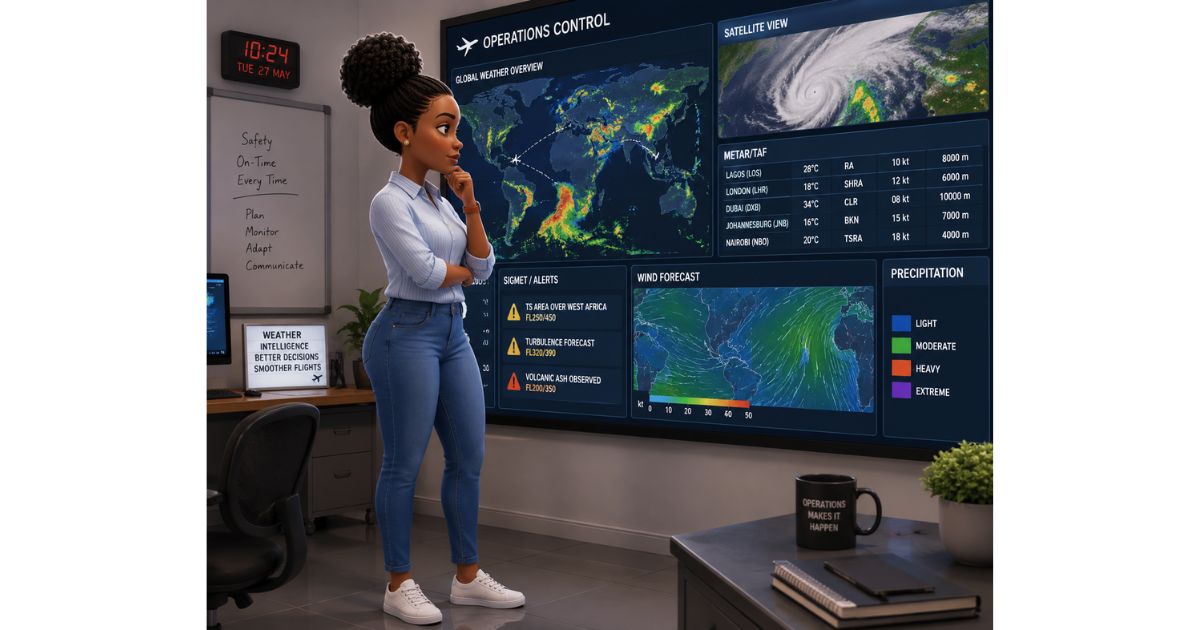
So how does AI predict flight delays before passengers even know there is a problem? The answer lies in the enormous amount of weather, flight, airport and operational data that airlines can analyse.
Have you ever checked your flight status and wondered how an airline could possibly know that your flight might be delayed when the weather outside looks perfectly fine?
Perhaps you are sitting at home looking at a bright blue sky.
Your weather app says everything looks good.
Yet somewhere behind the scenes, an airline system may already be warning that your flight could be delayed.
How does it know?
The answer involves something you interact with every day without necessarily realising it: data.
Airlines collect enormous amounts of information about flights, weather, aircraft, airports, routes and previous journeys. Increasingly, artificial intelligence can analyse this information, identify patterns and help predict what might happen next.
But there is an important question we need to ask:
Can AI actually tell a passenger whether their flight is safe to operate?
The answer is more complicated than you might think.
How AI Predicts Flight Delays: A Real Flight Experience
I have experienced this from the operational side of aviation.
On one particular flight, I operated to a certain city. After we landed, the weather changed.
We had to wait for some time before we could board for the next route.
At that point, the weather conditions was good for taking off. But we were also informed that more weather was approaching.
So there was a difficult window.
The weather was currently suitable for departure, but more challenging weather was closing in.
Eventually, we took off.
During the flight, we experienced turbulence.
By the time we landed, I heard that other airlines operating to that route had cancelled their flights.
Naturally, passengers were upset.
From a passenger’s perspective, it is understandable:
But aviation safety decisions are rarely that simple.
The decision to operate a flight isn’t based simply on whether it is raining or whether an app shows a storm nearby.
There are many factors involved.
And this is where data becomes incredibly important.
So, How Does AI Predict a Flight Delay?
Think about AI as a very sophisticated pattern finder.
It can examine huge amounts of information much faster than a human could.
For example, an airline may have information about:
- Previous flight delays
- Weather conditions
- Aircraft location
- Airport congestion
- Departure and arrival times
- Winds
- Visibility
- Thunderstorms
- Aircraft availability
- Crew schedules
- Air traffic restrictions
- Runway conditions
AI can analyse relationships between these different pieces of information.
Imagine that an airline’s historical data shows something interesting.
Whenever thunderstorms develop around a particular airport during a certain period of the day, flights arriving there tend to experience significant delays.
The AI system can recognise that pattern.
So when similar weather conditions begin developing again, the system may predict:
“There is a high probability that flights arriving here will experience delays.”
It is not predicting the future like a crystal ball.
It is using data to estimate what is likely to happen.
Weather Is One of the Biggest Pieces of the Puzzle
Weather can change rapidly.
A flight that looks perfectly normal in the morning could face very different conditions a few hours later.
Airlines and aviation authorities therefore use multiple sources of weather information.
These can include radar observations, forecasts, satellite information, airport weather observations, wind information and reports from aircraft already flying through an area.
The FAA explains that aviation weather systems combine observations and forecast models to help pilots, air traffic controllers and operators understand conditions that could affect flights.
This is important because a simple weather app might tell you:
Thunderstorms: 40% chance.
An aviation operation needs much more information.
Where exactly is the weather?
How quickly is it moving?
How severe is it?
Is it affecting the departure airport?
Is it affecting the destination?
What about the route between the two?
What will the conditions look like by the time the aircraft reaches that area?
Those are very different questions.
What About Turbulence?
This is another area where data becomes fascinating.
Turbulence can occur for many reasons, including thunderstorms, weather fronts, jet streams, mountains and changes in atmospheric conditions.
And sometimes it can occur even when the sky appears clear.
Modern aviation systems can use information from different sources to improve turbulence awareness.
For example, aircraft can provide information about turbulence encountered during flight. Pilot reports can also provide valuable information about what is actually happening in the atmosphere.
The FAA explains that newer turbulence detection methods can use aircraft and radar data to estimate turbulence conditions, while turbulence forecasts combine weather model information with observations.
This creates something very important:
Real world data can improve future predictions.
If several aircraft report turbulence in the same area, that information can help other crews and aviation systems understand what may be happening ahead.
But Here is the Interesting Part
Remember my flight?
The weather was good enough for takeoff at that particular moment.
But we were also told that more weather was approaching.
That distinction matters.
Weather is not simply:
Good
or
Bad
It is constantly changing.
An aircraft may be able to depart safely through a particular window while another flight later faces significantly different conditions.
That means two airlines can make different operational decisions without one necessarily being careless and the other being cautious.
Conditions can change.
Routes can be different.
Aircraft can encounter different weather.
Air traffic restrictions can change.
And the information available to the crew can change.
The FAA emphasises that pilots should continuously reassess weather and use multiple sources of information rather than relying on a single forecast.
Could AI Have Predicted What Happened on My Flight?
Possibly.
But we need to be careful with that statement.
AI could potentially identify patterns suggesting that weather conditions were becoming more likely to disrupt flights on a particular route.
It could analyse historical weather patterns, current observations and forecast information.
It could even help identify a developing risk before a traditional delay becomes obvious to passengers.
But predicting a potential delay is very different from determining whether an aircraft should take off.
That is where human expertise and aviation procedures remain essential.
Can a Passenger Determine This Through an App?
This is the question I think many travelers would find fascinating.
Imagine you are sitting at the airport.
Your airline says:
“Your flight is operating.”
But another airline has cancelled its flight to the same destination.
You open a weather app.
You see some clouds.
Maybe you see a red area on the radar.
Can you conclude:
My airline should cancel too?
Not safely.
A consumer weather app can be useful for awareness, but it does not provide the complete operational picture available to pilots, dispatchers, air traffic services and airline operations teams.
A passenger may see rain at the destination while the flight crew and operations team are looking at a much broader picture.
They may be considering the movement of weather systems, wind conditions, visibility, turbulence, thunderstorms, alternate airports, fuel requirements, airspace restrictions and the expected conditions along the route.
The FAA makes a similar distinction: having weather information available is not the same as being able to interpret it and make an operational decision from it.
So your weather app might tell you:
The weather looks bad.
An aviation operation needs to answer a much more specific question:
Can this particular aircraft safely operate this particular flight, on this particular route, at this particular time, given the conditions we expect?
Those are completely different questions.
Why Can One Airline Cancel While Another Operates?
This can be frustrating for passengers.
You might look at the departure board and see:
Airline A: Cancelled
Airline B: Delayed
Airline C: Operating
It is tempting to conclude that someone has made a mistake.
But there can be legitimate operational reasons for different decisions.
One aircraft may have a different route.
One flight may depart earlier.
One airline may have different operational constraints.
The weather may move between departures.
The destination conditions may improve or deteriorate.
There may also be differences in aircraft capability, fuel planning, available alternates and the information available at the time the decision is made.
And sometimes the safest decision is simply to wait or cancel.
As the FAA explains, thunderstorms can create hazards including turbulence, icing, wind shear and hail, and pilots may need to avoid areas of convection even when that means changing the route or delaying the flight.
This Is Where AI Becomes Really Interesting
AI could help aviation teams process enormous amounts of information.
Imagine a system constantly examining:
Weather + flight history + aircraft data + airport congestion + route information + turbulence reports + operational data
Instead of a human having to manually compare all those pieces of information, AI can identify patterns and flag potential problems.
For example:
“Based on current weather movement, historical patterns and traffic conditions, there is an increased probability of a 45 minute delay on this route.”
That doesn’t mean the flight will definitely be delayed.
It means the system has identified a pattern that humans may want to investigate.
This is one of the most useful ways to think about AI in aviation.
AI doesn’t necessarily replace the decision maker. It can give the decision maker better information.
What Happens When the Data Is Wrong?
This is where our conversation about data governance becomes important.
Imagine an AI system receives inaccurate weather information.
Or perhaps an important data feed is delayed.
Maybe an aircraft report hasn’t been received.
Perhaps historical data contains gaps.
The AI may produce a prediction that sounds convincing but is wrong.
And that’s why aviation cannot simply say:
The AI predicted it, so let’s do it.
The quality of an AI prediction depends heavily on the quality, timeliness and relevance of the data behind it.
Good data governance helps organisations understand:
- What data is being collected
- Where the data comes from
- Whether the data is accurate
- How current the data is
- Who is allowed to access it
- How the data is being used
- What happens when the data is wrong
That is particularly important when AI is being used in safety sensitive environments.
Could Your Airline App Become Much Smarter?
Now imagine the airline app of the future.
Instead of simply telling you:
“Flight delayed.”
It could say:
“Your flight currently remains scheduled to operate. Weather conditions along the route are being monitored. There is an increased possibility of delay because of developing thunderstorms near your destination. We will update you if the operational status changes.”
That would be much more useful.
The app wouldn’t pretend to know everything.
It would communicate uncertainty.
It would explain what is happening.
And most importantly, it would distinguish between information for the passenger and an operational safety decision.
That is where I think AI could genuinely improve the passenger experience.
What Should Passengers Trust?
Your weather app?
Your airline app?
The flight tracking application?
The airport departure board?
The answer is that each serves a different purpose.
A passenger can use technology to become better informed.
You can look at the weather.
You can monitor your flight.
You can see whether other flights are being delayed.
You can receive airline notifications.
But when it comes to the question:
Is this aircraft safe to operate?
that decision belongs within the aviation safety and operational framework, not to a passenger looking at a smartphone weather map.
The Future Could Be About Better Predictions, Not Perfect Predictions
One of the biggest misconceptions about AI is that it knows what will happen.
It doesn’t.
AI works with probabilities, patterns and data.
Weather itself is uncertain.
Human decisions are complex.
And aviation is constantly changing.
The goal is not to create an AI system that can predict every delay perfectly.
The goal is to create systems that can identify risks earlier, give aviation professionals better information and help passengers receive more useful updates.
That could mean fewer surprises at the airport.
It could mean earlier notifications.
It could mean better route planning.
And potentially, safer and more efficient operations.
On A Final Note
That flight I operated taught me something that a weather app could never fully explain.
From the ground, everything can look simple.
The weather appears good.
The aircraft is ready.
The passengers are ready to go.
But aviation decisions happen in a constantly changing environment.
A few minutes later, the situation can be completely different.
AI can help aviation make sense of enormous amounts of data and identify patterns that humans might otherwise miss. It can help predict potential delays, monitor weather trends and provide better information to airlines and passengers.
But prediction is not the same thing as permission to fly.
And that distinction matters.
The future of aviation will not simply be about giving AI more control. It will be about giving AI better data, using that data responsibly and keeping qualified humans in the loop when safety decisions have to be made.
So the next time your flight is delayed or cancelled while another airline continues operating, remember that there may be much more happening behind the scenes than your weather app can show you.
Sometimes, the safest decision is the one passengers understand only after they have landed safely.
Continue Reading
Who Owns Your Travel Data? What Happens to Your Information When You Book a Flight?
Every flight creates a trail of passenger and operational data. Discover where your travel information goes, who may use it and why data governance matters in modern aviation.
Can AI Be Wrong? Why AI Sometimes Gives Incorrect Answers
AI can sound incredibly confident and still get things wrong. Learn why artificial intelligence makes mistakes and why human oversight remains important as AI becomes more powerful.
1 Comment
[…] How AI Predicts Flight Delays: The Data Behind Airline Predictions […]