
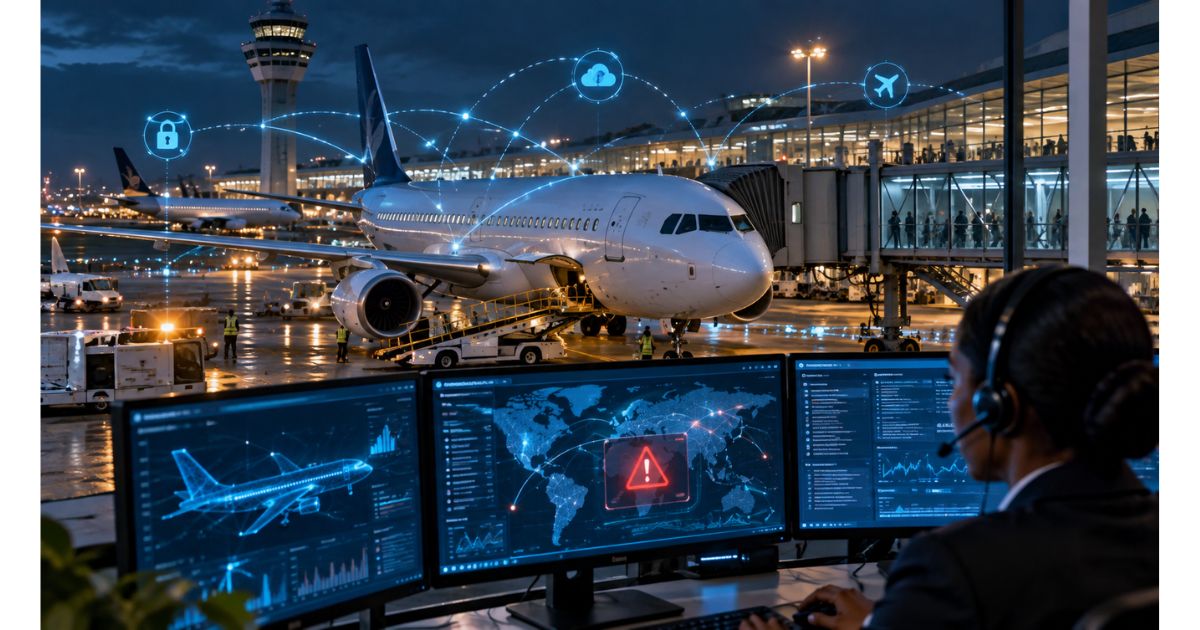
How AI helps airlines reduce flight delays is becoming one of the most interesting developments in modern aviation, because the technology is moving beyond simply predicting that something will go wrong.
Imagine you are sitting at an airport.
Your flight is scheduled to depart at 4:00 PM.
The departure board says On Time.
You buy your coffee, sit down and start scrolling through your phone.
What you cannot see is what is happening behind the scenes.
Your aircraft is still flying toward the airport.
A storm is developing along another part of the route.
The airport is becoming crowded.
Several other flights are arriving at around the same time.
And the airline is trying to work out whether one small delay could turn into a much bigger problem.
This is where how AI helps airlines reduce flight delays becomes more than a technology story.
It becomes a story about what happens before passengers ever notice a problem.
AI Is Moving From Prediction to Prevention
We have already explored how AI can predict flight delays.
But there is an important difference between predicting a delay and reducing a delay.
If an AI system tells an airline that a flight has an 80 percent chance of being delayed, that information is useful.
But the bigger question is:
What can the airline do about it?
This is where how AI helps airlines reduce flight delays becomes particularly interesting.
AI can analyse huge amounts of information and help airline and aviation teams identify problems early enough to respond.
The goal is not to make every flight perfectly punctual.
That is impossible.
The goal is to give people enough information to make better operational decisions before a small problem becomes a major disruption.
A Real World Example Is Already Here
This is not just something that might happen in the future.
In September 2026, the U.S. Federal Aviation Administration began deploying an AI supported system called SMART, or Strategic Management of Airspace, Routes and Trajectories, to help manage air traffic around the Washington, D.C. area.
The system brings together around 200 data streams, including weather, flight paths, traffic flow, airport capacity and controller staffing information. It is designed to help aviation specialists identify congestion and other problems before they occur.
That is a real example of how AI helps airlines reduce flight delays through earlier visibility into problems affecting the wider airspace.
The FAA says its related Flow Management Data and Services platform uses flight plans, airline schedules and real time aircraft position information to project congestion and capacity limitations in advance.
So the future we are talking about is already beginning to arrive.
1. AI Can See a Delay Before It Becomes Your Delay
Let’s go back to your 4:00 PM flight.
The aircraft scheduled to operate your flight is coming from another city.
But that aircraft is already 25 minutes late.
You might not know this.
The airline does.
An AI system can connect the aircraft’s current position with its next scheduled flight.
It can then estimate how the late arrival could affect the next departure.
This is one of the clearest examples of how AI helps airlines reduce flight delays.
Instead of waiting until the aircraft lands and discovering that the schedule has already fallen apart, airline operations teams can receive an earlier warning.
They may then have options.
Perhaps they can change the aircraft assignment.
Perhaps they can adjust the gate.
Perhaps they can reorganise the turnaround.
Perhaps they can communicate with connecting passengers.
The prediction itself does not remove the delay.
It gives people more time to respond.
2. AI Can Help Airlines Deal With Airport Congestion
Airports can become incredibly complicated places.
Imagine several aircraft arriving within a short period.
They need gates.
They need ground staff.
They need baggage handling.
They need cleaning.
They need refuelling.
They need catering.
They need passengers to board again.
One aircraft arriving late can affect several of these activities.
Research and operational projects are already exploring how AI can improve airline ground operations and staff scheduling by accounting for unpredictable disruptions. A University of Twente project working with KLM, for example, has explored AI based scheduling for baggage handling and other ground operations.
This shows another important part of how AI helps airlines reduce flight delays.
AI does not have to be sitting inside the aircraft.
It can be working behind the scenes on the ground.
3. AI Can Help With Weather
Weather is one of the biggest challenges in aviation.
You cannot negotiate with a thunderstorm.
You cannot tell heavy rain to move somewhere else.
And you certainly cannot ask lightning to wait until your flight has landed.
The FAA’s NextGen Weather Processor combines radar, satellite information, lightning data, surface observations, aircraft observations and weather forecast models to help identify aviation hazards and predict route and airspace capacity constraints.
This is another example of how AI helps airlines reduce flight delays.
When aviation teams have better information about developing weather conditions, they can potentially make better decisions about routes and traffic flow.
The aircraft might be rerouted.
Departure times might be adjusted.
Traffic might be managed differently.
The important thing is that the system is looking ahead rather than simply reacting after the disruption has already happened.
4. AI Can Help With Aircraft Maintenance
Now imagine your aircraft is ready for boarding.
Passengers are finding their seats.
The cabin crew is preparing for departure.
Then a maintenance issue appears.
The aircraft cannot leave until it is resolved.
This is where predictive maintenance becomes important.
Instead of waiting for a component to fail completely, AI systems can analyse aircraft data and identify patterns that may indicate an emerging problem.
The objective is to identify maintenance needs earlier and reduce unexpected disruptions.
AI applications in aviation are increasingly being explored for maintenance, operations and other areas of air transportation. A 2025 review of AI and data science applications in air transportation identified potential operational benefits including reduced delays, improved aircraft utilisation and lower maintenance costs.
This is another example of how AI helps airlines reduce flight delays before passengers are sitting at the gate wondering what is happening.
5. AI Can Help With Gate Assignments
Here is something passengers rarely think about.
The gate your aircraft uses can affect how efficiently the airport operates.
If an aircraft arrives at one gate but another aircraft needs the same gate shortly afterward, the airport has to coordinate the movement carefully.
AI can analyse arrival patterns, aircraft characteristics and congestion to help determine more efficient gate assignments.
OAG reports that AI based gate planning has been used to improve gate allocation and reduce taxi time at airports.
That is another practical example of how AI helps airlines reduce flight delays.
It is not glamorous.
You probably will not see it happening.
But small improvements across thousands of aircraft movements can matter.
6. AI Can Help Manage Air Traffic
Sometimes the problem is not your airline.
It is the amount of traffic in the air.
Imagine an airport can safely handle only a certain number of aircraft arriving within a particular period.
But more aircraft are heading toward that airport than the available capacity can comfortably handle.
Someone has to manage that flow.
This is where how AI helps airlines reduce flight delays becomes bigger than individual airlines.
The FAA says its Flow Management Data and Services platform analyses flight plans, airline schedules and real time aircraft positions to project congestion hours in advance. It can also support rerouting around severe weather.
The newer SMART system takes this further by combining information about schedules, weather, airspace conditions and airport capacity to identify potential conflicts before they happen.
Instead of waiting for the traffic jam to form, aviation specialists can potentially see the problem developing.
The Snowball Effect of One Delayed Aircraft
There is something passengers often do not realise about flight delays.
One delay can create another.
Imagine this:
Flight A arrives late.
Then:
Flight B cannot depart on time.
Then:
Flight B’s aircraft arrives late for Flight C.
Then:
Passengers miss their connections.
Then:
The airline has to reorganise aircraft and crew.
A delay that started with one aircraft can eventually affect multiple flights.
This is sometimes described as delay propagation.
That is why how AI helps airlines reduce flight delays is not simply about getting one aircraft out of the gate faster.
It is also about stopping small disruptions from spreading throughout the network.
AI Can Help Airlines Decide What to Do Next
This may be the most important part.
Suppose AI detects that your flight is likely to be delayed.
The system could potentially help operations teams explore different responses.
What happens if the airline changes the aircraft?
What happens if it changes the gate?
What happens if the flight leaves ten minutes later?
What happens if passengers with tight connections are prioritised?
What happens if aircraft are rerouted around severe weather?
AI can process many possible scenarios much faster than a person manually comparing every possibility.
EUROCONTROL has already deployed an AI based delay prediction tool called FADE within its Network Manager operational systems. The tool provides delay trend and predicted delay information to help airlines plan operations. EUROCONTROL reported that airlines testing the system found the information useful for planning activities such as boarding and rerouting.
This is a strong example of how AI helps airlines reduce flight delays by supporting operational decisions.
But AI Cannot Control Everything
This is important.
AI is not going to eliminate flight delays.
A thunderstorm can still close an airport.
A mechanical problem can still happen.
A runway can still become unavailable.
An aircraft can still arrive late.
A crew member can still become unavailable.
An air traffic restriction can still be introduced.
And sometimes the safest decision is to delay a flight.
That means how AI helps airlines reduce flight delays should not be interpreted as AI making every flight leave exactly on schedule.
Instead, AI can help airlines manage uncertainty better.
What About Safety?
There is another reason humans remain important.
Imagine an AI system recommends a faster route because it predicts that the route will reduce congestion.
An aviation professional still needs to consider safety.
The system needs to be checked.
The data needs to be reliable.
The recommendation needs to make operational sense.
And someone needs to remain accountable for the final decision.
The FAA has described SMART as a tool that supports aviation specialists rather than replacing human decision making.
This is where AI governance becomes part of the aviation conversation.
The question is no longer simply:
Can AI make a prediction?
It becomes:
Can aviation professionals trust the prediction enough to act on it?
So, Can AI Really Reduce Flight Delays?
How AI helps airlines reduce flight delays comes down to one fundamental idea:
See the problem earlier.
If an airline knows an aircraft is arriving late, it has more time to respond.
If it knows weather is likely to restrict a route, it can plan around the problem.
If it sees congestion developing, it can adjust traffic flows.
If maintenance data suggests a potential problem, the issue can potentially be investigated earlier.
If a gate is likely to create an operational bottleneck, it can potentially be reassigned.
The technology does not remove uncertainty.
It gives aviation teams more information with which to manage it.
The Future of Flight Delays May Start Before You Reach the Airport
The next time you see your flight marked On Time, there may be an enormous amount of information behind those two words.
Aircraft are moving.
Weather is changing.
Airports are filling up.
Crews are working.
Passengers are connecting.
Air traffic is flowing.
And thousands of pieces of data are constantly changing.
The most interesting part of how AI helps airlines reduce flight delays is that much of the work happens before passengers ever realise there is a problem.
The goal is not simply to tell you:
“Your flight is delayed.”
The bigger goal is to identify the warning signs early enough to ask:
“What can we do before it becomes a delay?”
That is where AI could have its greatest impact on the future of aviation.
Continue Reading….
Why Are Flights Delayed Even When AI Predicts Them?
AI can predict that a flight is at risk of delay, but prediction does not automatically prevent the delay. Explore why weather, air traffic, aircraft, crew and safety decisions can still disrupt a flight.
On A Final Note
The next time your flight is delayed, you might think the problem started when you received the notification.
It probably started much earlier.
The aircraft may have arrived late. Weather may have changed. Airport capacity may have tightened. Another flight may have created a ripple effect.
The difference AI could make is helping aviation teams see those problems earlier.
And in aviation, sometimes knowing about a problem ten minutes earlier can make a very big difference.