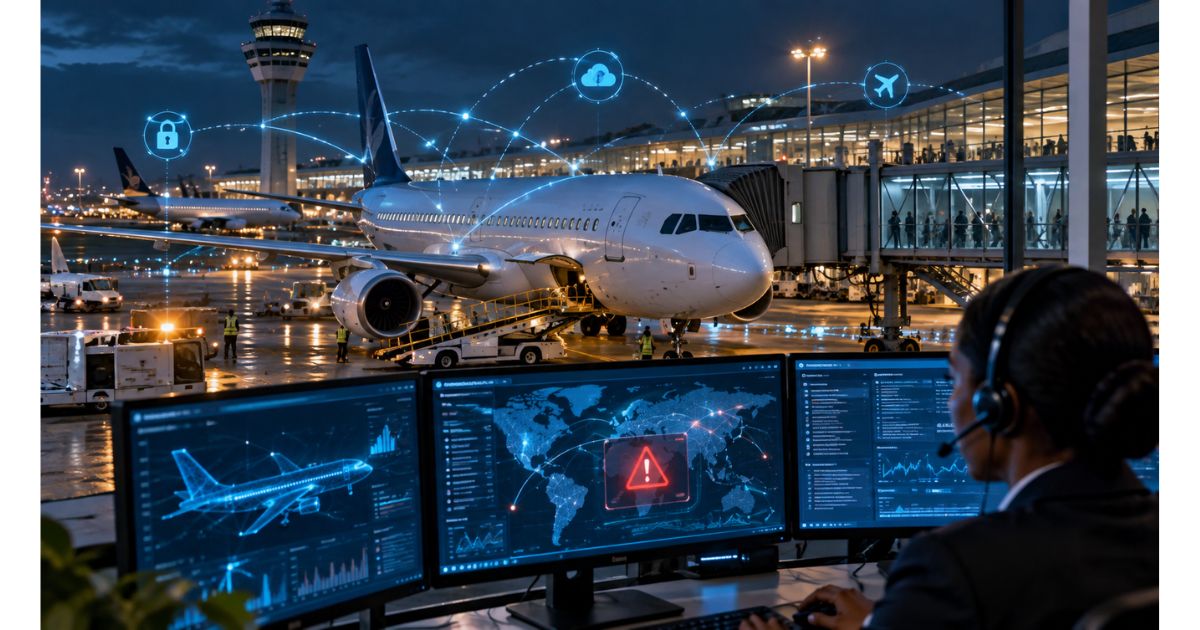
How AI could detect an airline cyberattack before flights are grounded.
Imagine arriving at the airport for your flight and seeing something you never expected.
Your flight has been cancelled.
The airline’s systems are experiencing problems. Staff are struggling to access information. Passengers are gathering around departure screens, trying to understand what has gone wrong.
There is no storm outside.
There is no aircraft mechanical problem.
The disruption started inside a computer system.
This is no longer just a science fiction scenario. In July 2025, a cyberattack on Russia’s Aeroflot disrupted the airline’s operations and resulted in more than 100 cancelled flights, with many others delayed.
The incident raises an important question for the future of aviation:
Could AI detect an airline cyberattack before flights are grounded?
The answer is not as simple as saying yes or no. But AI in aviation cybersecurity could become an important part of how airlines identify suspicious activity before a digital threat becomes an operational crisis.
The Aeroflot Cyberattack: When a Digital Problem Became an Aviation Problem
On July 28, 2025, Aeroflot experienced a major disruption to its computer systems.
The Russian Prosecutor’s Office later confirmed that the disruption was caused by a cyberattack and opened a criminal investigation. The Associated Press reported that more than 100 flights were cancelled, while other flights experienced significant delays. The disruption also affected Aeroflot subsidiaries Rossiya and Pobeda.
Two hacking groups, Silent Crow and the Belarusian Cyber Partisans, claimed responsibility for the attack. Reuters reported that the groups claimed to have carried out a long term intrusion into Aeroflot’s network, although some of their claims could not be independently verified.
For passengers, however, the technical details were probably less important.
They simply saw the consequences.
Flights were cancelled.
Flights were delayed.
Travel plans were disrupted.
And that is what makes the Aeroflot incident such an important case study when we talk about AI in aviation cybersecurity.
It shows that a cyberattack does not have to involve an aircraft flying through the sky before passengers can feel its impact.
A problem inside an airline’s digital infrastructure can eventually become a problem at the airport.
How Can a Cyberattack Ground an Airline?
When most people hear the word “cyberattack,” they may imagine someone trying to take control of an aircraft.
That is only one possible concern.
Modern airlines depend on a huge collection of digital systems.
Passenger information.
Flight schedules.
Employee accounts.
Internal communications.
Operational systems.
Networks.
Databases.
Airport connections.
When these systems are disrupted, airline operations can be affected.
This is one reason AI in aviation cybersecurity is becoming increasingly important.
An airline does not necessarily need every aircraft to be hacked before passengers experience disruption.
If critical systems become unavailable or cannot be trusted, the airline may have to slow down, change or temporarily suspend certain activities while the situation is investigated.
That is what makes cybersecurity an aviation issue rather than simply an IT issue.
So Where Does AI Come In?
This is where AI in aviation cybersecurity becomes particularly interesting.
Think about a cybersecurity team monitoring an airline’s digital environment.
There could be thousands or even millions of pieces of activity taking place.
People are logging into systems.
Computers are communicating with other computers.
Data is being transferred.
Applications are making requests.
Employees are accessing information.
Most of this activity is completely normal.
But hidden somewhere within all that activity could be something unusual.
A compromised account.
An unfamiliar connection.
A sudden change in behaviour.
An unusual amount of data being accessed.
A system communicating with something it normally never communicates with.
A human might miss the warning sign because there is simply too much information to examine manually.
AI in aviation cybersecurity could help by analysing large amounts of activity and identifying patterns that deserve closer attention.
AI Could Look for What Doesn’t Look Normal
One of the most useful concepts to understand is anomaly detection.
You do not necessarily have to tell an AI system exactly what a cyberattack looks like.
Instead, the system can learn what normal behaviour looks like and flag activity that appears unusual.
Imagine an airline employee normally logs into a particular system between 8 a.m. and 5 p.m.
One day, that account suddenly logs in at 3 a.m.
The account then accesses information it has never accessed before.
It begins communicating with an unfamiliar system.
Individually, each event might have a harmless explanation.
But together, they could form a pattern.
This is where AI in aviation cybersecurity could help a security team notice something that deserves investigation.
The AI is not necessarily saying:
‘This is definitely a hacker.’
It is saying:
‘This behaviour is unusual. Take a closer look’.
That difference is extremely important.
Could AI Have Prevented the Aeroflot Disruption?
We need to be careful here.
There is no evidence that allows us to say that AI in aviation cybersecurity would definitely have prevented the Aeroflot attack.
We also cannot say that AI would certainly have detected the attackers earlier.
The public information about the attack does not give us enough evidence to make that claim.
What the Aeroflot case does show is why earlier detection matters.
Reuters reported that the groups claiming responsibility said they had been inside Aeroflot’s network for an extended period. Those claims could not all be independently verified.
If suspicious activity is detected while an attacker is still inside a network, cybersecurity professionals may have more opportunity to investigate and respond.
That is the potential value of AI in aviation cybersecurity.
AI could potentially help identify unusual patterns earlier.
It could potentially reduce the amount of activity that security teams have to examine manually.
And it could potentially give humans an earlier warning.
But ‘could’ is the important word.
AI is not a magic shield.
What Would AI Actually Look For?
To understand AI in aviation cybersecurity, forget the complicated technical terminology for a moment.
Think about a security guard watching an airport.
The guard knows what normal behaviour looks like.
If someone suddenly enters an area they should not be in, the guard becomes suspicious.
AI can perform a similar function in a digital environment.
It can look for things such as:
Unusual login behaviour
Someone suddenly accessing an account at an unusual time or from an unexpected location.
Unusual access
An account suddenly accessing systems or information that it normally does not use.
Unusual network activity
A computer or system communicating in a way that does not match its normal behaviour.
Unusual data movement
Large or unexpected amounts of information suddenly being transferred.
Changes in established patterns
Activity that does not match what the system has previously learned to recognise as normal.
These signals do not automatically mean that a cyberattack is happening.
But they can give cybersecurity professionals somewhere to investigate.
That is where AI in aviation cybersecurity could provide value.
But What If AI Gets It Wrong?
This is one of the most important questions we need to ask.
Imagine the AI sees unusual activity and raises an alarm.
The cybersecurity team investigates.
They discover that there was no attack.
An employee was simply performing a new task.
That is a false positive.
Now imagine the opposite.
An attacker behaves in a way that looks normal enough to the AI.
The system does not raise an alarm.
That is a false negative.
Both situations matter.
Too many false alarms can overwhelm cybersecurity professionals.
But failing to identify a genuine threat could allow an attacker more time to cause damage.
This is why AI in aviation cybersecurity cannot simply be switched on and left to make decisions by itself.
It needs people.
AI Can Raise the Alarm. Humans Still Need to Investigate.
This may be the most important lesson from the discussion about AI in aviation cybersecurity.
AI can be very good at processing large amounts of information.
Humans are still essential for understanding context.
Imagine that an airline employee suddenly accesses a system they have never used before.
AI flags it.
But perhaps that employee has just been promoted and has been given new responsibilities.
The AI could not necessarily know that from the activity alone.
A human can investigate.
The cybersecurity team can determine whether the activity is legitimate.
If it is a genuine threat, they can take appropriate action.
This is where AI governance becomes important.
Someone has to decide:
Who is responsible for the AI system?
How is it tested?
How often is it monitored?
What happens when it makes a mistake?
Who makes the final decision?
How is sensitive information protected?
These are not simply technical questions.
They are governance questions.
Why Data Matters to AI Cybersecurity
There is another important piece of the puzzle.
AI needs data.
The effectiveness of AI in aviation cybersecurity therefore depends partly on the quality of the information available to the system.
If the data is incomplete, outdated or misleading, the AI may struggle to identify threats accurately.
This is why data governance matters.
An airline cannot simply collect huge amounts of information and assume that AI will automatically make everything secure.
The data needs to be properly managed.
It needs appropriate controls.
It needs protection.
And organisations need to understand how the data is being used.
The stronger the relationship between cybersecurity, data governance and AI governance becomes, the more useful AI in aviation cybersecurity can potentially become.
What About Hackers Trying to Trick the AI?
There is another problem.
If attackers know that an airline is using AI to detect unusual behaviour, they may try to behave in ways that look normal.
They may also try to manipulate the information that the AI uses.
This creates a new cybersecurity challenge.
The technology being used to defend an airline also needs to be protected.
This is why AI in aviation cybersecurity is not simply about buying an AI tool.
It is about creating a complete security environment around that technology.
The AI needs to be protected.
The data needs to be protected.
The network needs to be protected.
The people operating the system need appropriate training.
And the organisation needs a clear plan for what happens when something goes wrong.
What Does This Mean for Passengers?
You might be wondering:
Why should an ordinary passenger care about AI in aviation cybersecurity?
Because you are already part of the digital aviation ecosystem.
When you book a ticket, your information enters digital systems.
When you check in, more data is processed.
When your boarding pass is generated, technology is involved.
When the airline manages its schedule, digital systems are involved.
When staff communicate about operations, technology may be involved.
The passenger may only see the final result.
A flight is on time.
A flight is delayed.
A flight is cancelled.
But behind those outcomes can be an enormous digital infrastructure.
The Aeroflot incident demonstrated how a cyberattack can eventually become a passenger experience problem.
That is why AI in aviation cybersecurity matters even if you never work in technology.
Could AI Become Aviation’s Early Warning System?
This is where the future becomes particularly interesting.
Imagine an airline’s cybersecurity system continuously watching its digital environment.
Most of the time, everything looks normal.
Then one day, the AI identifies a pattern that is different.
It raises an alert.
Cybersecurity professionals investigate.
They discover that the activity is legitimate.
The alert is closed.
But imagine another scenario.
The team investigates and discovers evidence of unauthorised activity.
They can then begin responding before the situation becomes larger.
That is the promise of AI in aviation cybersecurity.
Not perfection.
Not guaranteed prevention.
Early detection.
The goal is to give people a better chance of finding a problem before it becomes a much bigger problem.
AI Cannot Replace Cybersecurity Professionals
The future of AI in aviation cybersecurity should not be presented as humans versus machines.
It should be humans working with machines.
AI can analyse.
AI can identify patterns.
AI can monitor.
AI can raise alerts.
But humans can investigate, understand context, make judgements and take responsibility for decisions.
That combination is particularly important in aviation because the consequences of a major system failure can extend far beyond a computer screen.
They can affect passengers, employees, aircraft operations and the wider aviation network.
The Aeroflot Lesson
The Aeroflot cyberattack provides a powerful lesson.
A cyberattack does not have to look like something from a Hollywood movie.
There may be no dramatic scene involving someone taking control of an aircraft.
Sometimes the disruption begins quietly inside digital systems.
By the time passengers see cancelled flights on an airport departure board, the underlying problem may already be significant.
That is why AI in aviation cybersecurity could become an important part of the future.
If AI can help identify unusual activity earlier, cybersecurity professionals may have more time to investigate and respond.
But that possibility comes with responsibility.
AI must be secure.
Its data must be trustworthy.
Its limitations must be understood.
Its decisions must be monitored.
And humans must remain accountable.
The Future of AI in Aviation Cybersecurity
The aviation industry is becoming increasingly dependent on digital technology.
That dependence creates enormous opportunities.
It also creates new risks.
The future of AI in aviation cybersecurity will therefore not simply be about building smarter AI.
It will be about building smarter and more resilient aviation systems around it.
The Aeroflot incident showed what can happen when an airline’s digital infrastructure is seriously disrupted.
The next challenge is figuring out how technology can help aviation detect such threats earlier.
AI may become part of that answer.
But it will not be the entire answer.
The strongest future will likely be built around several things working together:
Artificial intelligence.
Cybersecurity.
Reliable data.
Human expertise.
Strong governance.
And accountability.
That is what makes the future of aviation technology so fascinating.
The aircraft may be flying through the sky, but increasingly, part of aviation’s safety and resilience will depend on what is happening inside the digital systems on the ground.
On A Final Note
The Aeroflot cyberattack showed that an airline’s digital infrastructure can have a very real impact on passengers and flight operations.
AI in aviation cybersecurity could help airlines identify unusual behaviour, detect potential threats and give cybersecurity professionals an earlier warning.
But AI should never be treated as an infallible digital security guard.
It can make mistakes.
It can miss threats.
It can be attacked itself.
The real opportunity is to combine AI in aviation cybersecurity with human expertise, strong cybersecurity practices, reliable data and responsible AI governance.
The future of aviation will not simply be about smarter aircraft.
It will also be about building smarter and more resilient digital systems that help keep those aircraft moving safely.
Continue Reading
Can Hackers Trick AI in Aviation? The Cybersecurity Risks Passengers Should Know
Before we can trust AI to defend aviation, we also need to understand how attackers might try to manipulate AI systems. This article explores the cybersecurity risks passengers should know as artificial intelligence becomes increasingly connected to aviation.
Read More →
Sources
Aeroflot cyberattack and flight cancellations: https://www.nbcnews.com/world/russia/russias-aeroflot-cancels-flights-ukrainian-hackers-claim-cyberattack-rcna221444
Groups claiming responsibility and background: https://www.bbc.com/news/articles/c87e0ydy3d4o