
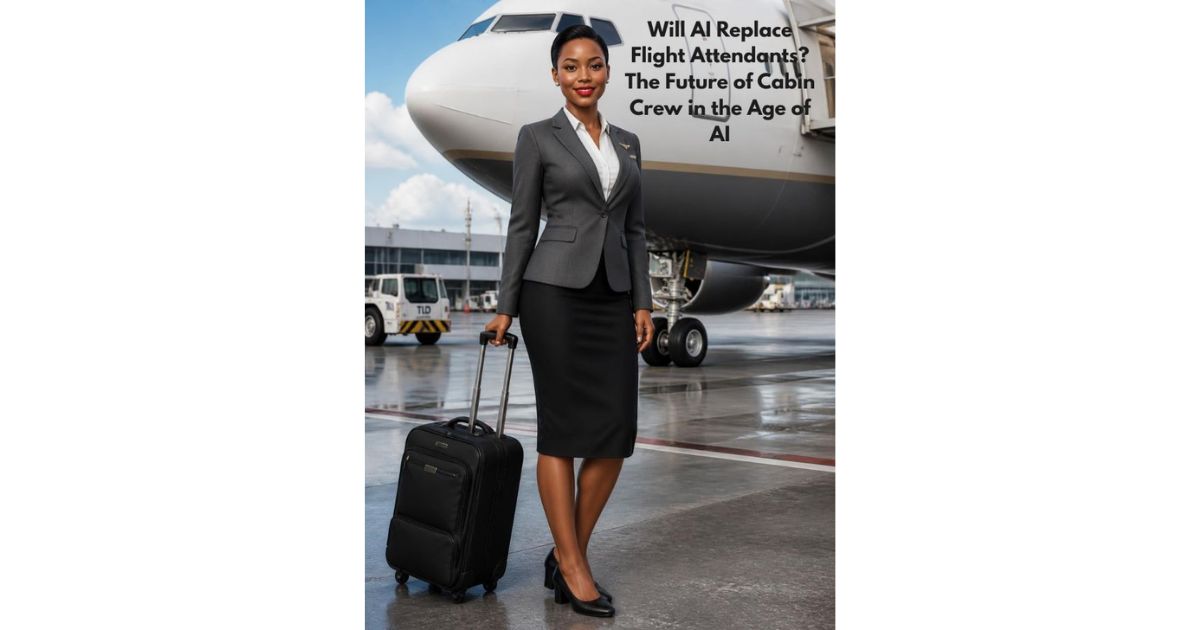

Beatrice had just finished serving coffee when a passenger smiled and asked a question she had started hearing more often.
With all this Artificial Intelligence, do you think airlines will still need flight attendants in the future?
She smiled.
It was not the first time someone had asked.
In fact, since AI became part of everyday conversations, many people have imagined a future where robots welcome passengers, serve meals, answer questions, and perhaps even replace cabin crew altogether.
As someone who has worked in aviation for years and is now learning AI Governance, I understand why people ask this question.
AI is transforming industries around the world.
Airlines are adopting AI for customer service, flight scheduling, maintenance planning, baggage handling, and operational efficiency.
But does that mean flight attendants will disappear?
I don’t believe so.
Not because AI isn’t intelligent.
But because being a flight attendant is about something AI does not possess.
Emotion.
AI Is Already Changing Aviation
There is no denying that AI is becoming part of airline operations.
Today, airlines use AI to:
- answer customer enquiries through chatbots
- optimise crew scheduling
- predict maintenance needs
- forecast passenger demand
- personalise travel experiences
- analyse operational data
- improve airport efficiency
These technologies help airlines become more efficient behind the scenes.
Passengers may not even realise AI is involved.
But AI’s role is growing.
Does That Mean Cabin Crew Are Next?
Not necessarily.
Many people assume that because AI performs tasks quickly, it can perform every job.
That assumption overlooks what the role of a flight attendant truly involves.
Serving meals is only a small part of the job.
The real responsibility begins when things don’t go according to plan.
The Engine of a Flight Attendant Is Emotion
After years of flying, one lesson stands out to me.
The engine of the flight attendant profession is not technology.
It is emotion.
Every flight brings together people from different countries, cultures, languages, religions, and personal experiences.
Some passengers are excited about a holiday.
Others are travelling for work.
Some are flying to celebrate a wedding.
Others are travelling to say goodbye to a loved one.
Some are nervous first time flyers.
Others have hidden disabilities or anxieties that no computer can immediately recognise.
As cabin crew, we learn to read emotions that are never spoken aloud.
Sometimes a smile hides fear.
Sometimes silence hides grief.
Sometimes frustration has nothing to do with the flight itself.
No amount of data can fully capture those human moments.
Can AI Understand Every Culture?
One of aviation’s greatest strengths is diversity.
Every destination has its own culture.
Its own customs.
Its own expectations.
Passengers board aircraft carrying different beliefs, traditions, and ways of communicating.
AI relies on data.
It learns from patterns.
But human interaction is rarely predictable.
A passenger from one culture may appreciate direct communication.
Another may value patience and subtlety.
Some cultures expect eye contact.
Others may interpret it differently.
Some passengers appreciate humour.
Others may find the same joke inappropriate.
These situations require emotional intelligence, cultural awareness, and empathy.
They require human judgement.
When Safety Depends on Human Decisions
Imagine unexpected severe turbulence.
Or a medical emergency.
Or smoke in the cabin.
Would passengers feel reassured by a robotic voice repeating instructions?
Or by calm, confident professionals moving quickly, making eye contact, providing reassurance, and adapting to an evolving situation?
Flight attendants are trained to make decisions under pressure.
They communicate.
Lead.
Comfort.
Protect.
These are deeply human skills.
AI can provide information.
But it cannot genuinely comfort a frightened child or reassure a passenger during an emergency.
AI Will Become a Powerful Assistant
This doesn’t mean AI has no place in the cabin.
Quite the opposite.
I believe AI will become one of the most valuable tools available to flight attendants.
Imagine AI helping cabin crew by:
- instantly translating conversations with passengers
- providing real time information about connecting flights
- identifying passengers requiring special assistance
- suggesting solutions during disruptions
- helping personalise customer service
- reducing administrative tasks
In this future, AI supports cabin crew.
It does not replace them.
The Role of AI Governance
As airlines continue adopting AI, another question becomes important.
How do we ensure AI is used responsibly?
This is where AI Governance enters the conversation.
AI Governance helps airlines establish rules that ensure AI systems are:
- accurate
- transparent
- accountable
- fair
- respectful of passenger privacy
- subject to human oversight
For example, if an AI system recommends personalised services based on passenger data, airlines must ensure that information is collected and used responsibly.
If an AI assistant provides travel information, there should always be a process for human intervention if the information is incomplete or incorrect.
AI Governance ensures technology serves people, not the other way around.
The Future of Cabin Crew
The future of cabin crew is unlikely to be humans competing against AI.
Instead, it will be humans working alongside AI.
Technology will automate repetitive tasks.
It will process data faster than any person.
It will provide valuable insights.
But it will never replace empathy.
It will never replace compassion.
It will never replace genuine human connection.
Those qualities cannot simply be downloaded into an algorithm.
My Perspective as a Flight Attendant
Having spent years working in aviation, I have learned something that every experienced cabin crew member understands.
Passengers rarely remember the meal they were served.
But they remember how they were treated.
They remember the crew member who reassured them during turbulence.
The smile that eased their anxiety.
The kindness shown during a difficult journey.
The calm voice during an emergency.
Those moments are not created by technology.
They are created by people.
Artificial Intelligence can analyse data.
It cannot genuinely care.
On A Final Note
Artificial Intelligence will continue transforming aviation in remarkable ways.
It will make airline operations smarter, faster, and more efficient.
It will help airlines analyse information, improve planning, and support better decision making.
But the role of a flight attendant has never been defined by efficiency alone.
It is defined by humanity.
Being cabin crew is about understanding emotions that cannot be measured, responding to situations that cannot always be predicted, and connecting with people whose stories, cultures, and experiences are wonderfully different.
AI relies on data.
Flight attendants rely on empathy.
And that is why I believe the future of aviation is not about replacing cabin crew with Artificial Intelligence.
It is about empowering cabin crew with intelligent tools while preserving the one thing technology cannot truly replicate.
The human heart behind exceptional passenger care.
Frequently Asked Questions
Will AI replace flight attendants?
No. AI is expected to support flight attendants by automating repetitive tasks and providing operational insights, while cabin crew continue to deliver safety, leadership, and emotional support that require human judgement.
How is AI used in aviation today?
Airlines use AI for customer service, crew scheduling, predictive maintenance, baggage tracking, demand forecasting, and operational planning.
Why can’t AI replace flight attendants?
AI can analyse data and automate tasks, but it cannot genuinely understand emotions, adapt to complex cultural interactions, or provide the empathy and reassurance passengers often need.
What is the role of AI Governance in aviation?
AI Governance helps ensure AI systems are used responsibly by promoting transparency, accountability, privacy, fairness, and human oversight across airline operations.