
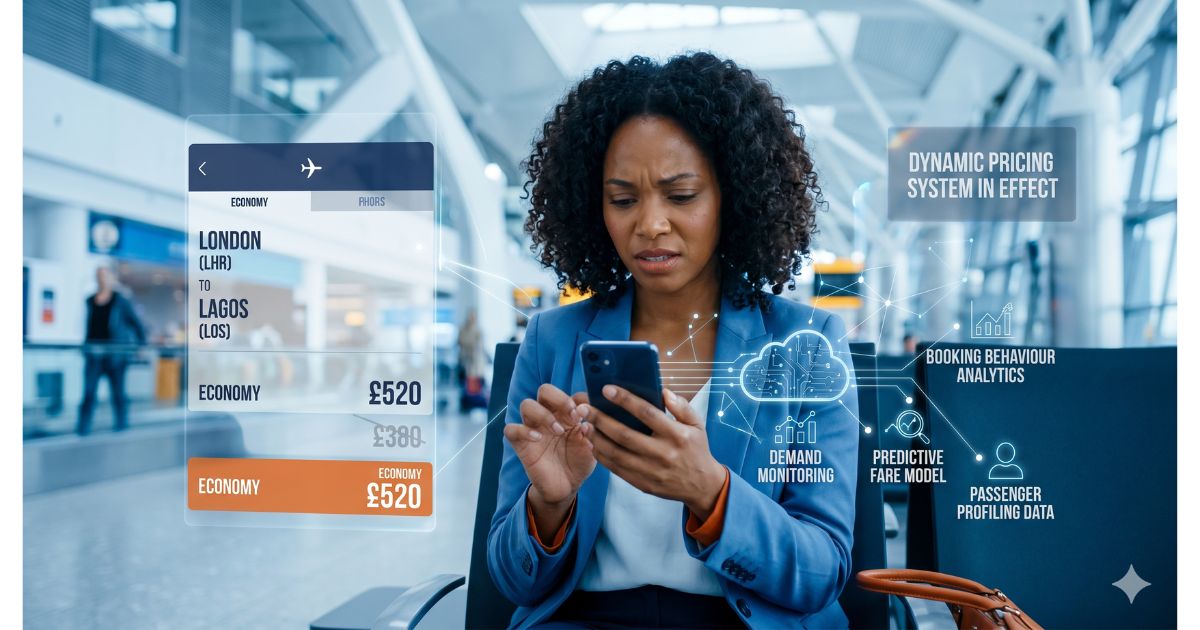
Beatrice checked the flight price twice.
The first time, the ticket from London to Lagos looked reasonable.
She hesitated.
Maybe she would book it later that evening.
A few hours later, during her layover, she checked again.
The price had increased.
Same flight.
Same route.
Same seat category.
Different price.
She stared at the screen for a moment.
How did it change so fast?
What Beatrice didn’t realise was this:
The airline wasn’t simply selling a ticket.
Behind the scenes, AI systems were already analysing demand, behaviour, and pricing patterns in real time.
How Airlines Use AI to Change Ticket Prices
Modern airlines in the UK and Europe increasingly use AI-powered pricing systems to manage ticket sales.
This process is often called:
- dynamic pricing
- predictive pricing
- AI fare optimisation
Instead of using fixed ticket prices, AI systems continuously adjust fares based on multiple factors.
These systems analyse:
- passenger demand
- route popularity
- booking history
- seasonal trends
- remaining seat availability
- travel timing
- browsing behaviour
The goal is simple: maximise efficiency and revenue while filling flights effectively.
Why Flight Prices Change So Quickly
Airline ticket pricing is no longer static.
AI systems can respond almost instantly to changing conditions.
For example:
If many people suddenly search for a specific route, the system may identify increased demand and adjust prices.
If seats begin filling quickly, prices may rise automatically.
If a flight is underbooked, prices may drop to encourage more sales.
This means two passengers may see different pricing conditions within a short period of time.
The Hidden Role of Passenger Data
This is where things become more interesting.
AI pricing systems do not only analyse flights.
They also analyse behaviour.
Systems may consider:
- when passengers search
- how often they revisit routes
- booking patterns
- travel periods
- customer trends
Over time, AI learns which pricing strategies are most likely to influence purchasing decisions.
This creates a more personalised and predictive pricing environment.
The Question Many Passengers Ask
As Beatrice looked at the changing price, she wondered something many travelers ask:
Is the system predicting how much I am willing to pay?
The answer is more complex than many people realise.
Airlines are not necessarily targeting individual passengers personally.
But AI systems are designed to predict:
- market demand
- passenger behaviour
- purchasing patterns
And those predictions influence pricing decisions.
The Benefits of AI Pricing Systems in Aviation
From an operational perspective, AI pricing systems help airlines:
- manage seat inventory efficiently
- respond to market demand faster
- reduce empty seats
- optimise route profitability
- improve forecasting accuracy
In a highly competitive industry like aviation, these systems help airlines remain commercially efficient.
The Hidden Risks of AI Airline Pricing
But AI-driven pricing also raises important concerns.
Passengers often do not understand:
- how prices are calculated
- why fares suddenly increase
- how behavioural data influences pricing systems
This creates questions around:
- pricing transparency
- fairness
- data usage
- algorithmic accountability
Especially when AI systems become more complex and automated.
Where GDPR and Data Privacy Come In
In the UK and Europe, passenger data usage is regulated by laws like the General Data Protection Regulation.
These regulations require organisations to:
- process personal data lawfully
- protect user privacy
- remain transparent about data collection
- minimise unnecessary data usage
But AI pricing systems still rely heavily on large amounts of behavioural and operational data.
And many passengers do not fully understand how their online behaviour contributes to pricing systems.
A Governance, Risk, and Compliance Perspective
This is where Governance, Risk, and Compliance becomes important.
Governance
Ensures airlines have clear policies around how AI pricing systems operate.
Risk Management
Identifies risks related to:
- unfair pricing concerns
- over-reliance on automation
- lack of transparency
- customer trust issues
Compliance
Ensures pricing systems comply with:
- GDPR requirements
- consumer protection laws
- aviation regulations
Because when AI influences financial decisions, accountability still matters.
Aviation Is Becoming More Predictive
As Beatrice finally booked her ticket, she realised something important.
Airlines are no longer simply reacting to passengers.
Increasingly, AI systems are predicting:
- when people travel
- what they are willing to pay
- and how they behave online
The aviation industry is becoming more intelligent, data-driven, and automated every year.
But with that intelligence comes responsibility.
On A Final Note
AI is transforming airline pricing across the UK and Europe.
It helps airlines operate faster, smarter, and more efficiently.
But behind every changing ticket price is a system analysing patterns, behaviour, and demand in real time.
And as AI becomes more embedded in aviation systems, transparency, privacy, and accountability will become just as important as efficiency itself.